Home
Class 12
PHYSICS
The value of resistance of an unknown re...

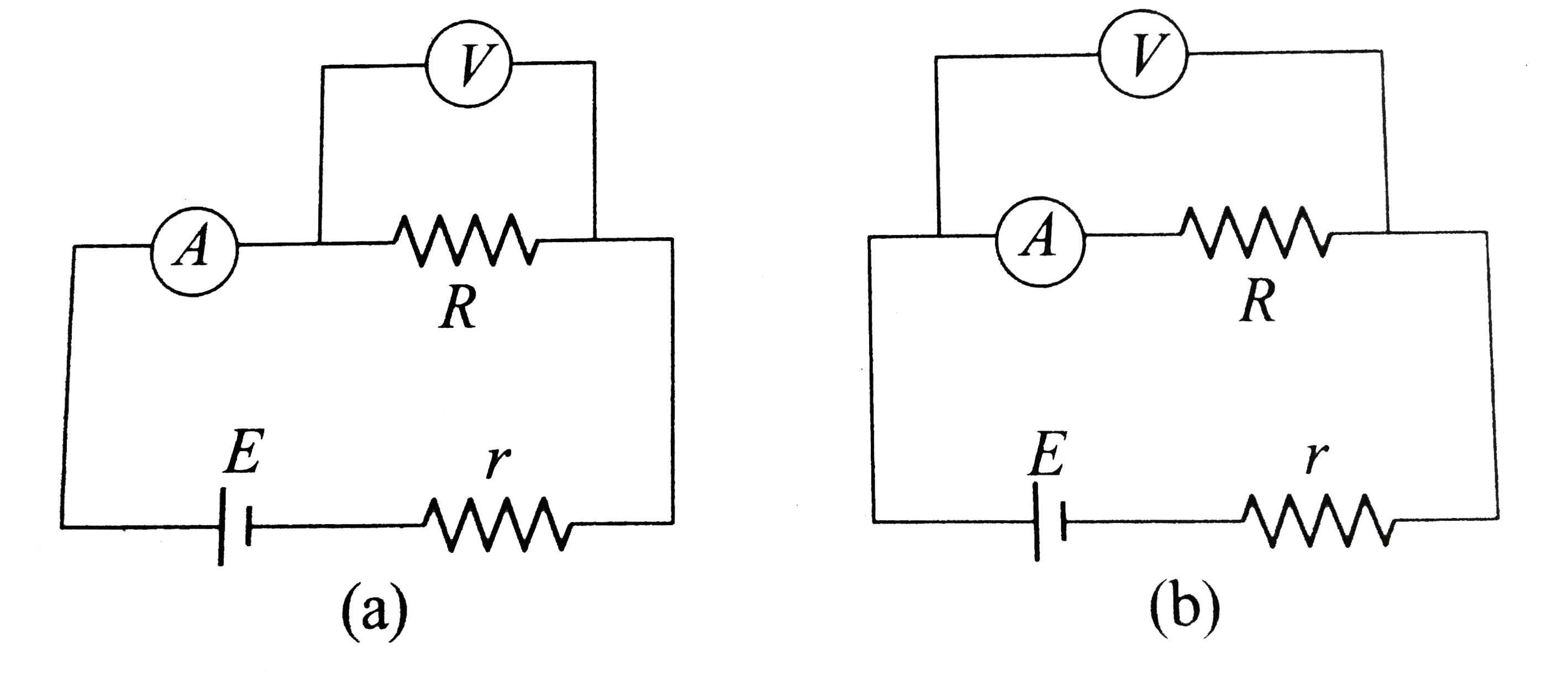
The value of resistance of an unknown resistor is calculated using the formula `R = V//I ` where V and I are the readings of the voltmeter and the ammeter, respectivley. Consider the circuits below. The internal resistances of the voltmeter and the ammeter `(R_V and R_G, respectively)` are finite and nonzero.
,
Let `R_(A) and R_(B)` be the calculated values in the two cases A and B , respectively.
If the resistance of voltmeter is `R_(V) = 1k Omega` and the percentage error in the measurement of R (the value of R is nearly `10 Omega`)is

A

zero in both cases

B

non zero but equal in both cases

C

more in circuit A

D

more in circuit B

Text Solution

Verified by Experts

The correct Answer is:

D

`%` error in case A
`(R_(A)-R)/(R)xx100=((R_(V))/(R+R_(V))-1)xx100`
`=(-R)/(R+R_(V))xx100approx-1%` `%` error in case B
`(R_(B)-R)/(R)xx100=(R_(G))/(R)xx100approx100approx10%`
Promotional Banner

Topper's Solved these Questions

  • CURRENT ELECTRICITY

    NARAYNA|Exercise Level 6|43 Videos
  • CURRENT ELECTRICITY

    NARAYNA|Exercise NCERT Based Questions|13 Videos
  • COMMUNICATION SYSTEM

    NARAYNA|Exercise Level-II(H.W)|25 Videos
  • DUAL NATURE OF RADIATION AND MATTER

    NARAYNA|Exercise ASSERTION AND REASON|15 Videos

Similar Questions

Explore conceptually related problems

The value of resistance of an unknown resistor is calculated using the formula R = V//I where V and I are the readings of the voltmeter and the ammeter, respectivley. Consider the circuits below. The internal resistances of the voltmeter and the ammeter (R_V and R_G, respectively) are finite and nonzero. , Let R_(A) and R_(B) be the calculated values in the two cases A and B , respectively. The relation between R_A and the actual value of R is

Resistance value of an unknown resistor is calculated using the formula R=V/I where V and I be the readings of the voltmeter and the ammeter respectively. Consider the circuits below. The internal resistances of the voltmeter and the ammeter ( R_v and R_G respectively ) are finite and non zero. Let R_v and R_G be the calculated values in the two cases A and B respectively. If the resistance of voltmeter is R_v=1kOmega and that of ammeter is R_G=1Omega the magnitude of the percentage error in the measurement of R (the value of R is nearly 10Omega ) is:

Resistance value of an unknown resistor is calculated using the formula R=V/I where V and I be the readings of the voltmeter and the ammeter respectively. Consider the circuits below. The internal resistances of the voltmeter and the ammeter ( R_v and R_B respectively ) are finite and non zero. Let R_A and R_B be the calculated values in the two cases A and B respectively. The relation between R_A and the actual value R is

Resistance value of an unknown resistor is calculated using the formula R=V/I where V and I be the readings of the voltmeter and the ammeter respectively. Consider the circuits below. The internal resistances of the voltmeter and the ammeter ( R_v and R_G respectively ) are finite and non zero. Let R_v and R_G be the calculated values in the two cases A and B respectively. The relation between R_B and the actual value of R is:

Let V and I be the readings of the voltmeter and the ammeter respectively as shown in the figure. Let R_(V) " and "R_(A) be their corresponding resistancce Therefore,

The actual value of resistance R, shown in the figure is 30 Omega . This is measured in an experiment as shown using the standard formula R = (V)/(I) , where V and I are the readings of the voltmeter and ammeter, respectively. If the measured value of R is 5% less, then the internal resistance of the voltmeter is

In the series L-C-R circuit , the voltmeter and ammeter readings are respectively

In the circuit shown below, the ammeter and the voltmeter readings are 3 A and 6 V respectively . Then, the value of the resistance R is

The ammeter A reads 2A and the voltmeter V reads 20V, the value of resistance R is (Assuming finite resistance's of ammeter and voltmeter)

NARAYNA-CURRENT ELECTRICITY-Level 5
  1. In the circuit P != R, the reading of the galvanometer is same with s...

    Text Solution

    |

  2. In the given circuit, with steady current, the potential drop across t...

    Text Solution

    |

  3. Express which of the following set ups can be used to verify ohm's l...

    Text Solution

    |

  4. In the shown arrangement of the experiment of the meter bridge if AC c...

    Text Solution

    |

  5. For the post office arrangement to determine the value of unknown resi...

    Text Solution

    |

  6. A moving coil galvanometer of resistance 100Omega is used as an ammete...

    Text Solution

    |

  7. To verify Ohm's law, a student is provided with a test resistor R(T), ...

    Text Solution

    |

  8. A microameter has a resistance of 100 omega and a full scale range of ...

    Text Solution

    |

  9. A capacitor is charged using an external battery with a resistance x i...

    Text Solution

    |

  10. A 4 muF capacitor, a resistance of 2.5 M Omega is in series with 12V b...

    Text Solution

    |

  11. Find the time constant for the given RC circuits in correct order (in ...

    Text Solution

    |

  12. Capacitor C1 of capacitance 1 micro-farad and capacitor C2 of capacita...

    Text Solution

    |

  13. An infinite line charge of uniform electric charge density lambda lies...

    Text Solution

    |

  14. The value of resistance of an unknown resistor is calculated using the...

    Text Solution

    |

  15. The value of resistance of an unknown resistor is calculated using the...

    Text Solution

    |

  16. The value of resistance of an unknown resistor is calculated using the...

    Text Solution

    |

  17. In the circuit given in the figure, both batteries are ideal . Emf E1 ...

    Text Solution

    |

  18. In the circuit givenn below, both batteries are ideal. EMF E(1) of bat...

    Text Solution

    |

  19. In the circuit given in the figure, both batteries are ideal . Emf E1 ...

    Text Solution

    |

  20. In the following circuit, the current through the resistor R (=2Omega)...

    Text Solution

    |
