Home
Class 12
CHEMISTRY
Consider the following sequence of reac...

Consider the following sequence of reactions
`C_(2)H_(5)C -= CH overset(CH_(3)MgBr)rarr A underset((2)H_(2)O^(+))overset((1)HCHO) rarr B`
The product `(B)` is

A

`C_(2)H_(5)C -= C-overset(OH)overset(|)(CH)-CH_(3)`

B

`C_(2)H_(5)C-= C-CH_(2)OH`

C

`C_(2)H_(5)overset(CH_(3))overset(|)(C) = CHCH_(2)OH`

D

`CH_(3)CH_(2)OH`

Text Solution

Verified by Experts

The correct Answer is:
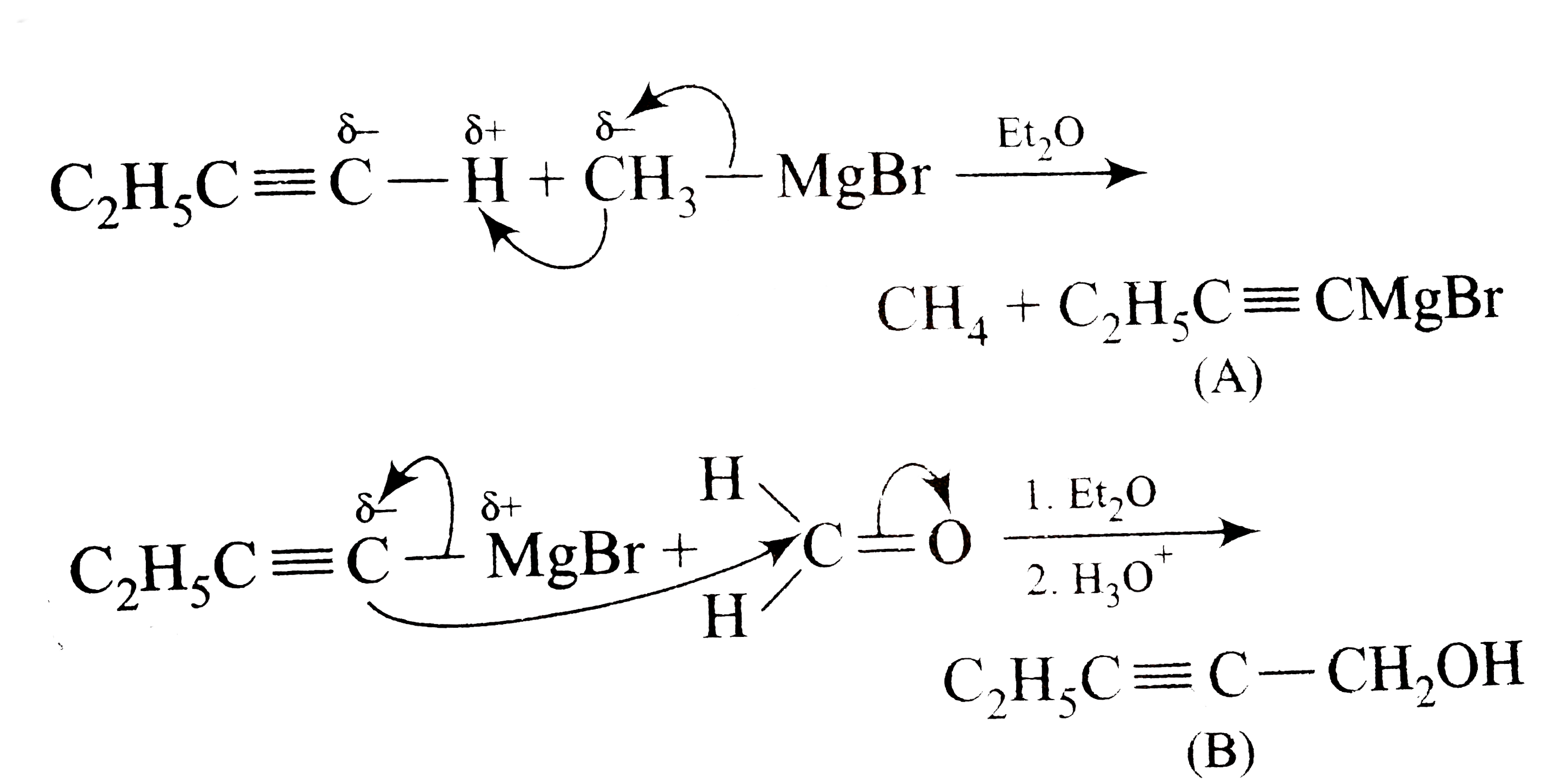
B

Promotional Banner

Topper's Solved these Questions

  • ALCOHOL, PHENOL AND ETHERS

    R SHARMA|Exercise Follow -Up Test -4|8 Videos
  • ALCOHOL, PHENOL AND ETHERS

    R SHARMA|Exercise Follow -Up Test -5|14 Videos
  • ALCOHOL, PHENOL AND ETHERS

    R SHARMA|Exercise Follow -Up Test -2|9 Videos
  • AMINES

    R SHARMA|Exercise Archives|36 Videos

Similar Questions

Explore conceptually related problems

Consider the following sequence of reactions CH_(2)=CH_(2)overset(PhCO_(3)H)underset(CH_(2)Cl_(2))(rarr)Aoverset(dil.H_(2)SO_(4))(rarr)B The product (B) is

In the reaction , CH_(3)CHO + HCN rarr A underset(H_(2)O)overset(H^(+))(rarr) B The product B is ?

In the reaction : CH_(3)COOH+C_(2)H_(5)OH rarrA overset(CH_(3)MgI)(rarr)B underset(H_(2)O)overset(H^(+))(rarr)C

In the following sequence of reactions: CH_(3)-Br overset(KCN)rarr A overset(H_(3)overset(+)(O))rarr B overset(LiAlH_(4))rarr C the end product (C ) is :

Consider the following sequence of reactions. C_(6)H_(6) + CH_(3) CH = CH_(2) underset("heat")overset(H_(3)PO_(4))rarrA underset(2. H_(3)O^(+))overset(1. O_(2), "heat")rarr B + C The products (B) and (C) are:

The end product (B) in the following sequence of reactions is CH_(3)Cl overset(KCN)rarr A overset(H_(2)O //H^(+))rarr B

In the following reaction sequence Ph -C -= CH underset(Hg^(2+)) overset(aq.H_(2)SO_(4)) rarr A underset(2.H_(2)O)overset(1.CH_(3)Mgl)rarr B the product (B) is

R SHARMA-ALCOHOL, PHENOL AND ETHERS-Follow -Up Test -3
  1. Propene is allowed to react with HBr in the presence of benzoyl peroxi...

    Text Solution

    |

  2. Which of the following alkyl halides undergoes hydrolysis with aqueous...

    Text Solution

    |

  3. The compound CH(3)COCH(2)COOC(2)H(5) is treated with LiAlH(4) in dry e...

    Text Solution

    |

  4. The product formed in the following reaction is

    Text Solution

    |

  5. Which of the following alcohols cannot be prepared by reduction of a ...

    Text Solution

    |

  6. The reducing agent used in Bouveault -Blanc reduction is

    Text Solution

    |

  7. For the preparation of 1-phenylethanol from benzaldehyde,which of the ...

    Text Solution

    |

  8. Which of the following reagents can convert propionic acid into propan...

    Text Solution

    |

  9. Which of the following sets of reactants may be used to prepare 2-met...

    Text Solution

    |

  10. Consider the following sequence of reactions C(2)H(5)C -= CH overse...

    Text Solution

    |

  11. Ethyl acetate (CH(3)COOC(2)H(5)) is allowed to react with excess of C...

    Text Solution

    |

  12. Consider the following reactions PhBr underset(Et(2)O,"heat")overset...

    Text Solution

    |

  13. In the following reaction sequence Ph -C -= CH underset(Hg^(2+)) ove...

    Text Solution

    |

  14. The major product formed in the reaction CH(3)CH = CH - overset(O)o...

    Text Solution

    |

  15. The maximum number of moles of carbonyl compound (aldehyde or ketone) ...

    Text Solution

    |

  16. Reduction of an acid chloride with LiAlH(4) produces

    Text Solution

    |

  17. Which of the following is expected to produce an alcohol on reaction w...

    Text Solution

    |

  18. In the reaction the product is

    Text Solution

    |

