Home
Class 12
CHEMISTRY
Intitial rate method: Use the following ...

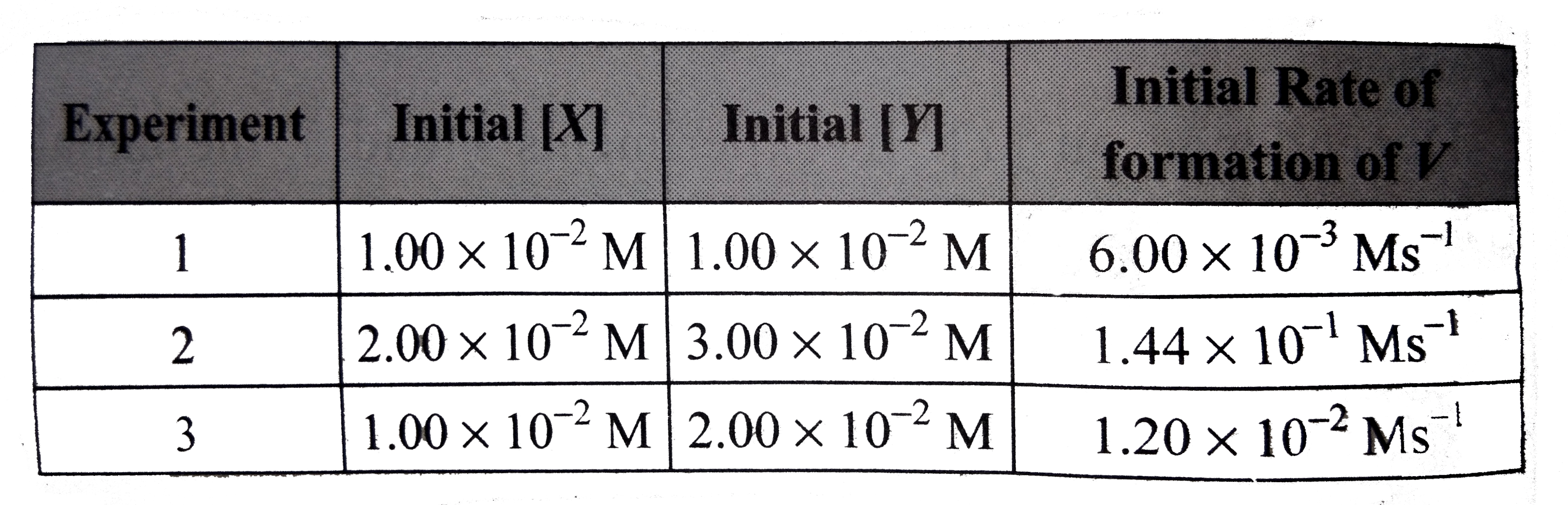
Intitial rate method: Use the following initial rate data determine the form of the rate law expressoin for the reaction `3X+2Yrarr2U+V`

Strategy: The rate law is of the form
`Rate = k[X]^(a)[Y]^(b)`
No two experiments have the same in initial [Y], thus, use the alternative method discussed earlier to evalaute a and b.

Text Solution

Verified by Experts

The initial concentration of X is the same in expermental 1 and 3, thus we divide the third rate law expression by the corresponding terms in the first one:
`(Rate_(3))/(Rate_(1))= (k[X]_(3)^(a)[Y]_(3)^(b))/(k[X]_(1)^(a)[Y]_(1)^(b))`
The value k cancels, and so do the concentrations of X because they are equal. Consequently, the expression simplifies to
`(Rate_(3))/(Rate_(1))= (([Y]_(3))/([Y]_(1)))^(b)`
Subsituting known values of rates and [Y],
`(1.20xx10^(-2)Ms^(-1))/(6.00xx10^(-3)Ms^(-1))= ((2.00xx10^(-2)M)/(1.00xx10^(-2)M))^(b)`
`2.0 = (2.0)^(b)`
or `b = 1`
Thus, the reaction is first order in Y. No two of the expermental runs have the same concentrations of Y, so we must proceed somewhat differntly. Let us compare expermints 1 and 2. The observed change in rate must be due to the ombination of the change in [X] and [Y]. We can divide the second rate law expression by the correponding terms in the first one. Canceling the equal k values and collecting terms, we get
`(Rate_(2))/(Rate_(1)) = (k[X]_(2)^(a)[Y]_(2)^(b))/(k[X]_(1)^(a)[Y]_(1)^(b)) = (([X]_(2))/([X]_(1)))^(a) (([Y]_(2))/([Y]_(1)))^(b)`
Inserting the known the known values for rates and concentratoins and the known [Y] exponent of 1, we have.
`(1.44xx10^(-1)Ms^(-1))/(6.00xx10^(-3)Ms^(-1))= ((2.00xx10(-2)M)/(1.00xx10^(-2)M))^(a) ((3.00xx10^(-2)M)/(1.00xx10^(-2)M))^(1)`
`24.0= (2.00)^(a) (3.00)`
`800=(2.00)^(a)`
`(2.00)^(3)= (2.00)`
Thus, `a=3`
and the reaction is third order in X. The complete rate law expression has the from
`Rate = k[X]^(3)[Y]`
Promotional Banner

Topper's Solved these Questions

  • CHEMICAL KINETICS

    R SHARMA|Exercise Follow-up 1|8 Videos
  • CHEMICAL KINETICS

    R SHARMA|Exercise Follow-up 2|10 Videos
  • BIOMOLECULES

    R SHARMA|Exercise Archives|47 Videos
  • CHEMISTRY IN EVERYDAY LIFE

    R SHARMA|Exercise Archives|11 Videos

Similar Questions

Explore conceptually related problems

Method of intial rates: Given the following data, determine the rate law expression and the value of the rate constant for the reaction. 2X+Y+ZrarrU+V Strategy: The rate law is of the from "Rate" = k[X]^(a)[Y]^(b)[Z]^(c ) We must evaluate a,b,c, and k by using the reasoning outlined earlier. Thus, to determine order with respect to X, we must select those experiments in which concentration of X changes but the concentrations of Y and Z are kept onstant and so on. Note that the coefficient of U in the balenced equation is 1, so the rate of reaction is equal to the rate of formation of U.

Form the data given below for the reaction: A to B to Products the rate law expression is:

The following initial rate data were obtianed for the reaction 2NO_(g)+Br(g)rarr2NOBr(g) Determine the reaction rat law and the value of te rate constant.

For a hypothetical reaction aA + bB rarr Product, the rate law is: rate = K[A]^(x)[B]^(y) , then

The rate law for the reaction 2X +Y rarr Z is Rate = k[X][Y] The correct statement with regard to this relation is

For the reaction X+3Y rarrZ , which form of differential rate law is incorrect?

R SHARMA-CHEMICAL KINETICS-Archives
  1. Intitial rate method: Use the following initial rate data determine th...

    Text Solution

    |

  2. The addition of a catallystic during a chemical reaction alters which ...

    Text Solution

    |

  3. The rate of a first-order reaction is 0.04 "mol L"^(-1) s^(-1) at 10 s...

    Text Solution

    |

  4. The rate constant of the reaction A rarr B is 0.6 xx 10^(-3) mole per ...

    Text Solution

    |

  5. The activation energy of a reaction can be determined from the slope o...

    Text Solution

    |

  6. When initial concentration of a reactant is doubled in a reaction, its...

    Text Solution

    |

  7. What is the activation energy for a reaction if its rate doubles when ...

    Text Solution

    |

  8. A reaction having equal energies of activation for forward and reverse...

    Text Solution

    |

  9. In a reaction , A + B rarr Product, rate is doubled when the concentra...

    Text Solution

    |

  10. In a zero-order reaction for every 10^(@) rise of temperature, the rat...

    Text Solution

    |

  11. Activation energy (E(a)) and rate constants (k(1) and k(2)) of a chemi...

    Text Solution

    |

  12. Which one of the following statements for the order of a reaction is i...

    Text Solution

    |

  13. The unit of rate constant for a zero order reaction is s^(-1).

    Text Solution

    |

  14. The half life of a substance in a certain enzyme catalyzed reaction is...

    Text Solution

    |

  15. 2N(2)O(5) rarr 4NO(2) + O(2) If (-d[N(2)O(5)])/(dt) = k(1)[N(2)O(5)]...

    Text Solution

    |

  16. For the reaction N(2)O(5) rarr 2NO(2) + (1)/(2) O(2), the rate of disa...

    Text Solution

    |

  17. During the kinetic study of the reaction 2A +B rarr C + D following ...

    Text Solution

    |

  18. For an endothermic reaction, where Delta H represents the enthalpy of ...

    Text Solution

    |

  19. The rate of the reaction 2NO+CI(2)rarr 2NOCI is given by the rate ...

    Text Solution

    |

  20. For the reaction, N(2) + 3H(2) rarr 2NH(3), if (d[NH(3)])/(d t) = 2 xx...

    Text Solution

    |

  21. In the reaction BrO^(-3)(aq) + 5Br^(-) (aq) + 6H^(+) rarr 3Br(2)(1) ...

    Text Solution

    |
