Home
Class 12
CHEMISTRY
The plot of concentration of the reactan...

The plot of concentration of the reactant vs time for a reaction is a straight line with a negative slope. This reaction follows

A

zero order reaction

B

first order reaction

C

second order reaction

D

third order reaction

Text Solution

Verified by Experts

The correct Answer is:
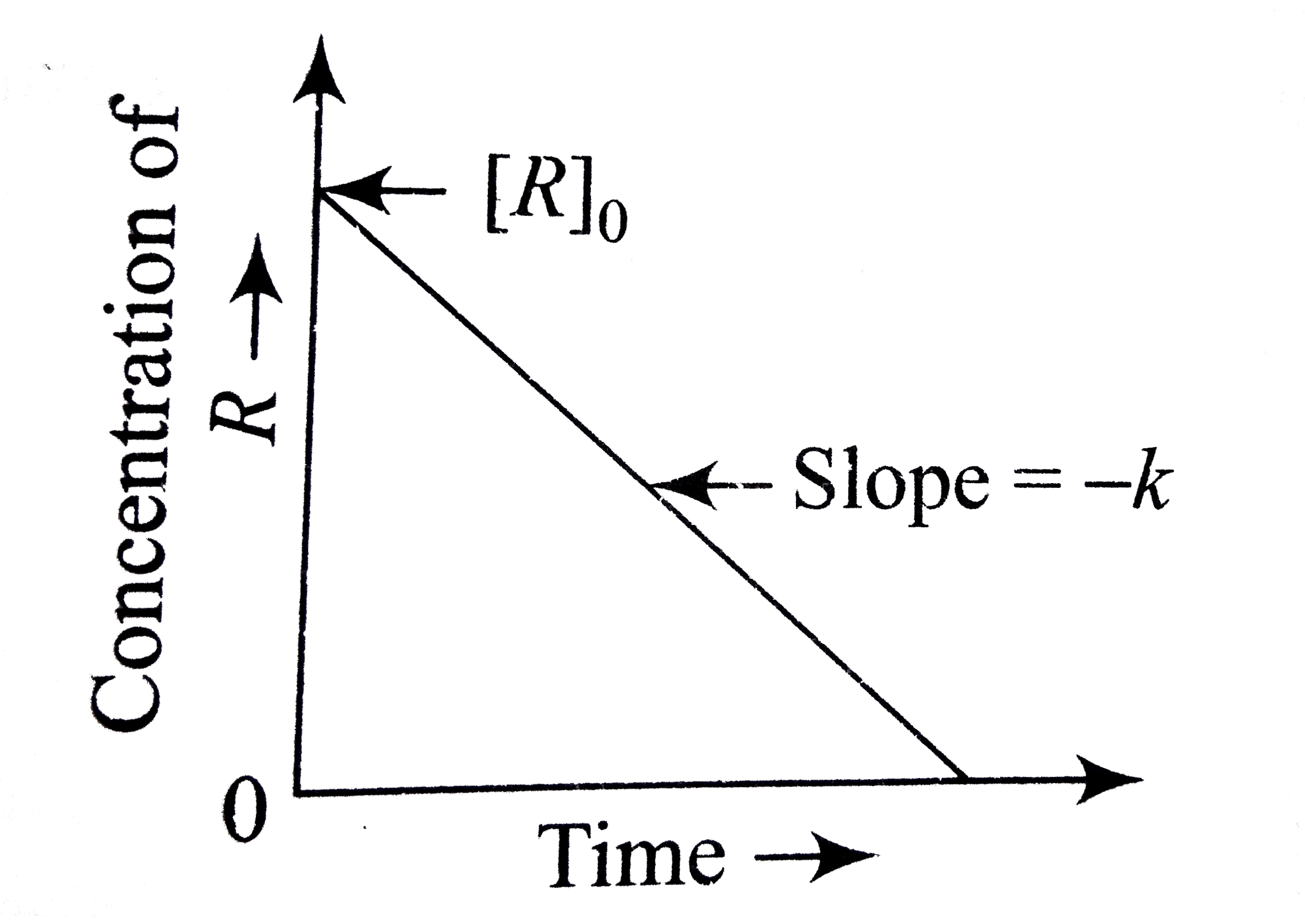
A

Consider the zero order reaction
`R to P`
Rate = `(d[R])/(dt) = k [R]^(@)`
As any quantity raised to power zero is unity, we have
Rate `= (-d[R])/(dt) = k xx 1`
or `d [R] = - k dt`
Integrating both rides
`[R] = - kt + I.C`
Where I.C. is the constant of integration.
At t = 0 the concentration of the reactant. `R = [R]_(0)`, where
`[R]_(0)` is initial concentration of the reactant. Subtituting this result in the above equation, we get
`[R]_(0) = - k xx 0 + I.C`
`[R]_(0) = I.C`
Thus, `[R] = - kt + [R]_(0)`
Comparing it with equation of a straight line, `y = mx + c`, if we plot `[R]` against t, we get a straight line with slope = - K are intercept equal to `[R]_(0)`
Promotional Banner

Topper's Solved these Questions

  • CHEMICAL KINETICS

    R SHARMA|Exercise Archives|39 Videos
  • CHEMICAL KINETICS

    R SHARMA|Exercise Follow-up 6|2 Videos
  • BIOMOLECULES

    R SHARMA|Exercise Archives|47 Videos
  • CHEMISTRY IN EVERYDAY LIFE

    R SHARMA|Exercise Archives|11 Videos

Similar Questions

Explore conceptually related problems

A plot of logarithm of rate vs logarithm of concentration of the reactant in a first order reaction is straight line whose slope is tan theta , where theta is

If the graph of concentration of [A] vs T for completion of reaction is a straight line, then the order of reaction is

For a lst order reaction , a straight line is obtained if you plot

Certain reactions follow the relation between concentrations of the reactant vs time as What is the expected order for such reactions

The given plots represent the variation of the concentration of a reactant R with time for two different reaction (i) and (ii) The respective orders of the reactions are

The given plots represent the variation of the concentration of a reactant R with time for different reactions (i) and (ii). The respective orders of the reactions are:

R SHARMA-CHEMICAL KINETICS-Question Bank (Building the knowledge)
  1. The experiment data for the reaction 2A + B(2) rarr 2AB is |{:("Expe...

    Text Solution

    |

  2. The activation energy for a simple chemical reaction A rarr B is E(a) ...

    Text Solution

    |

  3. The plot of concentration of the reactant vs time for a reaction is a ...

    Text Solution

    |

  4. A chemical reaction has catalyst X. Hence X

    Text Solution

    |

  5. For an exothermic reaction, the energy of activation of the reactants ...

    Text Solution

    |

  6. Higher order (gt3) reaction are rare due to :

    Text Solution

    |

  7. The rate of a reaction doubles when its temperature changes form 300 K...

    Text Solution

    |

  8. Plots showing the variation of the rate constant (k) with temperature ...

    Text Solution

    |

  9. For a first order reaction A rarr P, the temperature (T) dependent rat...

    Text Solution

    |

  10. Conisder a reaction aG+bH rarr Products. When concentration of both th...

    Text Solution

    |

  11. The time for half-life period of a certain reaction, A rarr products i...

    Text Solution

    |

  12. Rate of a reaction can be expressed by Arrhenius equation as: k = Ae...

    Text Solution

    |

  13. The reaction M(2)(g) rarrN(g)+(1)/(2)R(g) shows increase in pressure f...

    Text Solution

    |

  14. The raction 2FeCl(3) + SnCl(2) rarr 2FeCl(2) + SnCl(4) is an example ...

    Text Solution

    |

  15. A first order gas reaction has k = 1.5 xx 10^(-6) s^(-1) at 200^(@)C. ...

    Text Solution

    |

  16. While studying the decompoistion of gaseous N(2)O(5), it is observed t...

    Text Solution

    |

  17. 99% at a first order reaction was completed in 32 min. When will 99.9%...

    Text Solution

    |

  18. If the rate constant for a reaction repreasented by 2HI rarr H(2)+I(2)...

    Text Solution

    |

  19. In an exothermic reaction A rarr B, the activation energy of the forwa...

    Text Solution

    |

  20. In Arrhenius equation k = Ae^(-E(a)//RT)), A is the value of the rate ...

    Text Solution

    |

