Home
Class 12
PHYSICS
Three infinitely long thin wires, each c...

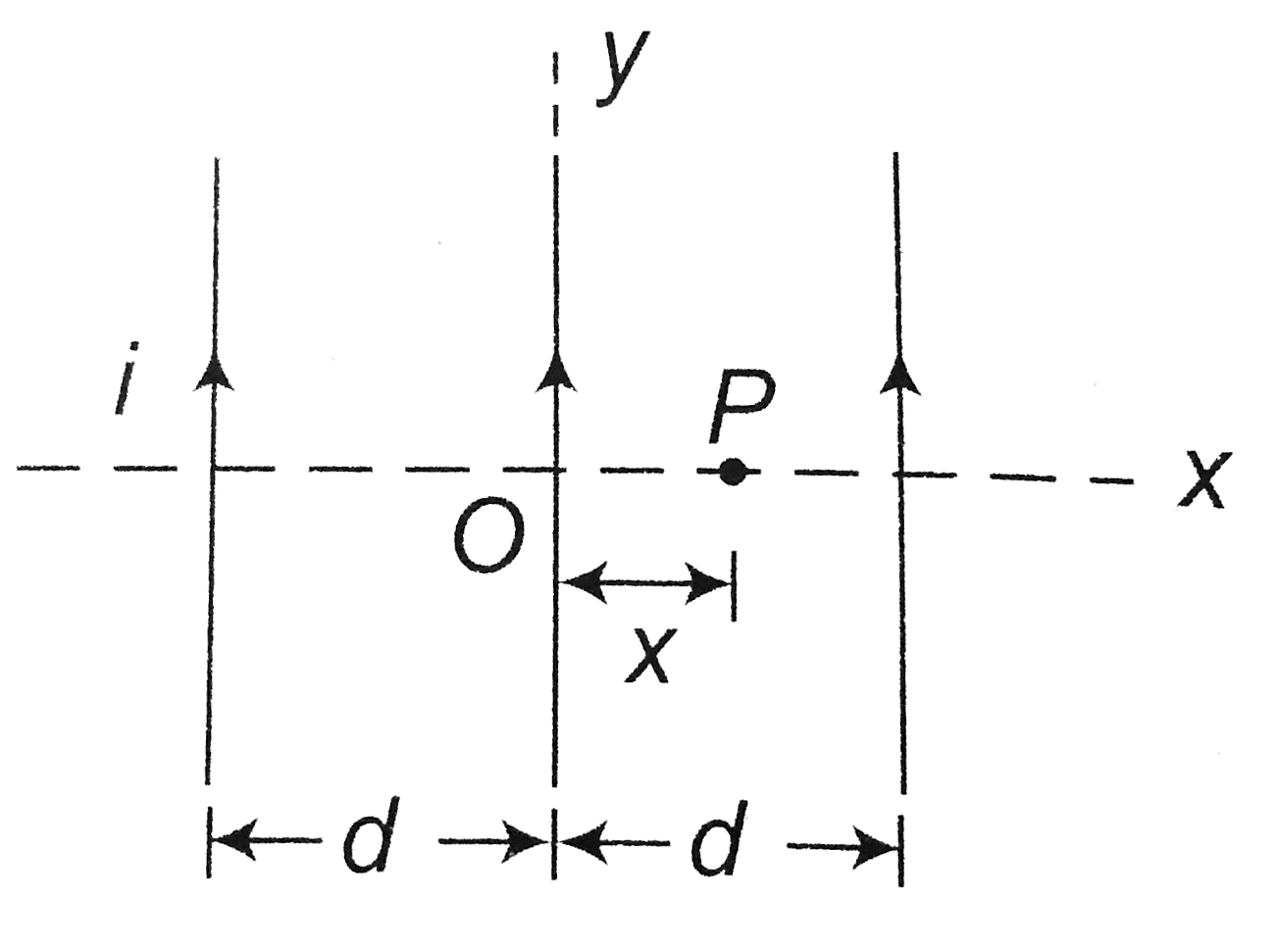
Three infinitely long thin wires, each carrying current `i` in the same direction, are in the `x-y` plane of a gravity free space . The central wire is along the `y - axis` while the other two are along `x = +-d`.
(i) Find the locus of the points for which the magnetic field `B` is zero.
(ii) If the central wire is displaced along the ` Z- direction` by a small amount and released, show that it will excecute simple harmonic motion . If the linear density of the wires is `lambda`, find the frequency of oscillation.

Text Solution

Verified by Experts
(a)
Magnetic field is zero on middle wire i.e. y-axis i.e. `x = 0`.
Let magnetic field is zero at point `P`
`(mu_(0)i)/(2pi) ((1)/(d + x) + (1)/(x)) = (mu_(0)i)/(2pi(d - x))`
`((2x + d))/(x(d + x)) = (1)/((d - x))`
`(2x + d)(d - x) = x(d + x)`
`2xd - 2x^(2) + d^(2) -xd = xd + x^(2)`
`x^(2) = (d^(2))/(3) rArr x = +- (d)/(sqrt(3))`
Locus of points where magnetic field is zero
`x = 0, x = +- (d)/(sqrt(3))`
(b)
When middle wire is displaced along z-axis, force on it due to other wire
`F = (mu_(0)i.i)/(2pisqrt(a^(2) + z^(2)))`
Restoring force on middle wire
`F' = - 2F cos theta - 2. (mu_(0)i^(2))/(2pi sqrt((d^(2)+ z^(2)))).(z)/(sqrt((d^(2) + z^(2)))`
`= (mu_(0)i^(2)z)/(pi(a^(2) + z^(2)))`, downward
Acceleration of middle wire
`a = (F')/(lambda) = (mu_(0)i^(2)z)/(pi(d^(2) + z^(2))lambda)`
Since `z lt ltd, z^(2)` is negligible
`a = -((mu_(0)i^(2))/(pi lambda d^(2)))z`
`a alpha - z` (case of `S.H.M.`)
`a = -omega^(2)z`
`omega = sqrt((mu_(0)i^(2))/(pi lambda d^(2)))`
`f = (omega)/(2pi) = sqrt((mu_(0)i^(2))/(4pi^(3) lambdad^(2)))`
`= (i)/(2pi d)sqrt((mu_(0))/(pi lambda))`
Note: `F': fo rce//l eng th, lambda: mass//l eng th`.
Promotional Banner

Topper's Solved these Questions

  • MAGNETIC FORCE, MOMENT AND TORQUE

    CP SINGH|Exercise Exercises|141 Videos
  • MAGNETIC FIELD

    CP SINGH|Exercise EXERCISE|77 Videos
  • NEET PREVIOUS YEAR

    CP SINGH|Exercise PAPER|89 Videos

Similar Questions

Explore conceptually related problems

Three infinitely long thein wires, each carrying curren i int eh same diecrtion, are the dxy plane of a gravilty free space. The central wire is along the y-axis while the other two are along x=+-d i find the locus of the points for which the magnetic field B is zero. ii If the central wire is displaced along the z -direction by a smal amount and released, show that it will execute simple harmonic motion. If the linear mass density of the wires is lamda , find the frequency of oscillation.

Three infinitely long thin wires each carrying current I in the same direction are in x-y plane of a gravity free space. The central wire is along the y -axis while the other two are along x=+-d . If the central wire is slightly displaced along z -axis and released, show that it will execute S.H.M . The linear mass density of the wire is lambda . If the time period of this small oscillation is (kpid)/(I)sqrt((pilambda)/(mu_(0))) , then find the value of k .

Two infinitely long wires each carrying current I along the same direction are made into the geometry as shown in the figure. The magnetic field at the point P is

Three infinitely long wires,each carrying equal current are placed in the xy -plane along x= 0,+d and -d .On the xy -plane,the magnetic field vanishes at

Two infinitely long parallel wires carry equal current in same direction. The magnetic field at a mid point in between the two wires is

Three long wires, each carrying current i are placed as shown. The middle wire is along Y -axis. The locus of point on the X -axis where magnetic field is zero is

A long, straight wire carries a current along the z-axis. One can find two points in the x-y plane such that

two infinite wires, carrying currents i_1 and i_2 ., are lying along x-and y-axes, as shown in the x-y plane. Then,

Two thin, long, parallel wires, separated by a distance 'd' carry a current of 'i' A in the same direction. They will

CP SINGH-MAGNETIC FORCE, MOMENT AND TORQUE-Exercises
  1. Three infinitely long thin wires, each carrying current i in the same ...

    Text Solution

    |

  2. A positively charged particle projected towards east is deflected towa...

    Text Solution

    |

  3. A vertical wire carries a current in upward direction. An electron bea...

    Text Solution

    |

  4. Which of the following particles will describe wll experience maximum...

    Text Solution

    |

  5. Which of the following particles will describe the smallest circle wh...

    Text Solution

    |

  6. Which of the follwing particles will have minimum frequency of revol...

    Text Solution

    |

  7. A stream of protons and alpha-particle of equal momenta enter a unifom...

    Text Solution

    |

  8. A proton, a deutron and alpha-particle, whose kinetic energies are sam...

    Text Solution

    |

  9. A proton, a deuteron and an alpha- particle having the same kinetic en...

    Text Solution

    |

  10. A charged particle enters a uniform magnetic field perpendicular to it...

    Text Solution

    |

  11. A beam of electrons is accelerated through a potential difference V. I...

    Text Solution

    |

  12. Two particle X and Y having equal charge, after being accelerated thro...

    Text Solution

    |

  13. Two ions have equal masses but one is singly- ionized and the other i...

    Text Solution

    |

  14. A particle is projected in a plane perpendicular to a uniform magnetic...

    Text Solution

    |

  15. Which of the following statement is correct ?

    Text Solution

    |

  16. A charged particle begins to move in a magnetic field, initially paral...

    Text Solution

    |

  17. Two charged particles P and Q enter a uniform magnetic field normally ...

    Text Solution

    |

  18. A beam consisting of protons and electrons moving at the same speed go...

    Text Solution

    |

  19. An electron and a proton enter a magnetic field at right angles to the...

    Text Solution

    |

  20. Two particles A and B of masses m(A) and m(B) respectively and having...

    Text Solution

    |

  21. A charged particle having kinetic energy E enters normally a region of...

    Text Solution

    |