

Home
Class 12
PHYSICS
A particle of charge +q and mass m movi...

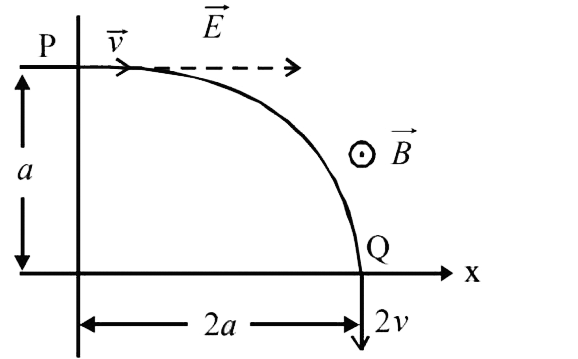
A particle of charge ` +q` and mass `m` moving under the influence of a uniform electric field ` E hat(i)` and uniform magnetic field ` B hat(k)` follows a trajectory from ` P to Q` as shown in fig. The velocities at `P and Q` are ` v hat(i)` and ` - 2v hat(j)` . which of the following statement(s) is/are correct ?

Text Solution

Verified by Experts

(a) Work is done by electric force, as magnetic force does no work. Work done by electric force from `P` to `Q`
`W =` force `xx` displacement along direction of-force
`= (qEhat(i)).(2ahat(i)) = 2qEa`
By work-energy theory
`W = Delta K = K_(Q) - K_(P)`
`2qEa = (1)/(2)m[(2v)^(2) - v^(2)] = (3)/(2) mv^(2)`
`E = (3)/(4)(mv^(2))/(qa)`
(b) Rate of work done by electric field
At `P`:
`P_(P) = vec(F).vec(v) = qEhat(i).vhat(i) = qEv = (3mv^(3))/(4a)`
`P_(Q) = 0`, as force and velocity are perpendicular.
( c) `vec(F)_(m)` is always perpendicular to `vec(v)`,
`P = 0`
Promotional Banner

Topper's Solved these Questions

  • MAGNETIC FORCE, MOMENT AND TORQUE

    CP SINGH|Exercise Exercises|141 Videos
  • MAGNETIC FIELD

    CP SINGH|Exercise EXERCISE|77 Videos
  • NEET PREVIOUS YEAR

    CP SINGH|Exercise PAPER|89 Videos

Similar Questions

Explore conceptually related problems

A particle of charge +q and mass m moving under the influnce of a uniform electric field E hati and a uniform magnetic field Bhatk follows trajectory from P to Q as shown in figure. The velocities at P and Q vhati and -2vhatj respectively. Which of the following statement(s) is/are correct

A particle of charge q and mass m starts moving from the origin under the action of an electric field vec E = E_0 hat i and vec B = B_0 hat i with a velocity vec v = v_0 hat j . The speed of the particle will become 2v_0 after a time.

A particle of charge q and mass m starts moving from the origin under the action of an electric field vecE=E_0 hat i and vec B=B_0 hat i with velocity vec v=v_0 hat j . The speed of the particle will become 2v_0 after a time

A particle ( mass = m and charge = q ) is moving in a region in which there exists a uniform electric field E vec( i ) and a uniform magnetic field B hat (k) . At t = 0 , the particle is at ( 0,a ) and is moving with v hat(i) . After some time, the particle is located at ( 2a, 0 ) and has a velocity - 2 v hat( j ) , then which of the following is true ?

An alpha particle moving with the velocity vec v = u hat i + hat j ,in a uniform magnetic field vec B = B hat k . Magnetic force on alpha particle is

An electron of charge -e , mass m, enters a uniform magnetic field vec(B)= B hat(i) with an initial velocity vec(v) = v_(x) hat(i) + v_(y) hat(j) . What is the velocity of the electron after a time interval of t seconds?

A particle of charge -q and mass m enters a uniform magnetic field vecB (perpendicular to paper inward) at P with a velocity v_0 at an angle alpha and leaves the field at Q with velocity v at angle beta as shown in fig.

A particle of charge q and mass m released from origin with velocity vec(v) = v_(0) hat(i) into a region of uniform electric and magnetic fields parallel to y-axis. i.e., vec(E) = E_(0) hat(j) and vec(B) = B_(0) hat(j) . Find out the position of the particle as a functions of time Strategy : Here vec(E) || vec(B) The electric field accelerates the particle in y-direction i.e., component of velocity goes on increasing with acceleration a_(y) = (F_(y))/(m) = (F_(e))/(m) = (qE_(0))/(m) The magnetic field rotates the particle in a circle in x-z plane (perpendicular to magnetic field) The resultant path of the particle is a helix with increasing pitch. Velocity of the particle at time t would be vec(v) (t) = v_(x) hat(i) + v_(y) hat(j) + v_(z) hat(k)

If the vectors 2 hat(i) - q hat(j) + 3 hat(k) and 4 hat(i) - 5 hat(j) + 6 hat(k) are collinear then find the value of q.

Figure 2 (EP). 13 shows the orientatione of two vectors vec u and vec v in the (XY) plane. If vec u = a hat I + b hat j and vec v = p hat + q hat j which of the following is correct ? .

CP SINGH-MAGNETIC FORCE, MOMENT AND TORQUE-Exercises
  1. A particle of charge +q and mass m moving under the influence of a un...

    Text Solution

    |

  2. A positively charged particle projected towards east is deflected towa...

    Text Solution

    |

  3. A vertical wire carries a current in upward direction. An electron bea...

    Text Solution

    |

  4. Which of the following particles will describe wll experience maximum...

    Text Solution

    |

  5. Which of the following particles will describe the smallest circle wh...

    Text Solution

    |

  6. Which of the follwing particles will have minimum frequency of revol...

    Text Solution

    |

  7. A stream of protons and alpha-particle of equal momenta enter a unifom...

    Text Solution

    |

  8. A proton, a deutron and alpha-particle, whose kinetic energies are sam...

    Text Solution

    |

  9. A proton, a deuteron and an alpha- particle having the same kinetic en...

    Text Solution

    |

  10. A charged particle enters a uniform magnetic field perpendicular to it...

    Text Solution

    |

  11. A beam of electrons is accelerated through a potential difference V. I...

    Text Solution

    |

  12. Two particle X and Y having equal charge, after being accelerated thro...

    Text Solution

    |

  13. Two ions have equal masses but one is singly- ionized and the other i...

    Text Solution

    |

  14. A particle is projected in a plane perpendicular to a uniform magnetic...

    Text Solution

    |

  15. Which of the following statement is correct ?

    Text Solution

    |

  16. A charged particle begins to move in a magnetic field, initially paral...

    Text Solution

    |

  17. Two charged particles P and Q enter a uniform magnetic field normally ...

    Text Solution

    |

  18. A beam consisting of protons and electrons moving at the same speed go...

    Text Solution

    |

  19. An electron and a proton enter a magnetic field at right angles to the...

    Text Solution

    |

  20. Two particles A and B of masses m(A) and m(B) respectively and having...

    Text Solution

    |

  21. A charged particle having kinetic energy E enters normally a region of...

    Text Solution

    |