Home
Class 11
PHYSICS
A force vecF=(3xy-5z)hatj+4zhatk is appl...

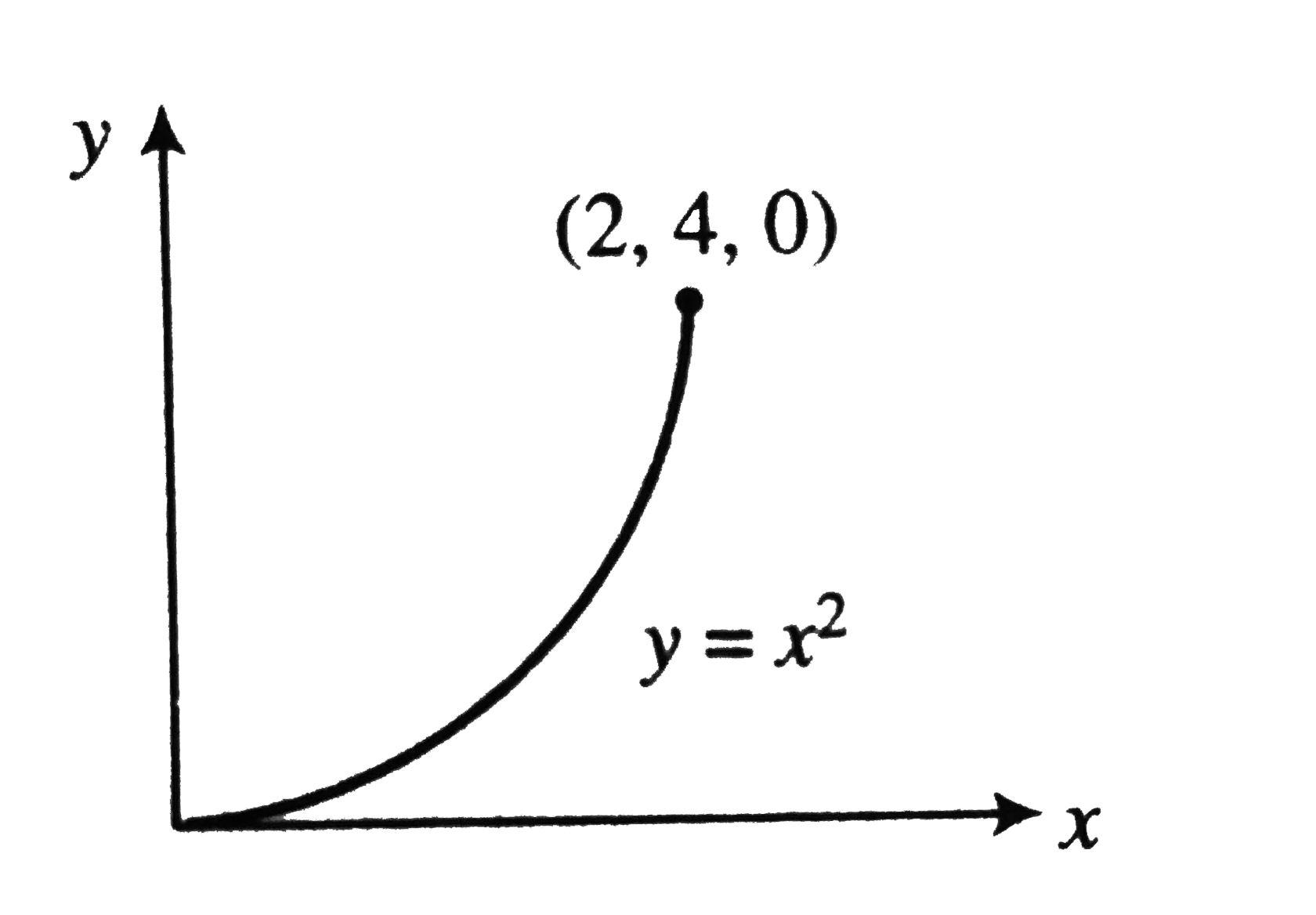
A force `vecF=(3xy-5z)hatj+4zhatk` is applied on a particle. The work done by the force when the particle moves from point `(0, 0, 0)` to point `(2, 4, 0)` as shown in figure.

A

`(280)/(5)` units

B

`(140)/(5)` units

C

`(232)/(5)` units

D

`(192)/(5)` units

Text Solution

Verified by Experts

The correct Answer is:

D

`z` and `x` components are useless points.
so, `dw =Fy.dy = 3xy.dy = underset(0) overset(2)int 6x^(4).dx = (192)/(5) units`.
Promotional Banner

Topper's Solved these Questions

  • WORK POWER AND ENERGY

    NARAYNA|Exercise Level-V (Multiple Answer)|13 Videos
  • WORK POWER AND ENERGY

    NARAYNA|Exercise Level-V (Comprehension)|22 Videos
  • WORK POWER AND ENERGY

    NARAYNA|Exercise NCERT (Based Questions)|45 Videos
  • WORK , ENERGY & POWER

    NARAYNA|Exercise EXERCISE IV|43 Videos

Similar Questions

Explore conceptually related problems

A force of vecF=2xhati+2hatj+3z^2hatk N is acting on a particle. Find the work done by this force in displacing the body from (1, 2, 3)m to (3, 6, 1)m .

A force (5y + 20) hatj displaces a particle from y=0 to y=10. Find work done by force

Force acting on a particle varies with x as shown in figure. Calculate the work done by the force as the particle moves from x = 0 to x = 6.0 m.

A force vecF = (2xhati+ 3hatj + 3z^2hatk) is acting on the particle of mass 2kg which is displaces from point A(2,3,0) to point B(3,2,1) . the work done by the force on the particle will be

A force of F=(0.5x+12)N acts on a particle. If x is in metre, calculate the work done by the force during the displacement of the particle from x = 0 to x = 4 m

Shown that work done by a conservative force on a particle moving between two points is path independent.

Calculate the work done to displace the particle from (1,2) to (4,5) .if vecF=4hati+3hatj

A force F=(3xhati+4hatj) Newton (where x is in metres) acts on a particle which moves from a position (2m, 3m) to (3m, 0m). Then the work done is

NARAYNA-WORK POWER AND ENERGY-Level-V (Single Answer)
  1. The blocks A and B shown in figure have masses MA=5kg and MB=4kg. The ...

    Text Solution

    |

  2. A particle is projected along a horizontal field whose coefficient of ...

    Text Solution

    |

  3. A force vecF=(3xy-5z)hatj+4zhatk is applied on a particle. The work do...

    Text Solution

    |

  4. A particle is being acted upon by one dimensional conservative force. ...

    Text Solution

    |

  5. A particle A of mass 10//7kg is moving in the positive direction of x-...

    Text Solution

    |

  6. The potential energy of a particle is determined by the expression U=a...

    Text Solution

    |

  7. An engine is hauling a train of mass m on a level track at a constant ...

    Text Solution

    |

  8. A body of mass m slides down a plane inclined at an angle alpha. The c...

    Text Solution

    |

  9. In the figure the variations of componets of acceleration of particles...

    Text Solution

    |

  10. For a particle moving on a straight lint the variation of acceleration...

    Text Solution

    |

  11. A block of mass m is being pulled up a rough incline by an agent deliv...

    Text Solution

    |

  12. The spring block system lies on a smooth horizontal surface. The free ...

    Text Solution

    |

  13. Two equal masses are attached to the two ends of a spring of spring co...

    Text Solution

    |

  14. A block of mass m is allowed to slide down a fixed smooth inclined pla...

    Text Solution

    |

  15. An object or mass (m) is located at the origin of a vertical plane. Th...

    Text Solution

    |

  16. The potential enery of a particle varies with posiion x according to t...

    Text Solution

    |

  17. A particle, which is constrained to move along the x-axis, is subjecte...

    Text Solution

    |

  18. A force F = -K(y hatI + x hatj) (where K is a posive constant ) acts o...

    Text Solution

    |

  19. A smooth spehre of radius R is made to translate oin a straight line w...

    Text Solution

    |

  20. The potential energy of a 1 kg particle free to move along the x- axis...

    Text Solution

    |
