Home
Class 11
PHYSICS
In the figure the variation of potential...

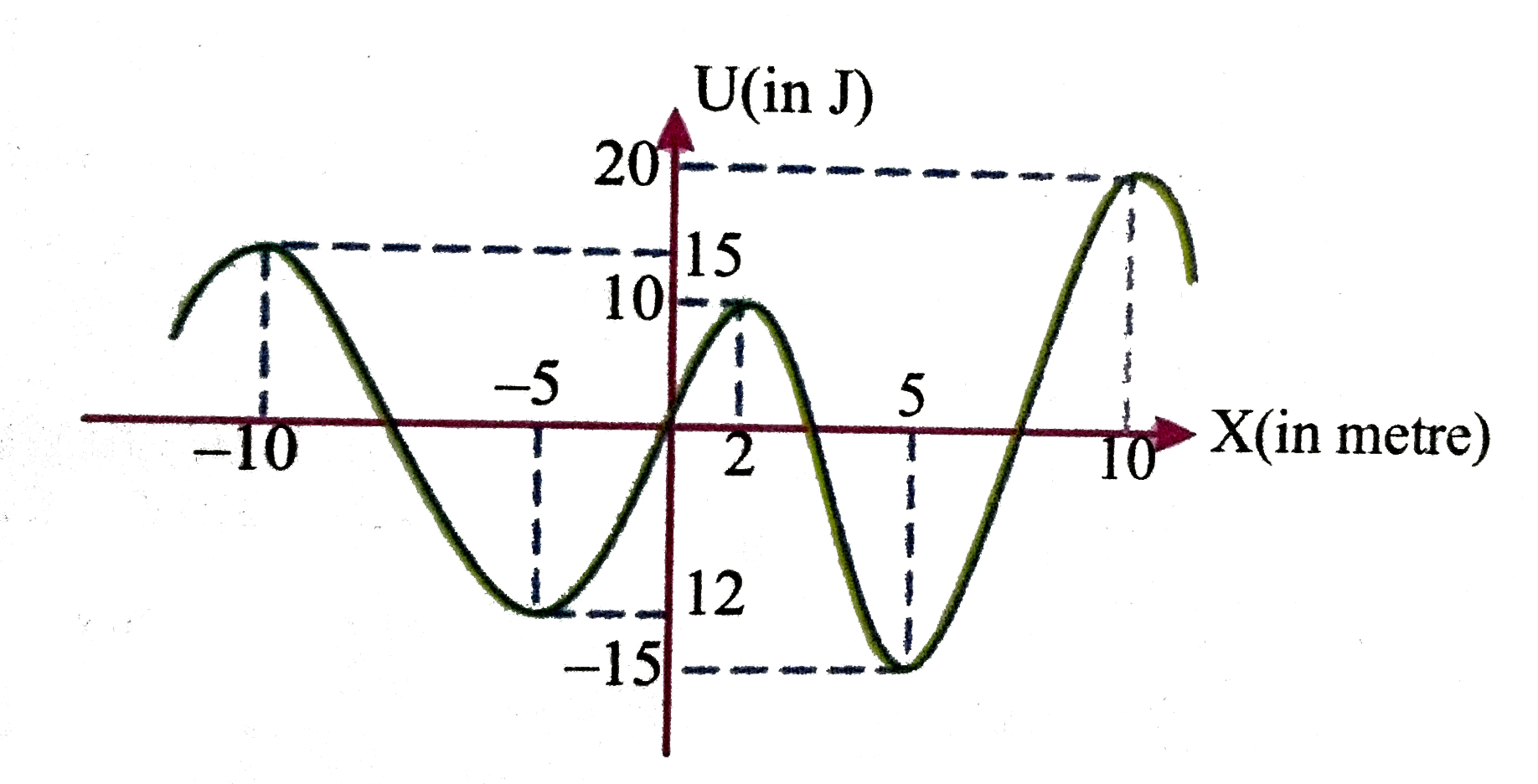
In the figure the variation of potential energy of a particle of mass `m = 2kg` is represented w.r.t. its x-coordinate. The particle moves under the effect of this conservative force along the x-axis.

`x = - 5m` and `x = 10 m` position of the particle are respectively of

A

neutral and stable equilibrium.

B

neutral and unstable equilibrium.

C

unstable and stable equilibrium.

D

stable and unstable equilibrium.

Text Solution

Verified by Experts

The correct Answer is:

D
Promotional Banner

Topper's Solved these Questions

  • WORK POWER AND ENERGY

    NARAYNA|Exercise Level-VI (Integer)|12 Videos
  • WORK POWER AND ENERGY

    NARAYNA|Exercise Level-VI (Multiple Answer)|11 Videos
  • WORK , ENERGY & POWER

    NARAYNA|Exercise EXERCISE IV|43 Videos

Similar Questions

Explore conceptually related problems

In the figure the variation of potential energy of a particle of mass m = 2kg is represented w.r.t. its x-coordinate. The particle moves under the effect of this conservative force along the x-axis. If the particle is released at the origin then

In the figure the variation of potential energy of a particle of mass m=2kg is represented w.r.t. its x-coordinate. The particle moves under the effect of this conservative force along the x-axis. Which of the following statements are correct about the particle:

In the figure, the variation of potential energy of a particle of mass m = 2kg is represented with respect to its x-coordinate. The particle moves under the effect of this conservative force along the X-axis. If the particle is released at the origin, then

In figure, the variation of potential energy of a particle of mass m=2kg is represented w.r.t its x-coordinate. The particle moves under the effect of the conservative force along the x-axis. Which of the following statements is incorrect about the particle?

In the figure, the variation of potential energy of a particle of mass m = 2kg is represented with respect to its x-coordinate. The particle moves under the effect of this conservative force along the X-axis. If the particle is released at x = 2 + Delta where Delta rarr 0 (it is positive), then its maximum speed in subsequent motion will be

The potential energy of a particle moving along x-axis is given by U = 20 + 5 sin (4 pi x) , where U is in J and x is in metre under the action of conservative force :

The potential energy of a particle under a conservative force is given by U ( x) = ( x^(2) -3x) J. The equilibrium position of the particle is at

v_(x) is the velocity of a particle moving along the x-axis as shown in the figure. If x=2.0m at t=1.0s, what is the position of the particle at t=6.0s ?

NARAYNA-WORK POWER AND ENERGY-Level-VI (Comprehension)
  1. The potential energy U(in J) of a particle is given by (ax + by), wher...

    Text Solution

    |

  2. The potential energy U(in J) of a particle is given by (ax + by), wher...

    Text Solution

    |

  3. The potential energy U(in J) of a particle is given by (ax + by), wher...

    Text Solution

    |

  4. The potential energy U(in J) of a particle is given by (ax + by), wher...

    Text Solution

    |

  5. A block of mass m sits at rest on a frictionless table in a rail car t...

    Text Solution

    |

  6. A block of mass m sits at rest on a frictionless table in a rail car t...

    Text Solution

    |

  7. A block of mass m sits at rest on a frictionless table in a rail car t...

    Text Solution

    |

  8. A block of mass m sits at rest on a frictionless table in a rail car t...

    Text Solution

    |

  9. A block of mass m sits at rest on a frictionless table in a rail car t...

    Text Solution

    |

  10. A block of mass m sits at rest on a frictionless table in a rail car t...

    Text Solution

    |

  11. In the figure the variation of potential energy of a particle of mass...

    Text Solution

    |

  12. In the figure the variation of potential energy of a particle of mass...

    Text Solution

    |

  13. Rod AO(3) of length L can rotate abput A. Initially rod was at positio...

    Text Solution

    |

  14. Rod AO(3) of length L can rotate abput A. Initially rod was at positio...

    Text Solution

    |

  15. A particle of mass M attached to an inextensible strintg is moving in ...

    Text Solution

    |

  16. A particle of mass M attached to an inextensible strintg is moving in ...

    Text Solution

    |

  17. A particle of mass M attached to an inextensible strintg is moving in ...

    Text Solution

    |

  18. A bead of mass m is threaded on a smooth circular wire centre O, radiu...

    Text Solution

    |

  19. A bead of mass m is threaded on a smooth circular wire centre O, radiu...

    Text Solution

    |

  20. A bead of mass m is threaded on a smooth circular wire centre O, radiu...

    Text Solution

    |
