Home
Class 11
PHYSICS
The angular elevation of an enemy's posi...

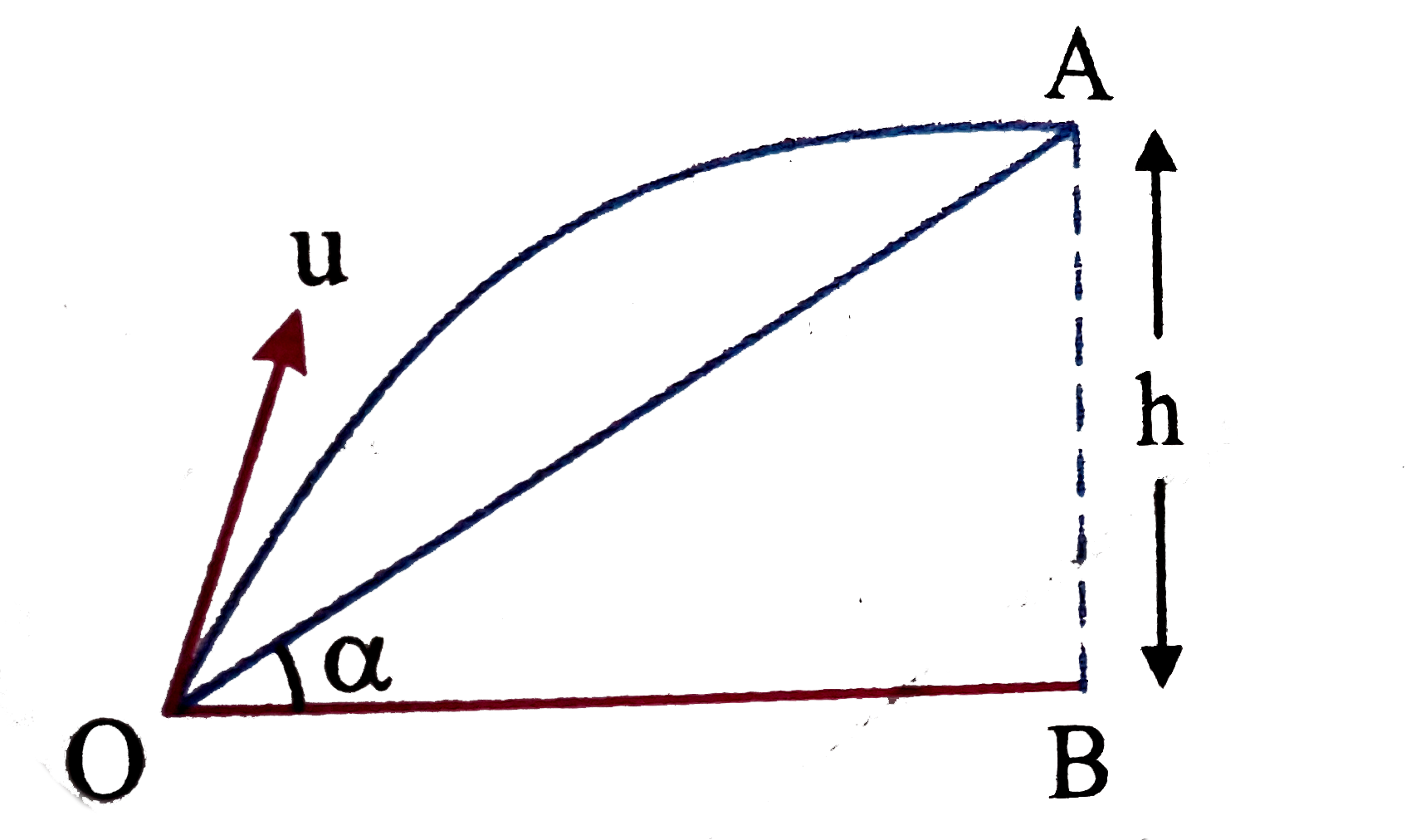
The angular elevation of an enemy's position on a hill 'h' ft height is `alpha`.Wha should be the minimum velocity of the projectile in order to hit the enemy?

A

`u=sqrt(gh(cos alpha+1))`

B

`u=sqrt(gh(sin alpha+1))`

C

`u=sqrt(gh(cossec alpha+1))`

D

`u=sqrt(gh(sec alpha+1))`

Text Solution

Verified by Experts

The correct Answer is:
C

`O` is the point of projection of the shell and `A` is the position of enemy at a height `h` above the level of `O`.
If `u` is the minimum initial velocity of the projectile to shell the enermy, then `OA` must be the maximum range up the inclined plane of angle `alpha`.
So `OA=u^(2)/(g(1+sin alpha))`....(i)
From `DeltaOAB, OA= h cosec alpha`....(ii)
From eqn.(i) and (ii) , `u=sqrt(gh(cosec alpha+1))`
Promotional Banner

Topper's Solved these Questions

  • MOTION IN A PLANE

    NARAYNA|Exercise Level -V Multi answer|18 Videos
  • MOTION IN A PLANE

    NARAYNA|Exercise Level -V Passage|15 Videos
  • MOTION IN A PLANE

    NARAYNA|Exercise NCERT BASED QUES. PASSAGE|8 Videos
  • MECHANICAL PROPERTIES OF SOLIDS

    NARAYNA|Exercise LEVEL-II (H.W)|24 Videos
  • MOTION IN A STRAIGHT LINE

    NARAYNA|Exercise Level 2 H.W|29 Videos

Similar Questions

Explore conceptually related problems

An airplane is moving with velocity v_0 horizontally at a height h. If a projectile is fired at the instant when the plane is overhead, What must be the angle of projection amd minimum velocity of projection in order that it may hit the airplane ?

An airplane is moving with velocity v_0 horizontally at a height h. If a projectile is fired at the instant when the plane is overhead, what must be the angle of projection and minimum velocity of projection in order that it may hit the airplane ?

Suppose the rod with the balls A and B of theprevious problem is clamped at the centre in such a way that it ca rotate freely about a horizontal axis through the clamp. The system is kept at rest in the horizontal position. A particle P of the same mass m is dropped from a heigh h hon the ball B. The particle collides with B and sticks to it. a. Find the angular momentum and the angular speed of the system just after the collision. b. What should be the minimum value of h so that the system makes a full rotation after the collision.

Four small particles charged with equal positive charges Q each are arranged at the four corners of a horizontal square of side a. A unit positive charge mass m is placed at a point P, at a height h above the centre of the square. What should be the magnitude of charge Q in order that the unit charge remain in equilibrium

In one-dimensional kinematics, a particle can move strictly along a straight line. The description of motion of the particle can be done in two ways: (i) mathematical equation and (ii) graphs. The choice of a particular method for solving a problem often depends upon the type and nature of problem, for example the graphical method provides more physical insight One dimensional motion is categorised into 1. motion with constant velocity 2. motion with constant acceleration, and 3. accelerated and de-accelerated motion If you represent inotion (1) by the graph on position time and velocity-time coordinates, the graphs may look like as given below. One very interesting case comes up, when a particle is thrown at a certain angle from the horizontal, the particle travels in the medium along a curved path, known as parabola. - The trajectory of the parabola written in the mathematical equation is given by y=xtantheta-(1)/(2)(gx^(2))/((v_0costheta))^(2) Ineglect resistance of medium and its motion where Vs and are the initial velocity of the projectile and the projection angle at the point of projection measured with the + x axis. There are some applications which we have seen in our life, like in many game shows, the theory of the projectile is always used An air gun is aimed at an elevated target, which is released in a free fall by some mechanism as the bullet leaves the nozzle. Irrespective of falling speed of object, the bullet will always hit the target. QThe graph shows the psition of a hard ball with respect to time .The hard ball hits and rebounds on the hard surface .Ehich of the following graph represent the correct variation with repect to time?

In one-dimensional kinematics, a particle can move strictly along a straight line. The description of motion of the particle can be done in two ways: (i) mathematical equation and (ii) graphs. The choice of a particular method for solving a problem often depends upon the type and nature of problem, for example the graphical method provides more physical insight One dimensional motion is categorised into 1. motion with constant velocity 2. motion with constant acceleration, and 3. accelerated and de-accelerated motion If you represent inotion (1) by the graph on position time and velocity-time coordinates, the graphs may look like as given below. One very interesting case comes up, when a particle is thrown at a certain angle from the horizontal, the particle travels in the medium along a curved path, known as parabola. - The trajectory of the parabola written in the mathematical equation is given by y=xtantheta-(1)/(2)(gx^(2))/((v_0costheta))^(2) Ineglect resistance of medium and its motion where Vs and are the initial velocity of the projectile and the projection angle at the point of projection measured with the + x axis. There are some applications which we have seen in our life, like in many game shows, the theory of the projectile is always used An air gun is aimed at an elevated target, which is released in a free fall by some mechanism as the bullet leaves the nozzle. Irrespective of falling speed of object, the bullet will always hit the target. QOut of the two methods, graphical method and mathematical equation, which gives you the better precision

NARAYNA-MOTION IN A PLANE-Level -V Single answer
  1. A block of mass m in floating in a river flowing with a velocity of 2m...

    Text Solution

    |

  2. From a point on the ground at a distance a from the foot of a pole, a ...

    Text Solution

    |

  3. A heavy particle is projected with a velocity at an angle with the hor...

    Text Solution

    |

  4. A fixed morter fires a bomb at an angle of 53^@ above the horizontal w...

    Text Solution

    |

  5. The angular elevation of an enemy's position on a hill 'h' ft height i...

    Text Solution

    |

  6. Two particles are projected simultaneously with the same speed v in th...

    Text Solution

    |

  7. Figure shows a sphere moving in a steady flow of air in the x-directio...

    Text Solution

    |

  8. A very broad elevator is going up vertically with a constant accelerat...

    Text Solution

    |

  9. A boy throws a ball upward with velocity v(0)=20m//s. The wind imparts...

    Text Solution

    |

  10. A particle is projected from an inclined plane OP1 from A with velocit...

    Text Solution

    |

  11. A particle is projected with a certain velocity at an angle prop above...

    Text Solution

    |

  12. A particle is projected at an angle 60^@ with speed 10(sqrt3)m//s, fro...

    Text Solution

    |

  13. A particle is projected from a point A with velocity usqrt2 at an angl...

    Text Solution

    |

  14. A particle is dropped from point P at time t = 0. At the same time an...

    Text Solution

    |

  15. Shots are fired simultaneously from the top and bottom of a vertical c...

    Text Solution

    |

  16. Two projectiles are projected simultaneously from two towers as shwon ...

    Text Solution

    |

  17. In the figure shown, the two projectiles are fired simultaneously. The...

    Text Solution

    |

  18. Two particles A and B are projected simultaneously in the directins sh...

    Text Solution

    |

  19. A particle starts from the origin of coordinates at time t = 0 and mov...

    Text Solution

    |

  20. Motion of a particle is governed by following relations y=x/alpha,V(x)...

    Text Solution

    |

