Home
Class 12
CHEMISTRY
Give the correct of initials T or F for ...

Give the correct of initials T or F for following statements. Use T if statements is true and F if it is false.
(I) Co(III) is stabilised in presence of weak field ligands, while Co(II) is stabilised in presence of strong field ligand.
((II) Four coordinated complexes of Pd(II) and Pt(II) are diamagnetic and square planar.
(III) `[Ni(CN)_(4)]^(4-)` ion and `[Ni(CO)_(4)]` are diamagnetic tetrahedral and square planar respectively.
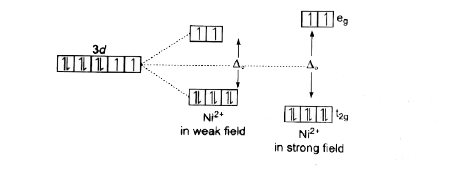
(IV) `Ni^(2+)` ion does not form inner orbital octahedral complexes

A

TFTF

B

TTTF

C

TTFT

D

FTFT

Text Solution

Verified by Experts

The correct Answer is:
D

(I) Both `CO^(2+) and Co^(3+)`, are stabilized in the presence of strong field ligands due to higher CFSE values.
(II) Because of higher `Z_(e f f)` value on the valence shell of `Pd^(2+) and Pt^(2+)` cations they, always from inner orbital complex.
(III) `[Ni(CO)_(4)],sp^(3)`, tetrahedral, `mu=0` BM
`[Ni(CN)_(4)]^(4-),sp^(3)`, tetrahedral, `mu=0` BM
(IV) `Ni^(2+)` in the octahedral field.

`implies` i.e., electronic distribution remains unaffected.
Promotional Banner

Topper's Solved these Questions

  • CO-ORDINATION COMPOUNDS

    VK JAISWAL|Exercise ONE OR MORE ANSWERS IS/ARE CORRECT|72 Videos
  • CO-ORDINATION COMPOUNDS

    VK JAISWAL|Exercise MATCH THE COLUMN|36 Videos
  • CHEMICAL BONDING (BASIC)

    VK JAISWAL|Exercise Level 3 (Passive 11)|6 Videos
  • d-BLOCK ELEMENTS

    VK JAISWAL|Exercise SUBJECTIVE PROBLEMS|6 Videos

Similar Questions

Explore conceptually related problems

Both [Ni(CO)_(4)] and [Ni(CN)_(4)]^(2-) are diamagnetic. The hybridisations of nickel in these complexes respectively, are

[NiCl_(4)]^(2-) is paramagnetic while [Ni(CO)_(4)] is diamagnetic though both are tetrahedral Why?

[NiCl_(4)]^(2-) is paramagnetic while [Ni(CO)_(4)] is diamagnetic though both are tetrahedral. Why?

Both [Ni(CO)_4] and [Ni (CN)_4]^(2-) are diamagnetic The hybridisations of nickel in these complexes , respectively are :

Give the correct order of initials T or F for following statements. Use T if statement is true and F if it is false. (I) Cu^(+) undergoes disproportionation to Cu and Cu^(2+) in aq. Solution (II) Hg_(2)Cl_(2) does not give chromyl chloride test. (III) [Fe(H_(2)O)_(5)NO]^(2+) complex is highly unstable due to the presence of weak field ligand. (IV) Bond length of CO^(+) is greater than CO.

VK JAISWAL-CO-ORDINATION COMPOUNDS-ASSERTION-REASON TYPE QUESTIONS
  1. Give the correct of initials T or F for following statements. Use T if...

    Text Solution

    |

  2. Assertion: In N(2) Molecule, any N-atom can coordinate with central at...

    Text Solution

    |

  3. Assertion: In N(2)H(4), any one N-atom can coordination with central m...

    Text Solution

    |

  4. These questions consist of two statements each, printed as Assertion a...

    Text Solution

    |

  5. Assertion: Acidified [Cu(NH(3))(4)]^(2+) and [Cu(H(2)O)(4)]^(2+) both ...

    Text Solution

    |

  6. Assertion: [Fe(EDTA)]^(-) complex is octahedral in shape. Reason: ED...

    Text Solution

    |

  7. STATEMENT-1: Tetrahedral complexes with chiral structure exhibit optic...

    Text Solution

    |

  8. Assertion: Oxidation state of Fe in Fe(CO)(5) is zero. Reason: Syner...

    Text Solution

    |

  9. Assertion: Zeise's salt is a pi-bonded organometallic compound. Reas...

    Text Solution

    |

  10. Assertion: [ClCl(3)(NH(3))(3)] does not give white precipitate with Ag...

    Text Solution

    |

  11. Assertion: Transition metal ion forming octahedral complexes undergo s...

    Text Solution

    |

  12. Assertion: Complex ion [Co(NH(3))(6)]^(2+) is readily oxidized to [Co(...

    Text Solution

    |

  13. Assertion: Hydrazine is a neutral ligand. Reason: It has two N as do...

    Text Solution

    |

  14. Reason: Complex anion [Re(2)Cl(8)]^(2-) has one delta-bond, one sigma ...

    Text Solution

    |

  15. Assertion: In N(2) Molecule, any N-atom can coordinate with central at...

    Text Solution

    |

  16. Assertion: In N(2)H(4), any one N-atom can coordination with central m...

    Text Solution

    |

  17. Assertion: [Ti(H(2)O)(6)]^(4+) is coloured while [Sc(H(2)O)(6)]^(3+) i...

    Text Solution

    |

  18. Assertion: Acidified [Cu(NH(3))(4)]^(2+) and [Cu(H(2)O)(4)]^(2+) both ...

    Text Solution

    |

  19. Assertion: [Fe(EDTA)]^(-) complex is octahedral in shape. Reason: ED...

    Text Solution

    |

  20. Assertion: Tetrahedral complexes with chiral structure exhibit optical...

    Text Solution

    |

  21. Assertion: Oxidation state of Fe in Fe(CO)(5) is zero. Reason: Syner...

    Text Solution

    |

