Home
Class 12
CHEMISTRY
A coordination complex of type MX(2)Y(2)...

A coordination complex of type `MX_(2)Y_(2)` (M-metal ion: X, Y-monodentate lingads), can have either a tetrahedral or a square planar geometry. The maximum number of posible isomers in these two cases are respectively:

A

1 and 2

B

2 and 1

C

1 and 3

D

3 and 2

Text Solution

Verified by Experts

The correct Answer is:
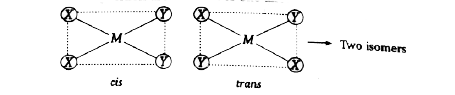
A

In tetrahedral all the posiiton are adjacent to one another hence only one isomer is possible
Promotional Banner

Topper's Solved these Questions

  • CO-ORDINATION COMPOUNDS

    VK JAISWAL|Exercise ONE OR MORE ANSWERS IS/ARE CORRECT|72 Videos
  • CO-ORDINATION COMPOUNDS

    VK JAISWAL|Exercise MATCH THE COLUMN|36 Videos
  • CHEMICAL BONDING (BASIC)

    VK JAISWAL|Exercise Level 3 (Passive 11)|6 Videos
  • d-BLOCK ELEMENTS

    VK JAISWAL|Exercise SUBJECTIVE PROBLEMS|6 Videos

Similar Questions

Explore conceptually related problems

The tetrahedral [CoI_(4)]^(2-) and square planar [PdBr_(4)]^(2-) complex ions are respectively :

Nickel (Z=28) combines with a uninegative monodentate ligand X^(-) to form a paramagnetic complex [NiX_4]^(2-) . The number of unpaired electron(s) in the nickel and geometry of this complex ion are, respectively:

Homoleptic octahedral complexes of a metal ion ' M^(3+) ' with three monodentate ligands L_(1),L_(2) and L_(3) absorb wavelengths in the region of green, blue and red respectively. The increasing order of the ligand strength is :

For an octahedral complex MX_4Y_2 (M=a transition metal, X and Y are monodenate achiral ligands), the correct statement, among the following, is

Velence bond theroy describes the bonding in complexs in terms of coordinate -covalent bond resulting from overlap filled ligand orbitals with vacant metal hybrid orbitals This theory explains magnetic behaviour and geometrical shape of coordination compounds Magnetic moment of a complex compound can be determined experimentally and theoretically by using spin only formula Magnetic moment sqrtn (n+2)BM (where n = No. unpaired electrons) . Ni^(2+) cation combines with a uninegative monodentate ligand X^(Θ) to form paramagnetic complex [NiCI_(4)]^(2-) The number of unpaired electrons(s) in central metal cation and geometry of this complex respectively are (a) One,tetrahedral (b) Two,tetrahedral (c ) One,square planar (d) Two, square planar .

Assertion : Tetrahedral complexes having two different types of unidentate ligands coordinated with central metal ion will show geometrical isomerism . Reason : Geometrical isomerism arises in homoleptic complexes due to different possible geometric arrangement of the ligands .

VK JAISWAL-CO-ORDINATION COMPOUNDS-ASSERTION-REASON TYPE QUESTIONS
  1. A coordination complex of type MX(2)Y(2) (M-metal ion: X, Y-monodentat...

    Text Solution

    |

  2. Assertion: In N(2) Molecule, any N-atom can coordinate with central at...

    Text Solution

    |

  3. Assertion: In N(2)H(4), any one N-atom can coordination with central m...

    Text Solution

    |

  4. These questions consist of two statements each, printed as Assertion a...

    Text Solution

    |

  5. Assertion: Acidified [Cu(NH(3))(4)]^(2+) and [Cu(H(2)O)(4)]^(2+) both ...

    Text Solution

    |

  6. Assertion: [Fe(EDTA)]^(-) complex is octahedral in shape. Reason: ED...

    Text Solution

    |

  7. STATEMENT-1: Tetrahedral complexes with chiral structure exhibit optic...

    Text Solution

    |

  8. Assertion: Oxidation state of Fe in Fe(CO)(5) is zero. Reason: Syner...

    Text Solution

    |

  9. Assertion: Zeise's salt is a pi-bonded organometallic compound. Reas...

    Text Solution

    |

  10. Assertion: [ClCl(3)(NH(3))(3)] does not give white precipitate with Ag...

    Text Solution

    |

  11. Assertion: Transition metal ion forming octahedral complexes undergo s...

    Text Solution

    |

  12. Assertion: Complex ion [Co(NH(3))(6)]^(2+) is readily oxidized to [Co(...

    Text Solution

    |

  13. Assertion: Hydrazine is a neutral ligand. Reason: It has two N as do...

    Text Solution

    |

  14. Reason: Complex anion [Re(2)Cl(8)]^(2-) has one delta-bond, one sigma ...

    Text Solution

    |

  15. Assertion: In N(2) Molecule, any N-atom can coordinate with central at...

    Text Solution

    |

  16. Assertion: In N(2)H(4), any one N-atom can coordination with central m...

    Text Solution

    |

  17. Assertion: [Ti(H(2)O)(6)]^(4+) is coloured while [Sc(H(2)O)(6)]^(3+) i...

    Text Solution

    |

  18. Assertion: Acidified [Cu(NH(3))(4)]^(2+) and [Cu(H(2)O)(4)]^(2+) both ...

    Text Solution

    |

  19. Assertion: [Fe(EDTA)]^(-) complex is octahedral in shape. Reason: ED...

    Text Solution

    |

  20. Assertion: Tetrahedral complexes with chiral structure exhibit optical...

    Text Solution

    |

  21. Assertion: Oxidation state of Fe in Fe(CO)(5) is zero. Reason: Syner...

    Text Solution

    |

