Home
Class 12
CHEMISTRY
[CoCl(2)(NH(3))(4)]^(+)+Cl^(-) to [CoCl(...

`[CoCl_(2)(NH_(3))_(4)]^(+)+Cl^(-) to [CoCl_(3)(NH_(3))_(3)]+NH_(3)`. If in this reaction two isomers of the produt are obtained, which is true for the iniital (reactant) complex:

A

compound is in cis-form

B

compound is in trans-form

C

compound is in both (cis and trans)

D

can't be predicted

Text Solution

Verified by Experts

The correct Answer is:
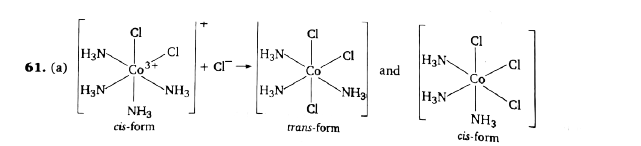
A

Promotional Banner

Topper's Solved these Questions

  • CO-ORDINATION COMPOUNDS

    VK JAISWAL|Exercise ONE OR MORE ANSWERS IS/ARE CORRECT|72 Videos
  • CO-ORDINATION COMPOUNDS

    VK JAISWAL|Exercise MATCH THE COLUMN|36 Videos
  • CHEMICAL BONDING (BASIC)

    VK JAISWAL|Exercise Level 3 (Passive 11)|6 Videos
  • d-BLOCK ELEMENTS

    VK JAISWAL|Exercise SUBJECTIVE PROBLEMS|6 Videos

Similar Questions

Explore conceptually related problems

[CoCl(NH_(3))_(5)]^(2+) is

Statement-1: In the reaction [CoCl_(2)(NH_(3))_(4)]^(+)+Cl^(-) to [CoCl_(3)(NH_(3))_(3)]+NH_(3) , when reactant is in cis-form two isomers of the product are obtained. Statement-2: Third chloride ions replaces an ammonia cis to both chloride ion or trans to one of the chloride ion.

In the reaction [CoCI_(2)(NH_(3))_(4)]^(o+)rarr[CoCI_(3)(NH_(3))_(3)]+NH_(3) , only one isomer of the complex product is obtained Is the initial complex cis or trans ? .

Four statements for the following reaction given below [CoCl_(2)(NH_(3))_(4)]^(+) to [CoCl_(3)(NH_(3))_(3)]+NH_(3) (P) Only one isomer is produced if the ractant complex ion is a trans isomer (Q) Three isomers are produced if the reactant complex ion is a cis isomer (R ) Two isomers are produced if the reactant complex ion is trans isomer (S) Two isomers are produced if the reactant complex is cis isomer The correct statements are :

Consider the following reaction and statements: [Co(NH_(3))_(4)Br_(2)]^(+)+Br^(-) to [Co(NH_(3))_(3)Br_(3)]+NH_(3) Two isomers are produced if the reactant complex ion is a cis-isomer Two isomers are produced if the reactant complex ion is a trans-isomer Only one isomer is produced if the reactant complex ion is a trans-isomer Only one isomer is produced if the reactant complex ion is a cis – isomer The correct statements are

VK JAISWAL-CO-ORDINATION COMPOUNDS-ASSERTION-REASON TYPE QUESTIONS
  1. [CoCl(2)(NH(3))(4)]^(+)+Cl^(-) to [CoCl(3)(NH(3))(3)]+NH(3). If in thi...

    Text Solution

    |

  2. Assertion: In N(2) Molecule, any N-atom can coordinate with central at...

    Text Solution

    |

  3. Assertion: In N(2)H(4), any one N-atom can coordination with central m...

    Text Solution

    |

  4. These questions consist of two statements each, printed as Assertion a...

    Text Solution

    |

  5. Assertion: Acidified [Cu(NH(3))(4)]^(2+) and [Cu(H(2)O)(4)]^(2+) both ...

    Text Solution

    |

  6. Assertion: [Fe(EDTA)]^(-) complex is octahedral in shape. Reason: ED...

    Text Solution

    |

  7. STATEMENT-1: Tetrahedral complexes with chiral structure exhibit optic...

    Text Solution

    |

  8. Assertion: Oxidation state of Fe in Fe(CO)(5) is zero. Reason: Syner...

    Text Solution

    |

  9. Assertion: Zeise's salt is a pi-bonded organometallic compound. Reas...

    Text Solution

    |

  10. Assertion: [ClCl(3)(NH(3))(3)] does not give white precipitate with Ag...

    Text Solution

    |

  11. Assertion: Transition metal ion forming octahedral complexes undergo s...

    Text Solution

    |

  12. Assertion: Complex ion [Co(NH(3))(6)]^(2+) is readily oxidized to [Co(...

    Text Solution

    |

  13. Assertion: Hydrazine is a neutral ligand. Reason: It has two N as do...

    Text Solution

    |

  14. Reason: Complex anion [Re(2)Cl(8)]^(2-) has one delta-bond, one sigma ...

    Text Solution

    |

  15. Assertion: In N(2) Molecule, any N-atom can coordinate with central at...

    Text Solution

    |

  16. Assertion: In N(2)H(4), any one N-atom can coordination with central m...

    Text Solution

    |

  17. Assertion: [Ti(H(2)O)(6)]^(4+) is coloured while [Sc(H(2)O)(6)]^(3+) i...

    Text Solution

    |

  18. Assertion: Acidified [Cu(NH(3))(4)]^(2+) and [Cu(H(2)O)(4)]^(2+) both ...

    Text Solution

    |

  19. Assertion: [Fe(EDTA)]^(-) complex is octahedral in shape. Reason: ED...

    Text Solution

    |

  20. Assertion: Tetrahedral complexes with chiral structure exhibit optical...

    Text Solution

    |

  21. Assertion: Oxidation state of Fe in Fe(CO)(5) is zero. Reason: Syner...

    Text Solution

    |

