Home
Class 12
PHYSICS
Two balls of charges q(1) and q(2) initi...

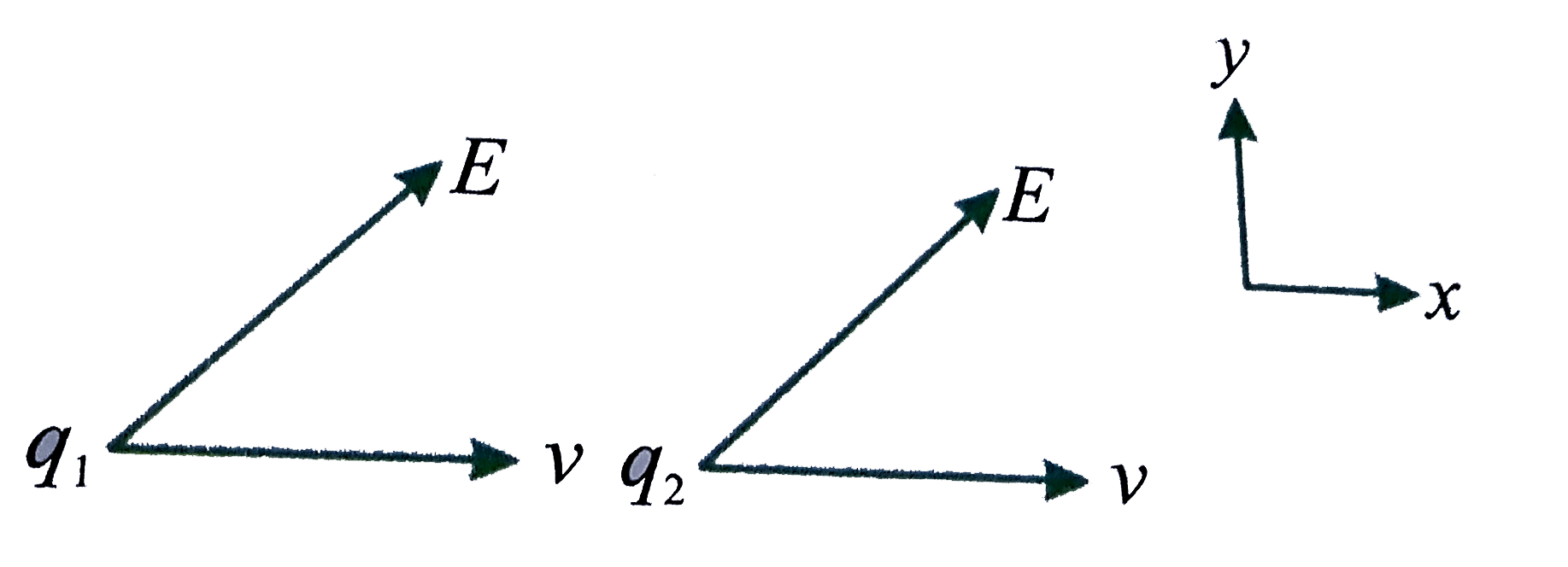
Two balls of charges `q_(1)` and `q_(2)` initially have a velocity of the same magnitude and direction. After a uniform electric field has been applied for a certain time. The direction of the first ball changes by `60^(@)` and the velocity magnitude is reduced by half. The direction of velocity of the second ball changes by `90^(@)`. In what ratio will the velocity of the second ball change? Determine, the magnitude of the charge to mass ratio of the second ball if it is equal to `alpha_(1)` for the first ball. Ignore the electrostatic interaction between the balls.
,

A

`(4alpha)/(3)`

B

`(2alpha)/(3)`

C

`(alpha)/(3)`

D

`alpha`

Text Solution

Verified by Experts

The correct Answer is:
A


Let `vec(E)=E_(x)hat(i)+e_(y)hat(j)`
By impuse-momentum therorem
Impulse =change in momentum
`rArr` Let the final velocity of balls be `v_(1)&v_(2)=(v)/(2)`
`q_(1)[E_(x)hat(i)+E_(y)hat(j)]Deltat=m_(1)((v)/(2)cos60hat(i)+(v)/(2)sin60hat(j))-m_(1)vhat(j)`
`q_(2)[E_(x)hat(i)+E_(y)hat(j)]Deltat`
` =m_(2)(v_(2)cos90hat(i)+v_(2)sin90hat(j))=m_(2)vhat(i)`
`q_(1)E_(x)(Deltat)=-(m_(1)3v)/(4),q_(1)E_(y)Deltat=(m_(1)sqrt(3)v)/(4)`
`q_(2)E_(x)(Deltat)-m_(2)v,q_(2)E_(y)(Deltat)=m_(2)v_(2)`
`rArr (q_(1)ExDeltat)/(q_(2)E_(x)Deltat)=(m_(1))/(m_(2))(3)/(4) rArr (q_(2))/(m_(2))=(4alpha)/(3)`
Promotional Banner

Topper's Solved these Questions

  • ELECTROSTATICS AND GAUSS LAW

    NARAYNA|Exercise Passage I|3 Videos
  • ELECTROSTATICS AND GAUSS LAW

    NARAYNA|Exercise Passage II|3 Videos
  • ELECTROSTATICS AND GAUSS LAW

    NARAYNA|Exercise NCERT based Question|14 Videos
  • ELECTROSTATIC POTENTIAL AND CAPACITANCE

    NARAYNA|Exercise ADDITIONAL PROBLEMS|14 Videos
  • EXPERIMENTAL PHYSICS

    NARAYNA|Exercise Comprehension type|6 Videos

Similar Questions

Explore conceptually related problems

Two balls of charges q_(1) and q_(2) initially have a velocity of the same nagnitude and direction. After a unform electric field has been applied for a certain time. The direction of the first ball changes by 60^(@) and the velocity magnitude is reduced by half. The direction ofvelocity of the second ball changes by 90^(@) . In whata ratio will hte velociyt of the second ball change? Determine, the magnitude of the charge to mass ratio of the ball if it is equal to alpha_(1) for the firt ball. Ignore the electrostatic interactin between the balls. ,

The direction of velocity continuously changes in

A uniform electric field and a uniform magnetic field are acting along the same direction in a certain region. If an electron is projected along the direction of the fields with a certain velocity then

Can the direction of motion of a body change if its velocity is changing at uniform rate ?

A ball is thrown such that the time of flight is 5 s and the horizontal range is 200 m . Find the magnitude and direction of velocity of projection.

Ball 1 collides directly with another identical ball 2 at rest. Velocity of second ball becomes two times that of 1 after collison. Find the coefficient of restitution between the two balls?

How does the velocity of a ball thrown upwards change on its way?

NARAYNA-ELECTROSTATICS AND GAUSS LAW-Level V
  1. The adjoining figure represent a semi-circular loop of charge Q and of...

    Text Solution

    |

  2. A charge q of mass m is projected form a long distance with speed v to...

    Text Solution

    |

  3. Two balls of charges q(1) and q(2) initially have a velocity of the sa...

    Text Solution

    |

  4. In the diagram shown the charge +Q is fixed. Another charge +2q and ma...

    Text Solution

    |

  5. The dipole moment of a system of charge +q distribyted uniformly on a...

    Text Solution

    |

  6. As shown in the figure an electric dipole lies at a distance x from th...

    Text Solution

    |

  7. Two short dipoles phat(k) and P/2 hat(k) are located at (0,0,0) & (1m,...

    Text Solution

    |

  8. A dipole of dipole moment P is kept at the centre of a ring of radius ...

    Text Solution

    |

  9. An electric dipole is placed at the origin O and is directed along the...

    Text Solution

    |

  10. A large sheet carries uniform surface charge density sigma . A rod of ...

    Text Solution

    |

  11. Two infinite line charges each having uniform charges density lamdba ....

    Text Solution

    |

  12. The figure shows an imaginary cube of length L//2 and a uniformly char...

    Text Solution

    |

  13. A ring of radius R is placed in the plane with its centre at origin an...

    Text Solution

    |

  14. A point charge q is placed at a distance d form the center of circular...

    Text Solution

    |

  15. Two point charges q and -q are separated by the distance 2l. Find the...

    Text Solution

    |

  16. a point charge q is placed at the centre of a cylinder of length L and...

    Text Solution

    |

  17. Two charges+q(1) and -q(2) are placed at A and B respectively. A line ...

    Text Solution

    |

  18. The potential inside a charged ball depends only on the distance r of ...

    Text Solution

    |

  19. Two very large thin conducting plates having same cross sectional are...

    Text Solution

    |

  20. Inside a ball charged uniformly with volume density rho there is a sph...

    Text Solution

    |

