Home
Class 12
PHYSICS
Two fixed charges 4Q (positive) and Q (n...

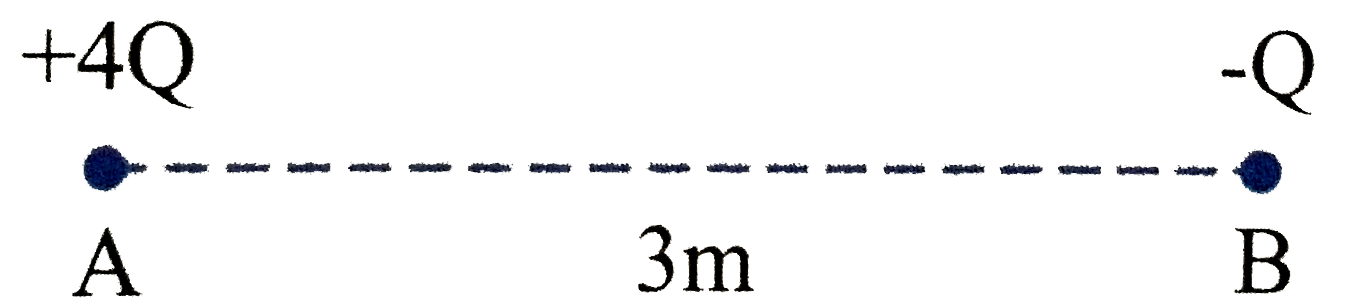
Two fixed charges `4Q` (positive) and `Q` (negative) are located at `A` and `B`the distance `AB` being `3m`

A

The point `P` where the resultant field due to both is zero is on `AB` outside `AB`

B

The point `P` where the resutlant field due to both is zero is on `AB` inside `AB`

C

If a positive charge is placed at `P` and displaced slightly along `AB` it will execute oscillations.

D

If a negative charge is placed at `P` and displaced slightly along `AB` it will execute oscillations.

Text Solution

Verified by Experts

The correct Answer is:

A,D

Use coulomb's law under equilibrium concept
Promotional Banner

Topper's Solved these Questions

  • ELECTROSTATICS AND GAUSS LAW

    NARAYNA|Exercise Passage I|3 Videos
  • ELECTROSTATICS AND GAUSS LAW

    NARAYNA|Exercise Passage II|3 Videos
  • ELECTROSTATICS AND GAUSS LAW

    NARAYNA|Exercise NCERT based Question|14 Videos
  • ELECTROSTATIC POTENTIAL AND CAPACITANCE

    NARAYNA|Exercise ADDITIONAL PROBLEMS|14 Videos
  • EXPERIMENTAL PHYSICS

    NARAYNA|Exercise Comprehension type|6 Videos

Similar Questions

Explore conceptually related problems

Two fixed charges 4 Q (positive ) and q (negative ) are located at A and B , ther distance AB being 3 m . .

Two point charges Q_(1) and Q_(2) are positioned at points I and 2. The field intensity to the right of the charge Q_(2) on the line that passes through the two charges varies according to a law that is represented in the figure. The field intensity is assumed to be positive if its direction coincides with the positive direction on the x-axis. The distance between the charges is l. (a) Find the sign of each charge (b) Find the ratio of the absolute values of the charges |(Q_(1))/(Q_(2))| (c) Find the value of b where the field intensity is maximum [(a) Q_(2) is negative and Q_(1) is positive (b) ((l +a)/(a))^(2) , (c) (l)/(((l+a)/(a))^(2//3)-1)]

Two positive charges q_(1) and q_(2) are located at the points with redius vectors r_(1) and r_(2) . Find a negative charge q_(3) and a radius vector r_(3) of the point at which it has to be placed for the force acting on each of the three charges to be equal to zero.

Two fixed charges -2 Q and Q are locatted at the points with coordinates ( -3 a, 0) and (+3 a, 0) prespectively in the X- Y plane . The expression for the potential V (x) at a general point on the x-axis is given by .

Two fixed, equal, positive charges, each of magnitude 5xx10^-5 coul are located at points A and B separated by a distance of 6m. An equal and opposite charge moves towards them along the line COD, the perpendicular bisector of the line AB. The moving charge, when it reaches the point C at a distance of 4m from O, has a kinetic energy of 4 joules. Calculate the distance of the farthest point D which the negative charge will reach before returning towards C.

Two charges +Q " and " -2Q are located at points A and B on a horizontal line as shown below The electric field is zero at a point which is located at a finite distance

Two fixed charges -2Q and +Q are located at points (-3a,0) and (+3a,0) respectively. Then which of the following statement is correct?

Two negative charges of a unit magnitude and a positive charge q are placed along a straight line. At what position and value of q will the system be in equilibrium? (Negative charges are fixed).

A particle of mass m and charge +q is located midway between two fixed charged particles each having a charge +q and at a distance 2L apart. Assuming that the middle charge moves along the line joining the fixed charges, calculate the frequency of oscillation when it is displaced slightly.

NARAYNA-ELECTROSTATICS AND GAUSS LAW-Level V
  1. A negative point charge placed at the point A is

    Text Solution

    |

  2. Four charges of 1mC,2mC,3mC and -6mC are placed one at each corner of ...

    Text Solution

    |

  3. Two fixed charges 4Q (positive) and Q (negative) are located at A and ...

    Text Solution

    |

  4. Two identical charges +Q are kept fixed some distance apart.A small pa...

    Text Solution

    |

  5. Select the correct statement :(Only force on a particle is due to elec...

    Text Solution

    |

  6. Two point charges Q and - Q //4 are separated by a distance X. Then ...

    Text Solution

    |

  7. Three point charge Q,4Q and 16Q are placed on a straight line 9cm long...

    Text Solution

    |

  8. Two infinite sheets of uniform charge density + sigma and - sigma a...

    Text Solution

    |

  9. If we use permitivity epsilon, resistance R, gravitational constant G ...

    Text Solution

    |

  10. A thin walled spherical conducting shells S of radius R is given charg...

    Text Solution

    |

  11. A hollow closed conductor of irregular shape is given some charge . Wh...

    Text Solution

    |

  12. three points charges are placed at the cornors of an equilibrium trian...

    Text Solution

    |

  13. An electric dipole is placed at the centre of a sphere. Mark the corre...

    Text Solution

    |

  14. An electric field converges at the origin whose magnitude is given by ...

    Text Solution

    |

  15. A conducting sphere A of radius a ,with charge Q , is placed concentri...

    Text Solution

    |

  16. Two thin conducting shells of radii R and 3R are as shown in the fig. ...

    Text Solution

    |

  17. X and Y are large, parallel conducting plates close to each other. Eac...

    Text Solution

    |

  18. A particle of mass m and charge q is thrown in a region where uniform ...

    Text Solution

    |

  19. Two large parallel conducting plates are placed close to each other ,t...

    Text Solution

    |

  20. the electric potential in the region of space is given by :V(x)=A+Bx+C...

    Text Solution

    |
