Home
Class 12
PHYSICS
X and Y are large, parallel conducting p...

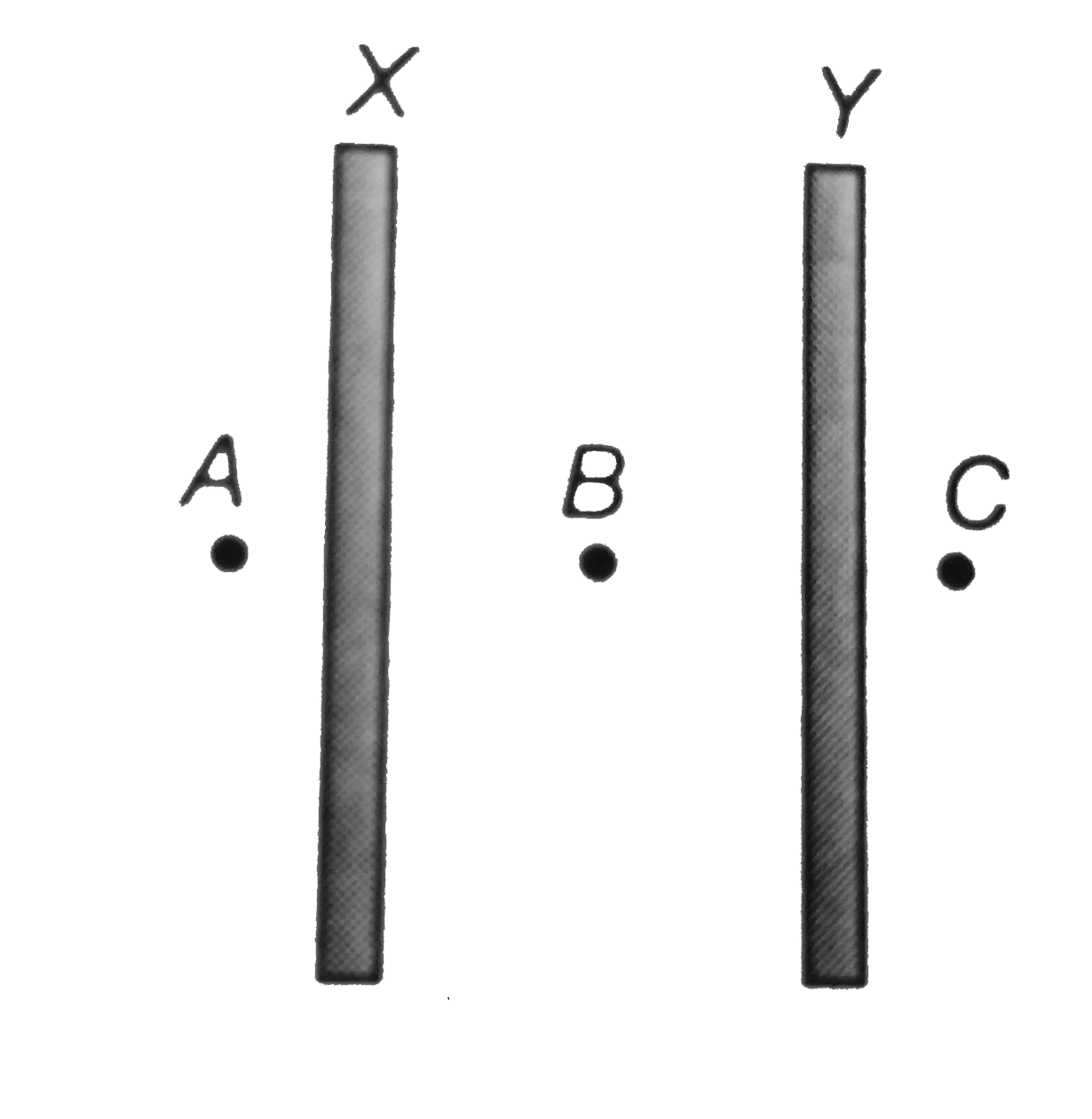
`X` and `Y` are large, parallel conducting plates close to each other. Each face has an area `A`. `X` is given a charge `Q`. `Y` is without any charge. Points `A,B` and `C` are as shown in the figure.

A

The field at `B` is `(Q)/(2epsilon_(0)A)`

B

The field at `B` is `(Q)/(epsilon_(0)A)`

C

The field at `A,B` and `C` are of the same magnitude.

D

The field at `A` and `C` are of the same magnitude but in opposite directions.

Text Solution

Verified by Experts

The correct Answer is:

A,C,D

`E=(sigma )/(2epsilon_(0))=(q)/(2Aepsilon_(0))` at points `A,B,&C`
Promotional Banner

Topper's Solved these Questions

  • ELECTROSTATICS AND GAUSS LAW

    NARAYNA|Exercise Passage I|3 Videos
  • ELECTROSTATICS AND GAUSS LAW

    NARAYNA|Exercise Passage II|3 Videos
  • ELECTROSTATICS AND GAUSS LAW

    NARAYNA|Exercise NCERT based Question|14 Videos
  • ELECTROSTATIC POTENTIAL AND CAPACITANCE

    NARAYNA|Exercise ADDITIONAL PROBLEMS|14 Videos
  • EXPERIMENTAL PHYSICS

    NARAYNA|Exercise Comprehension type|6 Videos

Similar Questions

Explore conceptually related problems

A and B are two large identical thin metal plates placed parallel to each other at a small separation. Plate A is given a charge Q. (i) Find the amount of charge on each of the two faces of A and B. (ii) Another identical plate C having charge 3Q is inserted between plate A and B such that distance of C from B is twice its distance from A. Plate A and B is shorted using a conducting wire. Find charge on all six faces of plates A, B and C. (iii) In the situation described in (ii) the plate A is grounded. Now write the charge on all six faces.

Two large , parallel conducting plates X and Y , kept close to each other , are given Q_(1) and Q_(2) (Q_(1) gt Q_(2)) . The four surfaces of the plates are A,B,C and D , as shown (i) The charge on A is (1)/(2) (Q_(1) + Q_(2)) (ii) The charge on B is (1)/(2) (Q_(1) - Q_(2)) (iii) The charge on C is (1)/(2) (Q_(2) - Q_(1)) (iv) The charge on D is (1)/(2) (Q_(1) + Q_(2))

Two conducting plates A and B are placed parallel to each other. A is given a charge. Q_1 and B a charge Q_2 . Find the distribution of charges on the four surface.

Two large parallel conducting plates are placed close to each other ,the inner surface of the two plates have surface charge densities +sigma and -sigma .The outer surfaces are without charge.The electric field has a magnitude of

There are two metallic plates of a parallel plate capacitor. One plate is given a charge +q while the other is earthed as shown. Points P, P_1 and P_2 are taken as shown in adjoining figure. Then the electric intensity is not zero at :

Two conducting plates X and Y, having large surface area A (on one side), are placed parallel to each other as shown in figure. The plate X is given a charge Q whereas the other is neutral. Find : (a) The surface charge density at the inner surface of the plate X, (b) The electric field at a point to the left of the plates, (c) The electric field at a point in between the plates and (d) The electric field at a point to the right of the plates.

Three large plates A, B and C are placed parallel to each other and charges are given as shown. The charge that appears on the left surface of plate B is

Three large conducting plates with charges Q , -Q and Q are kept close to each other as shown in the figure. ( where Q = 2 uc ). Now all the three plates A, B, and C are connected by a thin conducting wire. Find the charge ( in C) on left surface of plate A at electristatic equailibrium

Two conducting plates A and B are placed parallel to each other. A is given a charge Q_1 and B a charge Q_2 . Prove that the charges on the inner surfaces are of equal magnitude and opposite sign.

NARAYNA-ELECTROSTATICS AND GAUSS LAW-Level V
  1. If we use permitivity epsilon, resistance R, gravitational constant G ...

    Text Solution

    |

  2. A thin walled spherical conducting shells S of radius R is given charg...

    Text Solution

    |

  3. A hollow closed conductor of irregular shape is given some charge . Wh...

    Text Solution

    |

  4. three points charges are placed at the cornors of an equilibrium trian...

    Text Solution

    |

  5. An electric dipole is placed at the centre of a sphere. Mark the corre...

    Text Solution

    |

  6. An electric field converges at the origin whose magnitude is given by ...

    Text Solution

    |

  7. A conducting sphere A of radius a ,with charge Q , is placed concentri...

    Text Solution

    |

  8. Two thin conducting shells of radii R and 3R are as shown in the fig. ...

    Text Solution

    |

  9. X and Y are large, parallel conducting plates close to each other. Eac...

    Text Solution

    |

  10. A particle of mass m and charge q is thrown in a region where uniform ...

    Text Solution

    |

  11. Two large parallel conducting plates are placed close to each other ,t...

    Text Solution

    |

  12. the electric potential in the region of space is given by :V(x)=A+Bx+C...

    Text Solution

    |

  13. A dipole is placed in x-y plane parallel to the line y=2x there exist ...

    Text Solution

    |

  14. A 10 C charge is given to a conducting spherical shell, and a-3 C poin...

    Text Solution

    |

  15. For Gauss 'law mark out the corrrect statement(s)

    Text Solution

    |

  16. Two infinite parallel,non- conducting sheets carry equal positive char...

    Text Solution

    |

  17. Consider two large ,identical paralllel conducting plates having surfa...

    Text Solution

    |

  18. A particle having charge 's' starts from rest in a region where the el...

    Text Solution

    |

  19. Two charge Q(1) and Q(2) are placed at the points A and B having separ...

    Text Solution

    |

  20. In a parallel capacitor the potential difference between the plates is...

    Text Solution

    |
