Home
Class 12
PHYSICS
The sketech below show cross secion so e...

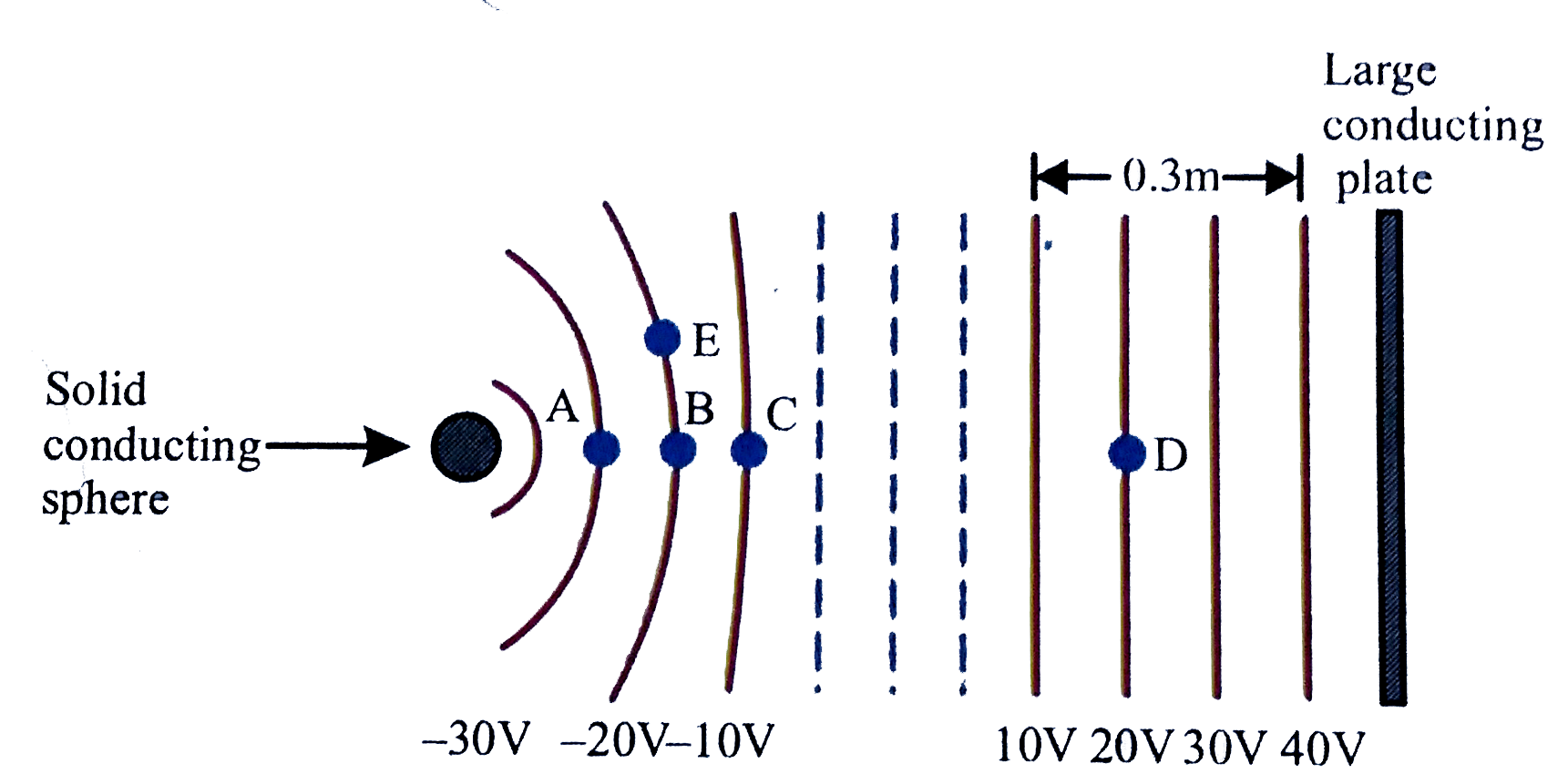
The sketech below show cross secion so equipotential surfaces between two charged.Conductors that are shwon in solid black.Some points on the wquipotenital surfaces .near the conductors are marked as `A,B,C…. .` The arrangements lies in air (Take `epsilon_(0)=8.85xx10^(-12)C^(2)//Nm^(2)]`

A positive charge is placed at `B`,When it is released:

A

no force will be exerted on it .

B

it will move towards `A`

C

it will move towards `C`

D

it will move towards `E`

Text Solution

Verified by Experts

The correct Answer is:

B

Direction of `E.F` at `B`is towards `A` will exert froce in this direction only, causing the positive charge to move .[`vec(E)` is perpendicular to equipotential surface and its direction is form high potential to low potential].
Promotional Banner

Topper's Solved these Questions

  • ELECTROSTATICS AND GAUSS LAW

    NARAYNA|Exercise Passage II|3 Videos
  • ELECTROSTATICS AND GAUSS LAW

    NARAYNA|Exercise Passage III|3 Videos
  • ELECTROSTATICS AND GAUSS LAW

    NARAYNA|Exercise Level V|93 Videos
  • ELECTROSTATIC POTENTIAL AND CAPACITANCE

    NARAYNA|Exercise ADDITIONAL PROBLEMS|14 Videos
  • EXPERIMENTAL PHYSICS

    NARAYNA|Exercise Comprehension type|6 Videos

Similar Questions

Explore conceptually related problems

The sketech below show cross secion so equipotential surfaces between two charged.Conductors that are shwon in solid black.Some points on the wquipotenital surfaces .near the conductors are marked as A,B,C…. . The arrangements lies in air (Take epsilon_(0)=8.85xx10^(-12)C^(2)//Nm^(2)] Surfaces charge density of the plate is equal to

The sketch below shows cross-sections of equipotential surface between two charged conductors that are shown in solid black. Some points one the euquipotential surface near the conductors are marked as A, B, C ………. The arrangement lies in air. ["Take " in_(0)=8.85xx10^(-12) C^(2)//N m^(2)] How much work is required to slowly move a -1 mu C charge from E to D?

The surface density of charge on the surface of a charged conductor in the air is 26.5 muCm^(-2) . The the outward force per unit area of the charged conductor is (epsilon_0=8.85xx10^-12C^2N^-1m^-2)

The surface density of charge on the surface of a charged conductor in air is 0.885 muC//m^(2) . If epsi_(0) =8.85xx10^(-12) C^(2)//N-m^(2) , then the outward force per unit area of the charged conductor is

A point charge of 4.427 mu C is at the centre of a cube Gaussian surface 9.0 cm on the edge. Find the net electric flux through the surface. ( epsilon_0=8.854xx10^(-12)C^2 N^(-1) m^(-2) )

A metal plate of surface area 2m^(2) is charged with sqrt(8.85muC) . What is the mechanical force acting on the plate if it is kept in air ? [ epsi_(0)=8.85xx10^(-12)C^(2) ]

Each plate of a parallel plate condenser has surface area of 5 cm^(2) . The distance between the plates is 2 mm. The dielectric constant of the medium between the plates is 5. Then the capacity of the condenser is (epsi_(0) = 8.85 xx 10^(-12) C^(2)//Nm^(2))

The surface density of charge on a conductor situated in air, is 2xx10^(-4)C//m^(2) . The electric intensity at a point very near to its surface is

A parallel plate capicitaor with plates of area 1m^2 each, are at a separation of 0.1 m. If the electric field between the plates is 100 N//C , the magnitude of charge on each plate is : (Take epsilon=8.85xx10^-12(C^2)/(N-m^2) )
