Home
Class 12
PHYSICS
For a positively charged particle moving...

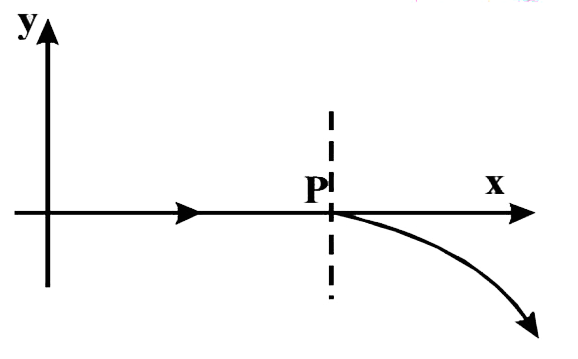
For a positively charged particle moving in a `x-y` plane initially along the `x-axis` , there is a sudden change in its path due to the presence of electric and//or magnetic fields beyond `p` . The curved path is shown in the ` x- y `plane and is found to be non - circular. Which one of the following combinations is possible ?

A

`vec(E)=0,vec(B)=bhat(i)+chat(k)`

B

`vec(E)=ai,vec(B)=chat(k)+ahat(i)`

C

`vec(E)=0,vec(B)=chat(j)+bhat(k)`

D

`vec(E)=ai,vec(B)=chat(k)+bhat(j)`

Text Solution

Verified by Experts

The correct Answer is:

2

Electric field can deviate the path of the particle in the shown direction only when it is along negaive `y-` direction . In the given options `vec(E)` is either zero or along `x-` direction. Hence it is magnetic field which is really responsible for its curved path. Options `(a)` and `(c )` can't be accepted as the path will be helix in that case `(` when the velocity vector makes an angle other than `0^(@),180^(@) or 90^(@)` with the magnetic field, path is a helix `)` option `(d)` is wrong because in that case component of net force on the particle also comes in `k` deirection which is not acceptable as the particle is moving in `x-y` plane. Only in option `(b)` the particle can move in `x-y` plane.
In option `(d) : vec(F)_(n et)qvec(E)+q(vec(v)xxvec(B))`
Initial velocity is along `x-` direction. So let
`vec(v)=vhat(i),vec(F)_(n et)=qahat(i)+q[(vhat(i))xx(chat(k)+bhat(j))]`
`=qahat(i)-qvchat(j)=qvbhat(k)`
In option `(b)`
`vec(F)_(n et)=q(ahat(i))+q[(vhat(i))xx(chat(k)+ahat(i))=qahat(i)-qvchat(j)`
Promotional Banner

Topper's Solved these Questions

  • MOVING CHARGES AND MAGNETISM

    NARAYNA|Exercise NCERT Based Questions|20 Videos
  • MOVING CHARGES AND MAGNETISM

    NARAYNA|Exercise LEVEL-V (SINGLE ANSWER QUESTION)|85 Videos
  • MOVING CHARGES AND MAGNETISM

    NARAYNA|Exercise Level-II(C.W)|63 Videos
  • MAGNETISM AND MATTER

    NARAYNA|Exercise EXERCISE - 4 (SINGLE ANSWER TYPE QUESTION)|17 Videos
  • NUCLEAR PHYSICS

    NARAYNA|Exercise LEVEL-II-(H.W)|9 Videos

Similar Questions

Explore conceptually related problems

A positively charge particle moving along x -axis with a certain velocity enters a uniform electric field directed along positively y-axis. Its

A charged particle moves along a circle under the action of possible constant electric and magnetic fields. Which of the following are possible?

x and y co-ordinates of a particle moving in x-y plane at some instant of time are x=2t and y=4t .Here x and y are in metre and t in second. Then The path of the particle is a…….

A charged particle moves along a circle under the action of passible constant electric and magnetic fields. Which of the following are possible?

An electrons is moving along +ve x -axis in the presence of uniform magnetic field along +ve y -axis. What is the direction of the force acting on it?

A particle of mass m and positive charge q is projected with a speed of v_0 in y–direction in the presence of electric and magnetic field are in x–direction. Find the instant of time at which the speed of particle becomes double the initial speed.

A particle moves in the the x-y Plane according to the scheme x-8 sin pit , where t is time. Find equation to the path of the particle. Show the path on a graph.

A point mass is moving in the x-y plane. Its acceleration is a constant vector perpendicular to the x-axis. Which of the following do/does not charge with time ?

A positively charged particle, having charge q, is accelerated by a potential difference V. This particle moving along the x-axis enters a region where an electric field E exists. The direction of the electric field is along positive y-axis. The electric field exists in the region bounded by the lines x=0 and x=a. Beyond the line x=a (i.e., in the region xgta ), there exists a magnetic field of strength B, directed along the positive y-axis. Find a. at which point does the particle meet the line x=a . b. the pitch of the helix formed after the particle enters the region xgea. (Mass of the particle is m.)

NARAYNA-MOVING CHARGES AND MAGNETISM-LEVEL-III
  1. A particle of mass mand charge q, moving with velocity v enters Region...

    Text Solution

    |

  2. A proton accelerated by a potential difference 500 KV moves though a ...

    Text Solution

    |

  3. Two identical charged particles enter a uniform magnetic field with sa...

    Text Solution

    |

  4. An electron whose e//m is 1.76X10^(11)c//kg enter a region 2X10^(-3) t...

    Text Solution

    |

  5. Two charged particles traverse identical helical paths in a completely...

    Text Solution

    |

  6. For a positively charged particle moving in a x-y plane initially alon...

    Text Solution

    |

  7. A metallic block carrying current I is subjected to a uniform magneti...

    Text Solution

    |

  8. Two parallel beams of protons and electrons, carrying equal currents a...

    Text Solution

    |

  9. Three very long straight conductors are arranged parallel to each othe...

    Text Solution

    |

  10. Two long wires are placed parallel to each other 10cm apart as shown i...

    Text Solution

    |

  11. Two long parallel wires are at a distance 2d apart. They carry stead...

    Text Solution

    |

  12. A circular loop of radius R=20 cm is placed in a uniform magnetic fiel...

    Text Solution

    |

  13. A non conducting disc of radius R, charge q is rotating about an axis ...

    Text Solution

    |

  14. A galvanometer of resistance 5 Omega is connected in series with a re...

    Text Solution

    |

  15. A thin wire of length L is made of an insulating material. The wire is...

    Text Solution

    |

  16. A rigid circular loop of radius r & mass m lies in the xy plane on a f...

    Text Solution

    |

  17. A hollow sphere has charge 'q' which is uniformly distributed over its...

    Text Solution

    |

  18. A loop carrying current I lies in the x-y plane as shown in the figu...

    Text Solution

    |

  19. Electric field strength bar(E)=E(0)hat(i) and magnetic induction bar(B...

    Text Solution

    |

  20. A long current carrying wire, carrying current such that it is flowing...

    Text Solution

    |
