Home
Class 12
PHYSICS
If i(1) = i(0) sin (omega t), i(2) = i(0...

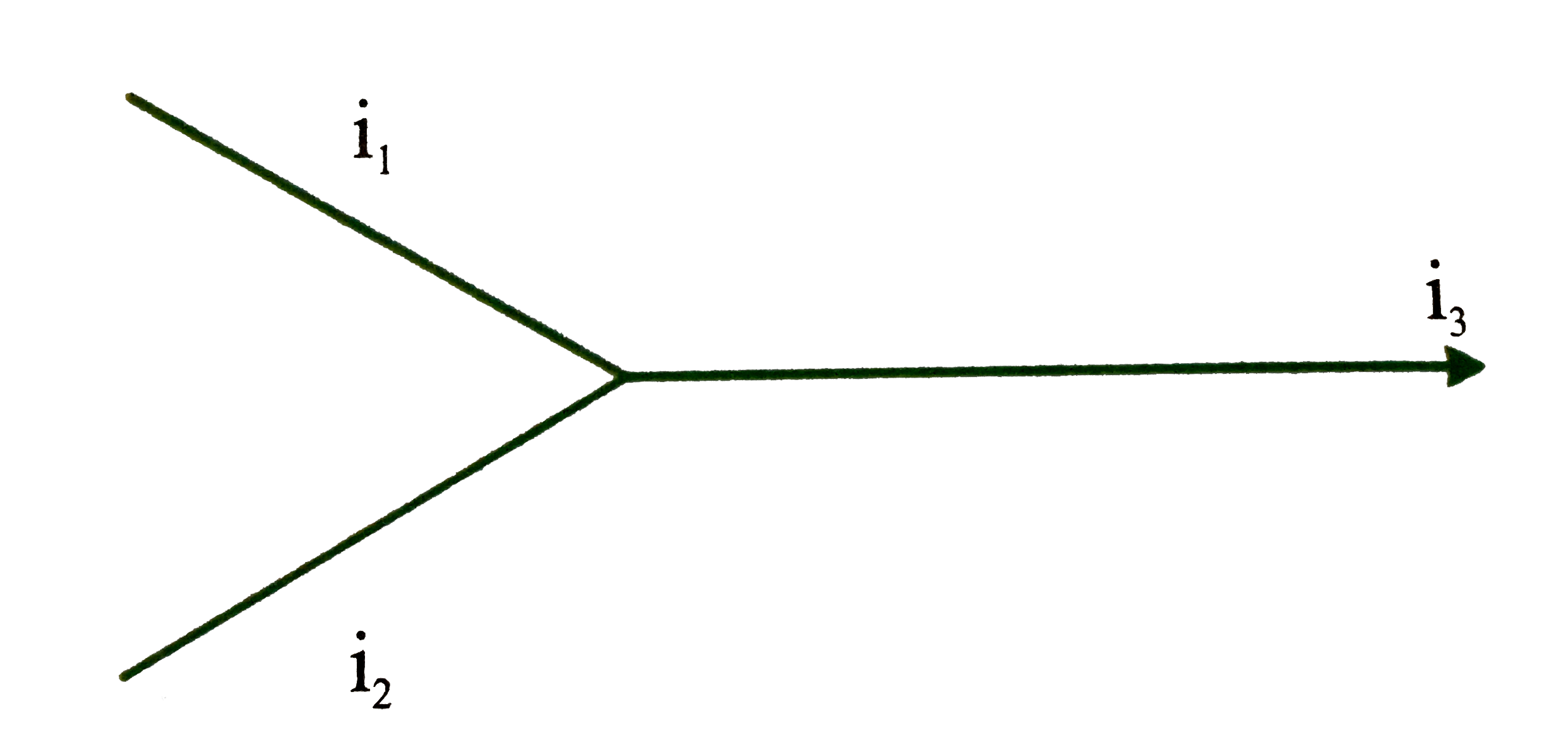
If `i_(1) = i_(0) sin (omega t), i_(2) = i_(0_(2)) sin (omega t + phi)`, then `i_(3) =`

A

`sqrt(i_(0_(1))^(2) + i_(0_(2))^(2)) sin {phi + omega t}`

B

`(i_(0_(1)) + i_(0_(2))) sin ((phi)/(2) + omega t)`

C

`(sqrt(i_(0_(1))^(2) + i_(0_(2))^(2) + 2i_(0_(1)) i_(0_(2)) cos phi)) sin [phi + omega t]`

D

`(sqrt(i_(0_(1))^(2) + i_(0_(2))^(2) + 2i_(0_(1)) i_(0_(2)) cos phi)) sin [alpha + omega t]` where `alpha=Tan^(-1) [(i_(0_(2)) sin phi)/(i_(0_(1))+i_(0_(2)) cos phi)]`

Text Solution

Verified by Experts

The correct Answer is:

D

Apply principle of superposition
Promotional Banner

Topper's Solved these Questions

  • ALTERNATING CURRENT

    NARAYNA|Exercise LEVEL - VI|120 Videos
  • ALTERNATING CURRENT

    NARAYNA|Exercise LEVEL - I (H.W)|23 Videos
  • ALTERNATING CURRENT

    NARAYNA|Exercise LEVEL - IV NCERT Based Questions|15 Videos
  • ATOMIC PHYSICS

    NARAYNA|Exercise LEVEL-II (H.W)|14 Videos

Similar Questions

Explore conceptually related problems

The maximum values of the phasors (currents and voltage) in AC circuits can be treated as vectors rotating with an angular frequency equal to the angular frequency of the rotor of the generator. If the phase difference between two phasors vec(A_(1)) and vec(A_(2)) is phi the resultant phasor is : A = sqrt(A_(1)^(2) + A_(2)^(2) + 2A_(1)A_(2) cos phi) and the phase of vec(A) with respects to A_(1) is beta = "tan"^(-1) (A_(2) sin phi)/(A_(1) + A_(2) cos phi) RHS value The rms value of y = f (t) is y_("rms") = {(int_(0)^(T) [f(t)]^(2) dt)/(T)}^((1)/(2)) Average value The average value of y = f (t) is y_(av) = (int_(0)^(T) ydt)/(T) Using the above concept, answer the following questions. The current i_(1) and i_(2) in A.C circuit are given as: i_(1) = 4 sin (omega t - (pi)/(3)) and i_(2) = 4 sin (omega t + (pi)/(3)) The current i_(3) can be given as :

If i_(1) = 3 sin omega t and i_(2) =6 cos omega t , then i_(3) is

If i_(1)=3 sin omega t and (i_2) = 4 cos omega t, then (i_3) is

Two SHM's are represented by y_(1) = A sin (omega t+ phi), y_(2) = (A)/(2) [sin omega t + sqrt3 cos omega t] . Find ratio of their amplitudes.

Four sound sources produce the following four waves (i) y_(1)=a sin (omega t+phi_(1)) (ii) y_(2)=a sin 2 omega t (iii) y_(3)= a' sin (omega t+phi_(2)) (iv) y_(4)=a' sin (3 omega t+phi) Superposition of which two waves gives rise to interference?

NARAYNA-ALTERNATING CURRENT-LEVEL - V
  1. An alternating voltage V = 100 sin omega t is applied across an LCR ci...

    Text Solution

    |

  2. The rms and the average value of the voltage wave shown in figure are

    Text Solution

    |

  3. If i(1) = i(0) sin (omega t), i(2) = i(0(2)) sin (omega t + phi), then...

    Text Solution

    |

  4. The average and effective values for the waveshaphe shown in figure ar...

    Text Solution

    |

  5. Calculate the reading which will be given by a hot-wire voltmeter if i...

    Text Solution

    |

  6. An alternating current I in an inductance coil varies with time t acco...

    Text Solution

    |

  7. Find the rms and average value of the wavefrom shown in figure

    Text Solution

    |

  8. Determine the rms value of a semi-circular current wave which has a ma...

    Text Solution

    |

  9. An electric bulb is designed to operate at 12 volts DC. If this bulb ...

    Text Solution

    |

  10. The current in a discharging LR circuit is given by I = i0 e^(-t/tau) ...

    Text Solution

    |

  11. The figure represents the voltage applied across a pure inductor. The ...

    Text Solution

    |

  12. A constant voltage at different frequencies is applied across a capaci...

    Text Solution

    |

  13. The resonance point in X(L) - f and X(C ) - f curves is

    Text Solution

    |

  14. When 100 V DC is applied across a solenoid, a current of 1.0 A flows i...

    Text Solution

    |

  15. A coil having an inductance of 1//pi henry is connected in series with...

    Text Solution

    |

  16. In a circuit containing an inductance of zero resistance, the current ...

    Text Solution

    |

  17. In RLC circuit, at a frequency v, the potential difference across each...

    Text Solution

    |

  18. The natural frequency of the circuit shown in the figure is

    Text Solution

    |

  19. If the phase difference between voltage and current is pi//6 and the r...

    Text Solution

    |

  20. In the circuit as shown in the figure, if value of R = 60 Omega, then ...

    Text Solution

    |
