Home
Class 12
PHYSICS
In figure i(1) = 10 e^(-2t) A, i(2) = 4 ...

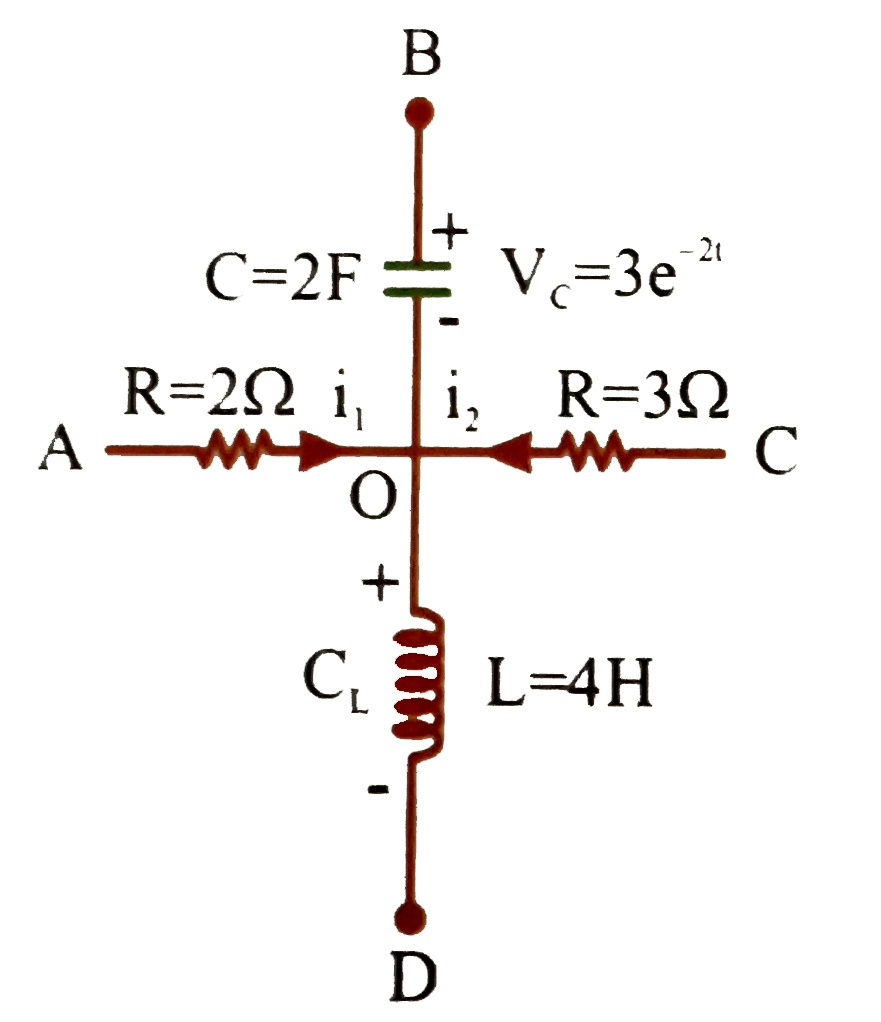
In figure `i_(1) = 10 e^(-2t) A, i_(2) = 4 A, v_(C ) = 3 e^(-2t) V`

The current `i_(L)` is

A

`[2 - 2 (1 - e^(-2t))]A`

B

`[2 + 2 (1 - e^(-2t))]A`

C

`[3 - 2 (1 - e^(-2t))]A`

D

`[2 + 3 (1 - e^(-2t))]A`

Text Solution

Verified by Experts

The correct Answer is:

B

In current in the capacitor,
`q = CV_(C ) = (2) (3 e^(-2t)) = 6 e^(-2t) A`
Current, `i_(c ) = (dq)/(dt) = - 12 e^(-2t) A`
Current flows from `B` to `O`.
From `KVL`, we have `i_(L) = i_(1) + i_(2) + i_(c )`
`10 e^(-2t) + 4 - 12 e^(-2t) = (4 - 2 e^(-2t)) A`
`= [2 + 2 (1 - e^(-2t))] A`
Promotional Banner

Topper's Solved these Questions

  • ALTERNATING CURRENT

    NARAYNA|Exercise LEVEL - VI|120 Videos
  • ALTERNATING CURRENT

    NARAYNA|Exercise LEVEL - I (H.W)|23 Videos
  • ALTERNATING CURRENT

    NARAYNA|Exercise LEVEL - IV NCERT Based Questions|15 Videos
  • ATOMIC PHYSICS

    NARAYNA|Exercise LEVEL-II (H.W)|14 Videos

Similar Questions

Explore conceptually related problems

In figure i_(1) = 10 e^(-2t) A, i_(2) = 4 A, v_(C ) = 3 e^(-2t) V The variaton of current in the inductor with time can be repesented as :

In figure i_(1) = 10 e^(-2t) A, i_(2) = 4 A, v_(C ) = 3 e^(-2t) V The potential difference across inductor V_(L) is :

In figure i_(1) = 10 e^(-2t) A, i_(2) = 4 A, v_(C ) = 3 e^(-2t) V The potential difference across AB (V_(AB)) is:

In figure i_(1) = 10 e^(-2t) A, i_(2) = 4 A, v_(C ) = 3 e^(-2t) V The variation of potential difference acorss A and C with time can be represented as

In the figure shown, i_(1)=10e^(2t)A , i_(2)=4A and V_(c)=3e^(-2t)V Determine (a) i_(L) and V_(L) (b) V_(ac) , V_(ab) and V_(cd)

In the circuit shown below E_(1) = 4.0 V, R_(1) = 2 Omega, E_(2) = 6.0 V, R_(2) = 4 Omega and R_(3) = 2 Omega . The current I_(1) is

In the Figure shown i_1=10e^(-2t) A, i_2=4A and V_C=3e^(-2t)V . Determine a. i_L and V_L b. V_(ac), V_(ab), V_(cd)

NARAYNA-ALTERNATING CURRENT-LEVEL - V
  1. A lamp consumes only 50% of peak power in an a.c. circuit. What is the...

    Text Solution

    |

  2. Voltage and current for a circuit with two elements in series are expr...

    Text Solution

    |

  3. When an ac source of emfe=E(0) sin (100 t) is connected across a circu...

    Text Solution

    |

  4. The figure shows variation of R,X(L) and X(C) with frequency f in a se...

    Text Solution

    |

  5. Which of the following plots may represent the reactance of a series L...

    Text Solution

    |

  6. An inductor-coil , a capacitor and an AC source of rms voltage 24 V ar...

    Text Solution

    |

  7. A circuit consisting of a capacitor and a coil in series is connected ...

    Text Solution

    |

  8. An AC source producing emf epsilon = epsilon0 [cos(100 pi s^(-1)) t ...

    Text Solution

    |

  9. In the circuit shown in figureure the AC source gives a voltage V=20co...

    Text Solution

    |

  10. In figure i(1) = 10 e^(-2t) A, i(2) = 4 A, v(C ) = 3 e^(-2t) V Th...

    Text Solution

    |

  11. In figure i(1) = 10 e^(-2t) A, i(2) = 4 A, v(C ) = 3 e^(-2t) V Th...

    Text Solution

    |

  12. In figure i(1) = 10 e^(-2t) A, i(2) = 4 A, v(C ) = 3 e^(-2t) V Th...

    Text Solution

    |

  13. In figure i(1) = 10 e^(-2t) A, i(2) = 4 A, v(C ) = 3 e^(-2t) V Th...

    Text Solution

    |

  14. In figure i(1) = 10 e^(-2t) A, i(2) = 4 A, v(C ) = 3 e^(-2t) V Th...

    Text Solution

    |

  15. In figure i(1) = 10 e^(-2t) A, i(2) = 4 A, v(C ) = 3 e^(-2t) V Th...

    Text Solution

    |

  16. An ac generator G with an adjustable frequency of oscillation is used ...

    Text Solution

    |

  17. An ac generator G with an adjustable frequency of oscillation is used ...

    Text Solution

    |

  18. An ac generator G with an adjustable frequency of oscillation is used ...

    Text Solution

    |

  19. An ac generator G with an adjustable frequency of oscillation is used ...

    Text Solution

    |

  20. An ac generator G with an adjustable frequency of oscillation is used ...

    Text Solution

    |
