Text Solution
Verified by Experts



Topper's Solved these Questions
HALOALKANES AND HALOARENES
PRADEEP|Exercise ADDITIONAL QUESTIONS (SHORT ANSWER QUESTIONS)|47 VideosHALOALKANES AND HALOARENES
PRADEEP|Exercise ADDITIONAL QUESTIONS (LONG ANSWER QUESTIONS)|4 VideosHALOALKANES AND HALOARENES
PRADEEP|Exercise NCERT EXEMPLAR PROBLEMS WITH ANSWERS, HINTS AND SOLUTIONS (LONG ANSWER QUESTIONS)|3 VideosGENERAL PRINCIPLES AND PROCESSES OF ISOLATION OF ELEMENTS
PRADEEP|Exercise Curiosity Questions|2 VideosORGANIC COMPOUNDS CONTAINING NITROGEN
PRADEEP|Exercise IMPORTANT QUESTIONS FOR BOARD EXAMINATION|27 Videos
Similar Questions
Explore conceptually related problems
PRADEEP-HALOALKANES AND HALOARENES-ADDITIONAL QUESTIONS (VERY SHORT ANSWER QUESTIONS)
- In the pair, (CH(3))(3)C Cl and CH(3)Cl, CH(3)Cl will react faster in ...
Text Solution
|
- Which one undergoes S(N)2 substitution reaction faster and why?
Text Solution
|
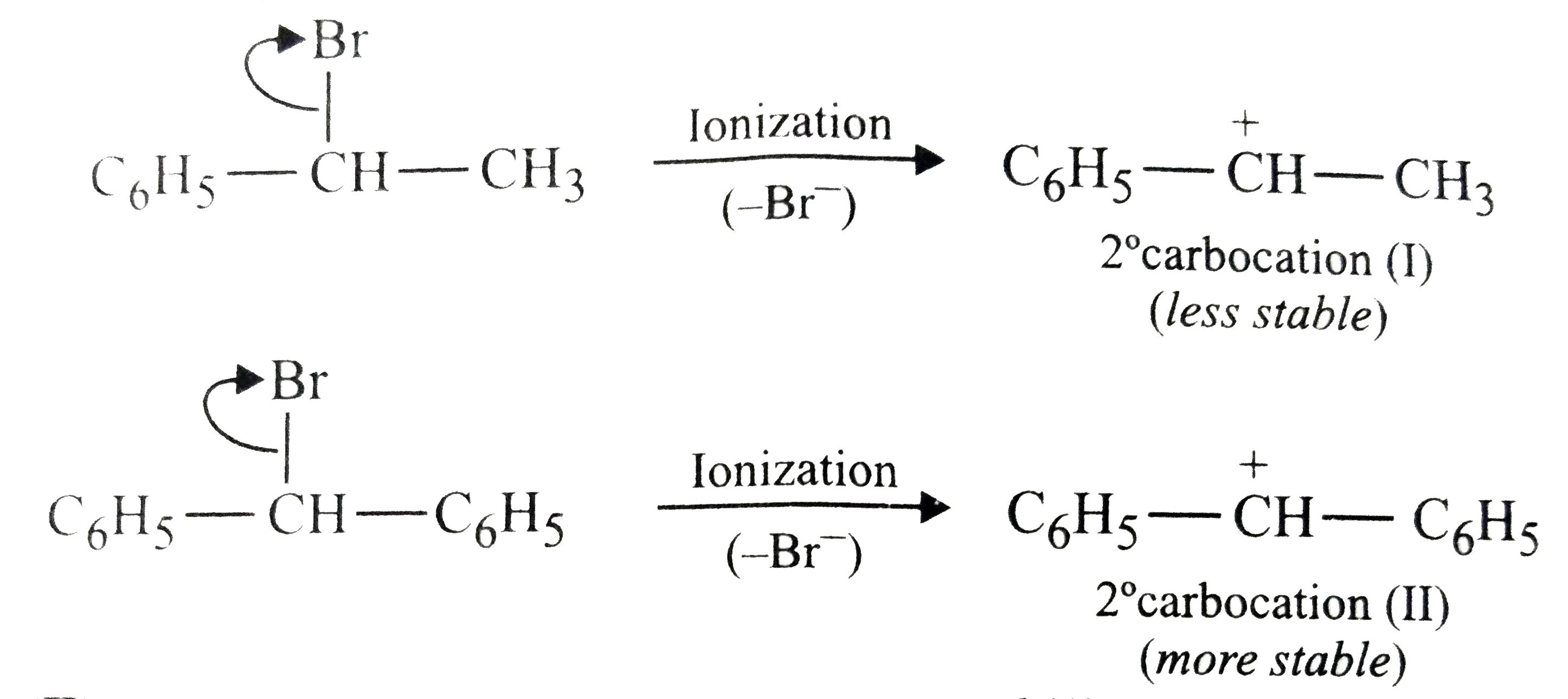
- Out of two bromoderivatives C(6)H(5)CH(CH(3))Br and C(6)H(5)CH(C(6)H...
Text Solution
|
- Which compound in each of the following pairs will react faster by S(N...
Text Solution
|
- What is the reagent used for dehydrohalogenation of an alkyl halide?
Text Solution
|
- Write a chemical reaction to illustrate Saytzeff's rule.
Text Solution
|
- How do you convert: 2-Bromobutane to but-2-ene?
Text Solution
|
- Name the alkyl halide which can be used to prepare methane and ethane ...
Text Solution
|
- What is meant by plane polarized light ? What type of waves show this ...
Text Solution
|
- What is an asymmetric or chiral carbon?
Text Solution
|
- What is the condition to be satisfied for a compound to be chiral?
Text Solution
|
- What type of isomerism is shown by lactic acid.
Text Solution
|
- What do prefixes (+),(-) and (+-) before an organic compound mean?
Text Solution
|
- What is a racemic mixture? Give an example
Text Solution
|
- S(N)1 reactions are accompanied by racemization in optically active ha...
Text Solution
|
- What is the lowest molecular mass alkane that is chiral? Is there anot...
Text Solution
|
- An acid of molecular formula, C(5)H(10)O(2) is optically active. What ...
Text Solution
|
- A carboxylic acid of the formula, C(3)H(5)O(2)Br is optically active. ...
Text Solution
|
- Give the structure of lowest molecular mass alcohol which is chiral?
Text Solution
|
- C(C(6)H(12)), and optically active dydrocarbon which on catalytic hydr...
Text Solution
|