A
B
C
D
Text Solution
Verified by Experts
The correct Answer is:
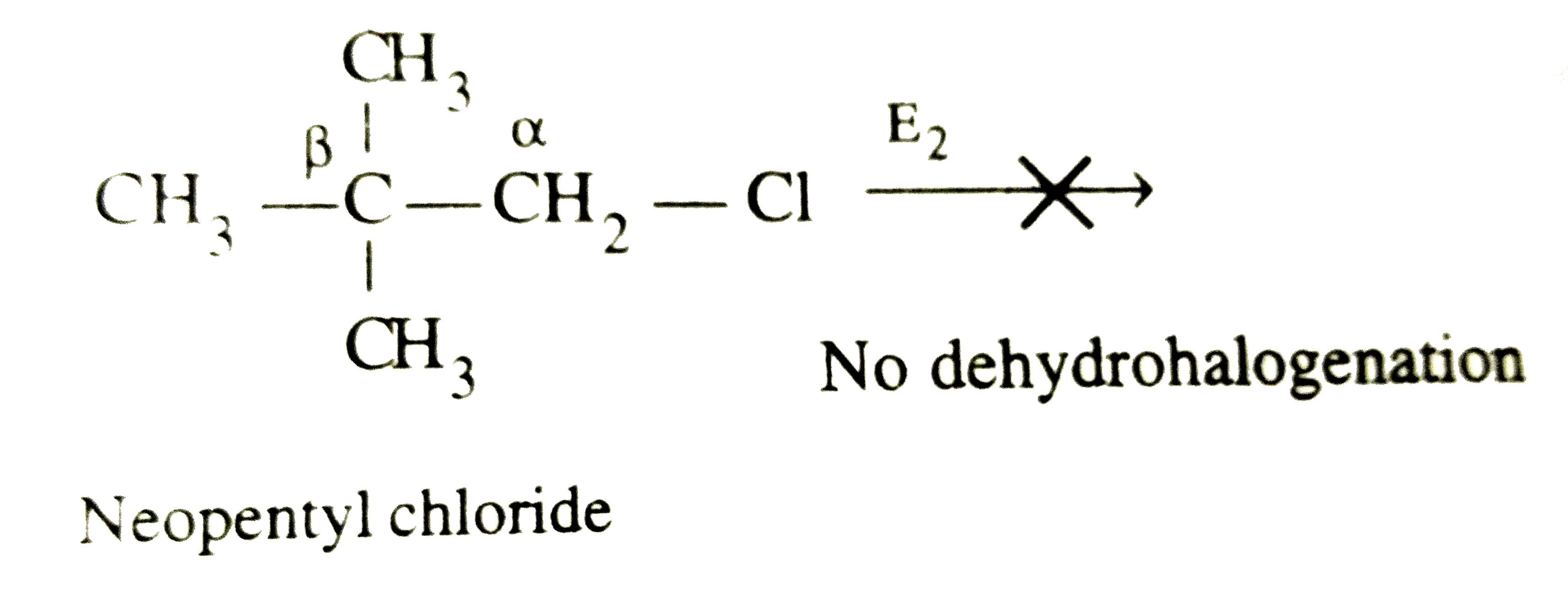



Topper's Solved these Questions
HALOALKANES AND HALOARENES
PRADEEP|Exercise Competition Focus (JEE (MAIN AND ADVANCED)/MEDICAL ENTRANCE SPECIAL (MULTIPLE CHOICE QUESTIONS-II))|8 VideosHALOALKANES AND HALOARENES
PRADEEP|Exercise Competition Focus (JEE (MAIN AND ADVANCED)/MEDICAL ENTRANCE SPECIAL (MULTIPLE CHOICE QUESTIONS-III COMPREHENSION TYPE ))|7 VideosHALOALKANES AND HALOARENES
PRADEEP|Exercise VALUE BASED QUESTIONS WITH ANSWERS|4 VideosGENERAL PRINCIPLES AND PROCESSES OF ISOLATION OF ELEMENTS
PRADEEP|Exercise Curiosity Questions|2 VideosORGANIC COMPOUNDS CONTAINING NITROGEN
PRADEEP|Exercise IMPORTANT QUESTIONS FOR BOARD EXAMINATION|27 Videos
Similar Questions
Explore conceptually related problems
PRADEEP-HALOALKANES AND HALOARENES-Competition Focus (JEE (MAIN AND ADVANCED)/MEDICAL ENTRANCE SPECIAL (MULTIPLE CHOICE QUESTIONS - I))
- Identify the set of reagents/ reaction condition ‘X’ and ‘Y’ in the fo...
Text Solution
|
- The ease of dehydrohalogenation of alkyl halide with alcoholic KOH is-
Text Solution
|
- Which of the following organohalogen compound when heated with alcohol...
Text Solution
|
- For the following reaction : (A) CH(3)CH(2)CH(2)Br+KOH to CH(3)CH=CH...
Text Solution
|
- The major product formed in the reaction is: CH(3)-underset(H)unders...
Text Solution
|
- underset(("major"))(B) underset(CH(3)CH(2)OH)overset(CH(3)CH(2)O^(-)Na...
Text Solution
|
- 2-chloro-2-methylpentane on reaction with sodium methoxide in methanol...
Text Solution
|
- The major product obtained on treatment of CH(3)CH(2)CH(F) CH(3) " wit...
Text Solution
|
- An alkyl chloride produces a single alkene when it reacts with sodium ...
Text Solution
|
- In the following reaction, C(6)H(5)CH(2)Br underset((ii)H(3)O^(+))ov...
Text Solution
|
- (CH(3))(3)CMgBr on reaction with D(2)O produces :
Text Solution
|
- The products expected to be formed in the Wurtz reaction of a mixture ...
Text Solution
|
- Cycloalkane formed when 1,4-dibromopentane is heated with sodium is:
Text Solution
|
- 1-bromo-3-chlorocyclobutane when treated with two equivalents of Na, i...
Text Solution
|
- Two possible stereo-structures of CH(3)CHOHCOOH, which are optically a...
Text Solution
|
- Which of the following compounds is chiral? .
Text Solution
|
- How many chiral compounds are possible on mono chlorination of 2-methy...
Text Solution
|
- Out of the following the alkene that exhibits optical isomerism is
Text Solution
|
- The total number of optical isomers possible for 2,3-dibrom https://d1...
Text Solution
|
- How many stereoisomerse does this molecule has? CH(3)CH=CHCH(2)CHBrC...
Text Solution
|