Home
Class 12
CHEMISTRY
Define the following as related to prote...

Define the following as related to proteins :
(i) Peptide linkage
(ii) Primary structure
(iii) Denaturation

Text Solution

Verified by Experts
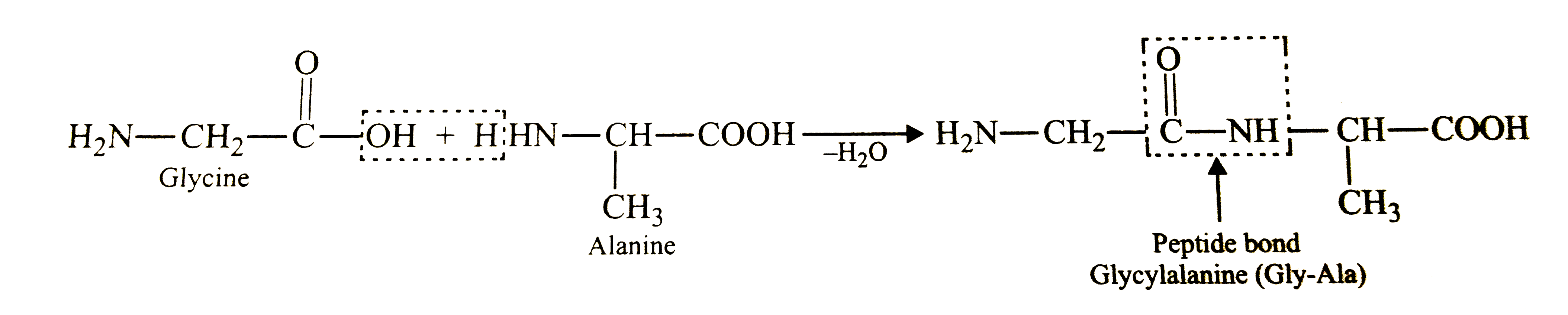
(i) Peptide bond. Proteins are condensation polymers of `alpha`-amino acids in which the same or different `alpha`-amino acids are connected by peptide bonds. Chemically, a peptide bond is an amide linkage formed between `-COOH` group of one `alpha`-amino acid and `-NH(2)` group of the other `alpha`-amino acid by loss of a molecule of water. For example,

(ii) Primary strcuture : Proteins may contain one or more polypeptide chains. Each polypeptide chain has a large number of `alpha` - amino acids which are linked to one another in a specific sequence. The specific sequencein which the various `alpha` -amino acids present in a protein are linked to one another is called is primary structure. Any change in the sequence of `alpha`-amino acids creates a different protein. The gerneral primary structure of a protein is given.
(iii) Denaturation : Each proteins in the biological system has a unique three - dimensional structure and has specific biological activity. This is called native form of a protein. When a protein in its native form is subjected to physical changes in temperature, p H etc .hydrogen bonds are broken. Due to cleavage of hydrogen bonds, unfolding of protein molecule occurs and the protein loses its biological activity. This loss of biological activity is called denaturation. As a result of denaturation, globular proteins (soluble in `H_2O`) are converted into fibrous proteins (insoluble in `H_2O`). In other words , denaturation leads to coagulation. That is why coagulated proteins are also called denatureated proteins.
The most common example of denaturation of proteins is the coagulation of albumin present in the while of an egg. When the egg is boiled hard , the soluble globular protein present in it is denatured and is converted into insoluble fibrous protein. Another example is curding of milk which is caused due to formation of lactic acid by bacteria present in milk.
Promotional Banner

Topper's Solved these Questions

  • BIOMOLECULES

    PRADEEP|Exercise NCERT (EXEMPLAR PROBLEMS) (With answers, Hints And Solution) (Multiple Choice Questions-I )|19 Videos
  • BIOMOLECULES

    PRADEEP|Exercise NCERT (EXEMPLAR PROBLEMS) (With answers, Hints And Solution) (Multiple Choice Questions-II )|9 Videos
  • BIOMOLECULES

    PRADEEP|Exercise NCERT (QUESTIONS AND EXERCISES) WITH ANSWERS (NCERT INTEXT UNSOLVED QUESTIONS)|8 Videos
  • APPENDIX

    PRADEEP|Exercise MODEL TEST PAPER <br> (Section C )|15 Videos
  • CHEMICAL KINETICS

    PRADEEP|Exercise ADVANCED PROBLEMS FOR COMPETITIONS|14 Videos

Similar Questions

Explore conceptually related problems

Define the following as related to proteins. (i) peptide linkage (ii) Denaturation.

Define the following term in relation to proteins : (i) Peptide bond (ii) Denaturation of proteins.

Describe the following (i) Glycosidic linkage (ii) Peptide linkage.

Define a 'Peptide linkage'.

What is meant by (i) peptide linkage (ii) biocatalysts

PRADEEP-BIOMOLECULES -NCERT (EXERCISES)
  1. What is glycogen? How is it different from starch?

    Text Solution

    |

  2. What are the hydrolysis products of (i) sucrose and (ii) lactose?

    Text Solution

    |

  3. What is the basic structural difference between starch and cellulose?

    Text Solution

    |

  4. What happenes when D-glucose is treated with the following reagents? ...

    Text Solution

    |

  5. Enumerate the reactions of D-Glucose which cannot be explained by its ...

    Text Solution

    |

  6. What are essential and non-essential amino acids ? Give two examples o...

    Text Solution

    |

  7. Define the following as related to proteins : (i) Peptide linkage ...

    Text Solution

    |

  8. What are the common types of secondary structures fo proteins?

    Text Solution

    |

  9. What type of bonding helps in stabilising the alpha-helix structure of...

    Text Solution

    |

  10. Differentiate between globular and fibrous proteins.

    Text Solution

    |

  11. How do you explain the amphoteric behaviour of amino acids ?

    Text Solution

    |

  12. What are enzymes ?

    Text Solution

    |

  13. What is the effect of denaturation on the structure of proteins?

    Text Solution

    |

  14. How are vitamins classified? Name the vitamin responsible for the coag...

    Text Solution

    |

  15. Why are vitamin A and vitamin C essential for us? Give their important...

    Text Solution

    |

  16. What are nucleic acids ? Mention their two important functions.

    Text Solution

    |

  17. What is the difference between a nucleoside and a nucleotide?

    Text Solution

    |

  18. The two strands in DNA are not identical but are complementary. Explai...

    Text Solution

    |

  19. Write the important structral and functional differences between DNA a...

    Text Solution

    |

  20. What are the different types of RNA found in the cell?

    Text Solution

    |

