Home
Class 11
PHYSICS
A small spherical monoatomic ideal gas b...

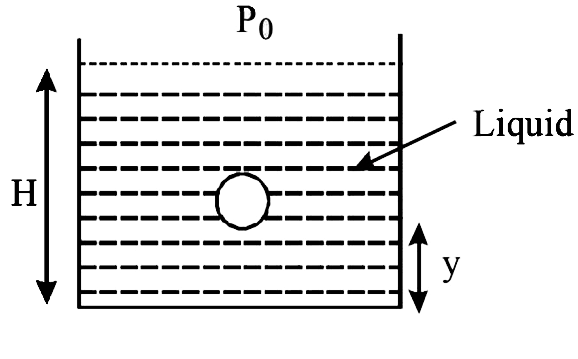
A small spherical monoatomic ideal gas bubble `(gamma=5//3)` is trapped inside a liquid of density `rho` (see figure). Assume that the bubble does not exchange any heat with the liquid. The bubble contains n moles of gas. The temperature of the gas when the bubble is at the bottom is `T_0`, the height of the liquid is H and the atmospheric pressure `P_0` (Neglect surface tension).

When the gas bubble is at a height y from the bottom, its temperature is-

A

Only the force of gravity

B

The force due to gravity and the force due pressure of the liquid

C

The force due to gravity, the force due pressure of the liquid and the force due to visco of the liquid.

D

The force due to gravity and the force due viscosity of the liquid.

Text Solution

Verified by Experts

The correct Answer is:

D

Gravity and viscous force
Promotional Banner

Topper's Solved these Questions

  • KINETIC THEORY OF GASES

    NARAYNA|Exercise LEVEL-I (H.W)|12 Videos
  • KINETIC THEORY OF GASES

    NARAYNA|Exercise SOLVED EXAMPLE|83 Videos
  • KINETIC THEORY OF GASES

    NARAYNA|Exercise LEVEL-V|10 Videos
  • GRAVITATION

    NARAYNA|Exercise EXERCISE -IV|40 Videos
  • LAW OF MOTION

    NARAYNA|Exercise EXERCISE - IV|35 Videos

Similar Questions

Explore conceptually related problems

A small spherical monoatomic ideal gas bubble (gamma= (5)/(3)) is trapped inside a liquid of density rho_(l) (see figure) . Assume that the bubble does not exchange any heat with the liquid. The bubble contains n moles of gas. The temperature of the gas when the bubble is at the bottom is T_(0) , the height of the liquid is H and the atmospheric pressure is P_(0) (Neglect surface tension). When the gas bubble is at a height y from the bottom , its temperature is :-

A small spherical monoatomic ideal gas bubble (gamma=5//3) is trapped inside a liquid of density rho (see figure). Assume that the bubble does not exchange any heat with the liquid. The bubble contains n moles of gas. The temperature of the gas when the bubble is at the bottom is T_0 , the height of the liquid is H and the atmospheric pressure P_0 (Neglect surface tension). The buyoncy force acting on the gas bubble is (Assume R is the universal gas constant)

A small spherical monoatomic ideal gas bubble (gamma=5//3) is trapped inside a liquid of density rho (see figure). Assume that the bubble does not exchange any heat with the liquid. The bubble contains n moles of gas. The temperature of the gas when the bubble is at the bottom is T_0 , the height of the liquid is H and the atmospheric pressure P_0 (Neglect surface tension). As the bubble moves upwards, besides the buyoncy force the following forces are acting on it

When a large bubble rises from the bottom of a lake to the surface, its radius doubles. The atmospheric pressure is equal to that of a column of water of height H. The depth of the lake is

When a large bubble rises from the bottom of a lake to the surface its radius doubles. If atmospheric pressure is equal to that of column of water height H then the depth of lake is

The gas inside a spherical bubble expands uniformly and slowly so that its radius increases from R to 2R . Let the atmospheric pressure be p_(0) and surface tension be S . The work done by the gas in the process is

An air bubble of radius r in water is at a depth h below the water surface at some instant. If P is atmospheric pressure, d and T are density and surface tension of water respectivley . the pressure inside the bubble will be :

Two spherical bubbles of radii 3 cm and 4cm coalesce to form another spherical bubble. Calculate the surface tension of the bubble. The radius of the bubble formed=4.498 cm and the atmopheric pressure =10^(5) Pa
