Home
Class 12
CHEMISTRY
An electrochemical cell is constructed w...

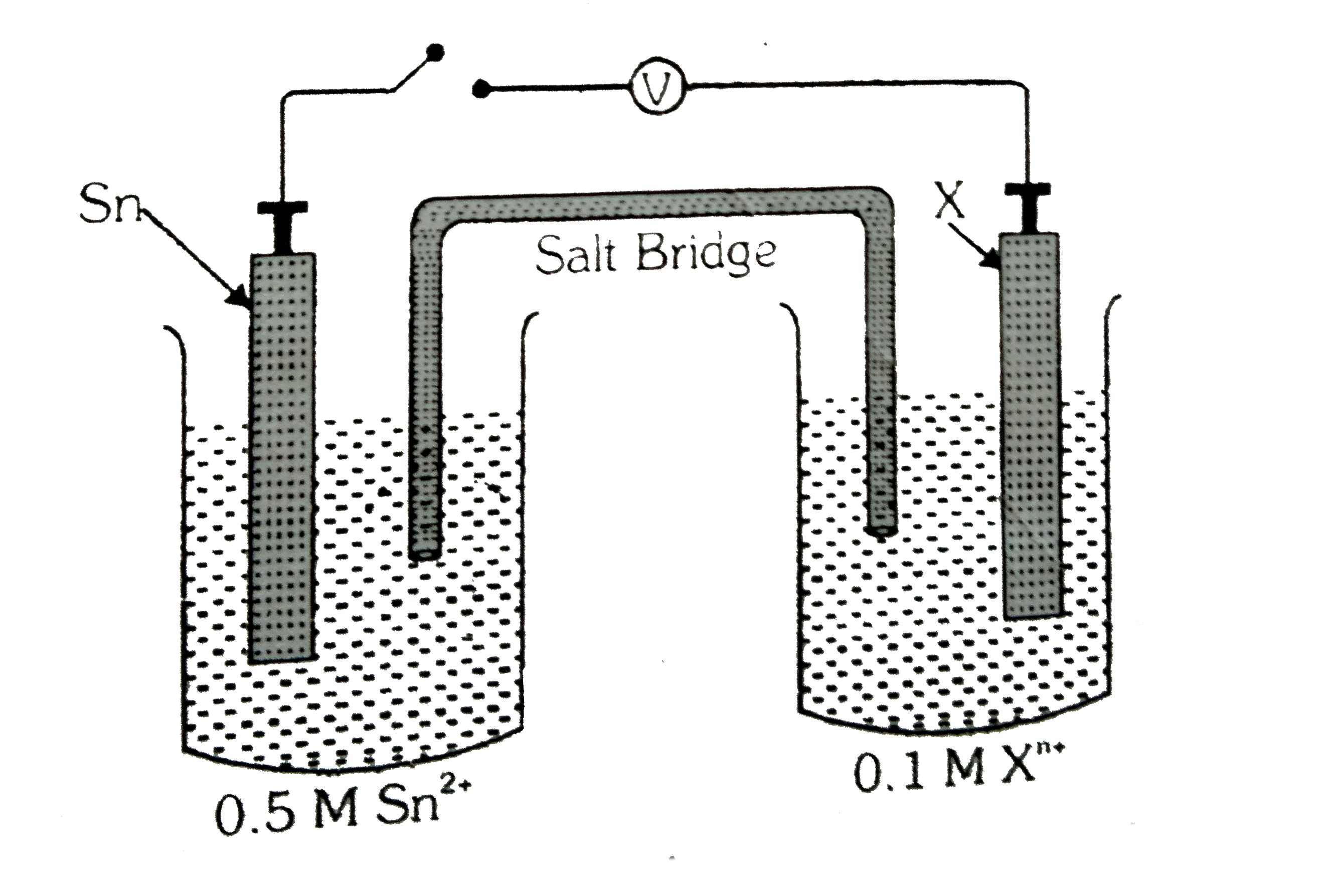
An electrochemical cell is constructed with an open switch as shown below:

when the switch is closed, mass of tin-electrode increases. If `E^(@) (Sn^(2+)//Sn) = 0.14V` and for `E^(@) (X^(n+)//X) =- 0.78V` and initial emf of the cell is `0.65V`, determine n and indicate the direction of electron flow in the external circuit.

Text Solution

Verified by Experts

The correct Answer is:

`n = 3 & X`-electrode to Sn-electrode

At cathode:
`Sn^(+2) +2e^(-) rarr Sn`
At anode:
`X rarr X^(+n) +n e^(-)`
Cell reaction
`nSn^(+2) +2X rarr 2X^(+n) +nSn`
`E^(@) =- 0.14 +0.78 = 0.64`
`E = E^(@) -(0.0591)/(2n)log.([X^(+n)]^(2))/([S^(+2)]^(n))`
`0.65 =0.64 -(0.0591)/(2n) [log 0.01 -log (0.5)^(n)]`
`0.01 =- (0.0591)/(2n) [-2 +n log 2]`
`0.03384 n = 2 -0.3010n`
`0.6394 n = 2`
`n = 3.12 =3`
Promotional Banner

Topper's Solved these Questions

  • ELECTROCHEMISTRY

    ALLEN|Exercise EXERCISE-05 [A]|28 Videos
  • ELECTROCHEMISTRY

    ALLEN|Exercise EXERCISE -05 [B]|38 Videos
  • ELECTROCHEMISTRY

    ALLEN|Exercise EXERCISE-04 [A]|56 Videos
  • CHEMISTRY AT A GLANCE

    ALLEN|Exercise ORGANIC CHEMISTRY|483 Videos
  • HYDROCARBON

    ALLEN|Exercise MCQ|15 Videos

Similar Questions

Explore conceptually related problems

An electrochemical cell is constructed with an open switch as shown below. When the switch is closed, mass of tin-electrode increase. If E^(@)(Sn^(2+)//Sn)=-0.14V and for E^(@)(X^(n+)//X)=-0.78V and initial emf of the cell is 0.65 V, determine n and indicate ad direction of electron flow in the external circuit.

For the electrochemical cell (M|M^(+))|| (X^(-)|X) E^(@) (M^(+)//M) = 0.44V and E^(@) (X//X^(-))=0.33V From this data one can deduce that :

Standard electrode potential for Sn^(4+)//Sn^(2+) couple is 0.15 V and that for the Cr^(3+)//Cr couple is -0.74 V . These two couples in their standard state are connected to make a cell. The cell potential will be

Standard electrode potential for Sn^(4+)//Sn^(2+) couple is +0.15 V and that for the Cr^(3+)//Cr couple is -0.74 V . These two couples in their standard state are connected to make a cell . The cell potential will be

ALLEN-ELECTROCHEMISTRY-EXERCISE-04 [B]
  1. The e.m.f. of cell: H(2)(g) |Buffer| Normal calomal electrode is 0.688...

    Text Solution

    |

  2. The direct current of 1.25A was passed through 200mL of 0.25M Fe(@)(SO...

    Text Solution

    |

  3. An electrochemical cell is constructed with an open switch as shown be...

    Text Solution

    |

  4. 10g fairly concentrated solution of CuSO(4) is electrolyzed using 0.01...

    Text Solution

    |

  5. One of the methods of preparation of per disulphuric acid, H(2)S(2)O(8...

    Text Solution

    |

  6. Assume that impure copper contains only iron, silver and a gold as imp...

    Text Solution

    |

  7. For galvanic cell: Ag|AgCI(s), KCI(0.2M|| KBr (0.001M), AgBr(s)|Ag C...

    Text Solution

    |

  8. An aqueous solution of NaCI on electrolysis gives H(2(g)), CI(2(g)) an...

    Text Solution

    |

  9. An acidic solution of Cu^(2+) salt containing 0.4g of Cu^(2+) is elect...

    Text Solution

    |

  10. In the refining of silver by electrolytic method what will be the weig...

    Text Solution

    |

  11. Hydrogen peroxide can be prepared by successive reaction: 2NH(4)HSO(...

    Text Solution

    |

  12. Dal lake has water 8.2 xx 10^(12)litre approximately. A power reactor ...

    Text Solution

    |

  13. Determine the degree of hydrolysis and hydrolysis constant of aniline ...

    Text Solution

    |

  14. The emf of the cell, Pt|H(2)(1atm)|H^(+) (0.1M, 30mL)||Ag^(+) (0.8M)Ag...

    Text Solution

    |

  15. A dilute aqueous solution of KCI was placed between two electrodes 10 ...

    Text Solution

    |

  16. 100mL CuSO(4)(aq) was electrolyzed using inert electrodes by passing 0...

    Text Solution

    |

  17. Calculate the equilibrium concentration of all ions in an ideal soluti...

    Text Solution

    |

  18. Determine at 298 for cell: Pt|Q, QH(2), H^(+) ||1M KCI |Hg(2)CI(2)|H...

    Text Solution

    |

  19. At 25^(@)C, DeltaH(f)(H(2)O,l) =- 56700 J//mol and energy of ionizatio...

    Text Solution

    |

  20. Calculate the cell potential of a cell having reaction Ag(2)S +2e^(-) ...

    Text Solution

    |
