Home
Class 12
PHYSICS
A two stage rocket is fired vertically u...


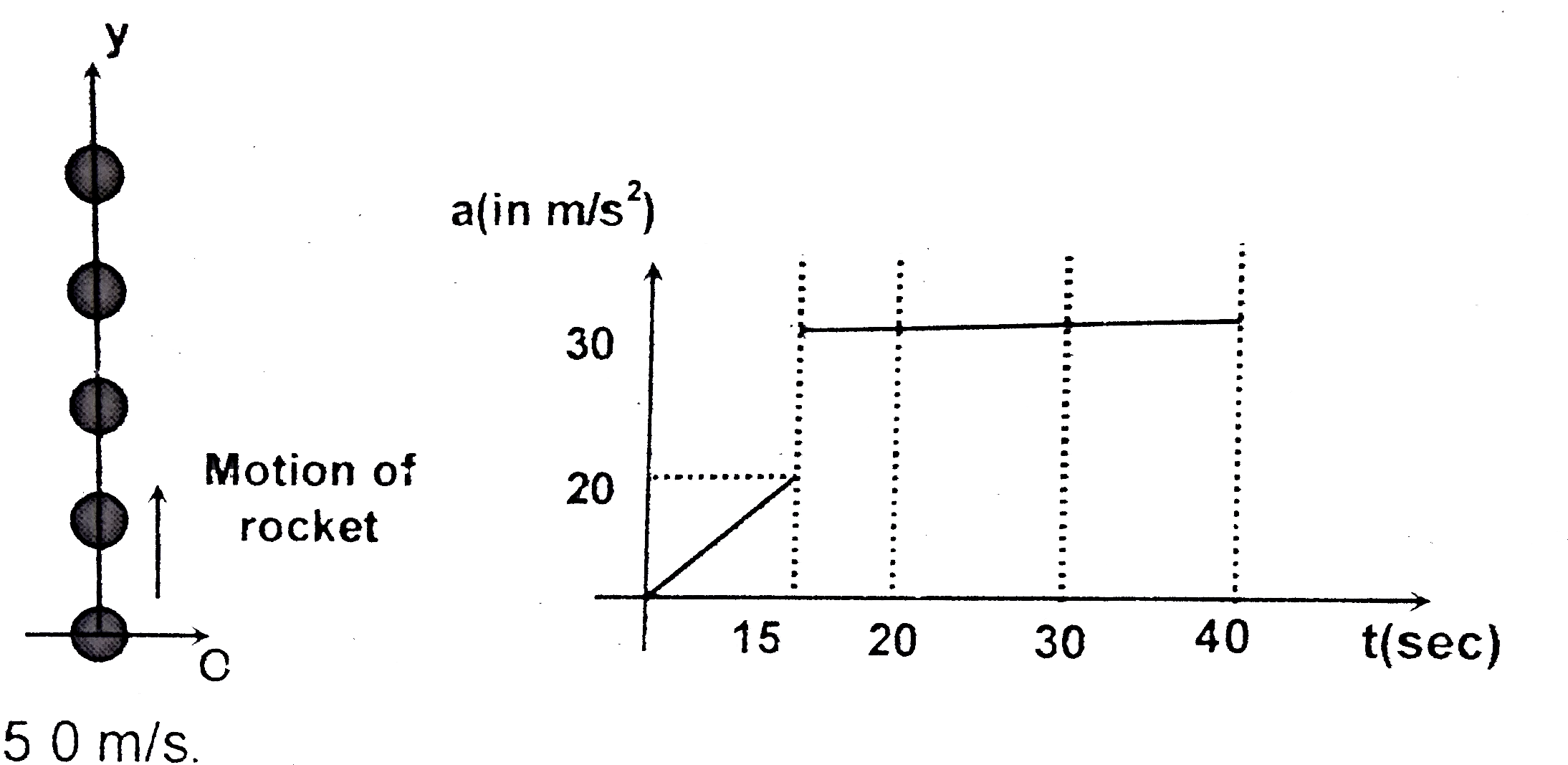
A two stage rocket is fired vertically upward from rest with acceleration as shown in a-t graphs. After 15 sec, the first stage burns out and second stage ignites. Choose the INCORRECT statement regarding motion of rocket in the time interval `0letle40s`.

A

at t=15 sec, the speed of rocket is 15.0m/s

B

At t=20 sec, the speed of rocket is 300m/s

C

In time interval t=0 sec to t=15 sec, the distance travelled by rocket is 750 m.

D

in time interval t-0 sec to t=20 sec, the distance travelled by rocket is 1500 m.

Text Solution

Verified by Experts

The correct Answer is:

D

`v{{:((2t^(2))/(9)hatj,"if "0letle15sec),(150+150(5-15)+15(t-15)^(2)hatj,"if "15sletle40s):}`
at t=15
`r=(2xx15xx15xx15)/(3xx3)=750m`
Promotional Banner

Topper's Solved these Questions

  • TEST PAPERS

    FIITJEE|Exercise PHYSICS|747 Videos
  • SIMPLE HARMONIC MOTION

    FIITJEE|Exercise Assignment Problems (Objective) (Level-II)|20 Videos
  • WORK, ENERGY AND POWER

    FIITJEE|Exercise COMPREHENSIONS ( Comprehension-II)|5 Videos

Similar Questions

Explore conceptually related problems

A rocket is fired vertically from the ground. It moves upwards with a constant acceleration 10m//s^(2) after 30 sec the fuel is finished. After what time from the instant of firing the rocket will attain the maximum height? g=10m//s^(2) :-

A rocket is fired vertically up from the ground with an acceleration 10 m//s^(2) . If its fuel is finished after 1 minute then calculate - (a) Maximum velocity attained by rocket in ascending motion. (b) Height attained by rocket fuel is finished. (c ) Time taken by the rocket in the whole motion. (d) Maximum height attained by rocket.

A particle starts from rest at t=0 and undergoes an acceleration as shown in figure. Draw the velocity-time graph of the motion of the particle during the interval from zero to 4 second.

Two bodies are projected vertically upwards from one point with the same initial velocity v_0. The second body is projected t_0 s after the first. How long after will the bodies meet?

A rocket is fired vertically upwards with a net acceleration of 4 m//s^2 and initial velocity zero. After 5s its fuel is finished and it decelerates with g. At the highest point its velocity becomes zero. Then, it accelerates downwards with acceleration g and return back to ground. Plot velocity-time and displacement -time graphs for the complete journey. Take g=10m//s^2.

A particle starts from rest at t=0 and undergoes an acceleration as shown in figure. Draw the displacement-time graph of the motion of the particle during the same time interval. In both the above cases, explain the various steps.

A rocket with an initial mass of 1000 kg , is launched vertically upward from rest under gravity. The rocket burns fuel at the rate of 10 kg per second. The burnt matter is ejected vertically downwards with a speed of 2000 m//s relative to the rocket . Find the velocity of the rocket after 1 min of start.

A particle starts motion from rest and moves along a straight line. Its acceleration-time graph is shown. Find out speed of particle at t=2s and at t=3s .

FIITJEE-TEST PAPERS-PHYSICS
  1. A mass of mass 60 kg hangs himself from a massless spring balance. Whi...

    Text Solution

    |

  2. One end of a heavy uniform rod AB can slide along rough horizontal gui...

    Text Solution

    |

  3. A two stage rocket is fired vertically upward from rest with accelerat...

    Text Solution

    |

  4. A particle whose velocity is given as vecv=hati+6thatjm//s is moving i...

    Text Solution

    |

  5. An ideal string pulley system is shown in the figure and system is rel...

    Text Solution

    |

  6. A sphere of mass m and radius r rolls without slipping over a tunnel o...

    Text Solution

    |

  7. In the given figure, a long platform of mass m is placed on frictionle...

    Text Solution

    |

  8. A non uniform rod OM (of length l m) is kept along x-axis and rotating...

    Text Solution

    |

  9. Identical constant forces push two identical cars A and B continuously...

    Text Solution

    |

  10. Two moles of an ideal monoatomic gas is taken through a cyclic process...

    Text Solution

    |

  11. Two ends of a rod of uniform cross sectional area are kept at temperat...

    Text Solution

    |

  12. An ideal gas is taken through a process PT^(3)= constant. The coeffici...

    Text Solution

    |

  13. 4 kg of ice at -20^(@)C is mixed with 5 kg of water at 40^(@)C. The wa...

    Text Solution

    |

  14. The molar heat capacity of an ideal gas in a process varies as C=C(V)+...

    Text Solution

    |

  15. A point charge q'q is placed at distance 'a' from the centre of an unc...

    Text Solution

    |

  16. A solid sphere of radius 'R' density rho and specific heat 'S' initial...

    Text Solution

    |

  17. Two point electric dipoles with dipole moment P(1) and P(2) are separa...

    Text Solution

    |

  18. 4 moles of an ideal monoatomic gas is heated isobarically so that its ...

    Text Solution

    |

  19. A point charge 'q' is placed at the centre of left circular end of a c...

    Text Solution

    |

  20. Two concentric spherical conducting shells of radii 'a' and 2a are ini...

    Text Solution

    |
