Home
Class 12
PHYSICS
A non uniform rod OM (of length l m) is ...


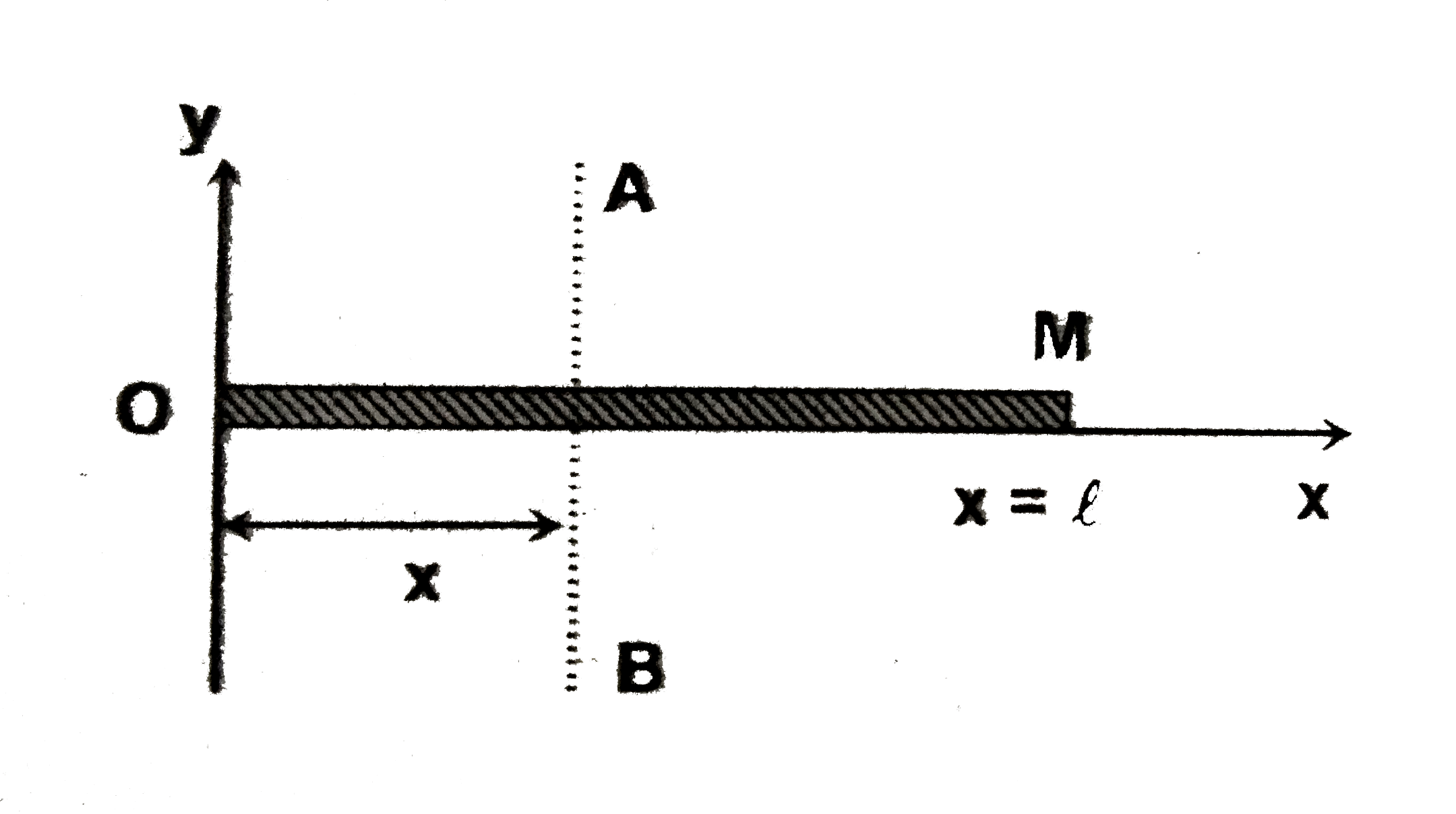
A non uniform rod OM (of length l m) is kept along x-axis and rotating about an axis AB, which is perpendicular to rod as shown in the figure. The rod has linear mass densty that varies with the distance x from left end of the rod according to `lamda=lamda_(0)((x^(3))/(L^(3)))`
Where unit of `lamda_(0)` is kg/m. What is the value of x so that moment of inertia of rod about axis AB `(I_(AB))` is minimum?

A

`(7l)/(15)`

B

`(2l)/(5)`

C

`(8l)/(15)`

D

`(4l)/(5)`

Text Solution

Verified by Experts

The correct Answer is:
D

First method:
`I_(AB)=inty^(2)dm=(lamda_(0))/(l^(3))int_(-x)^(l-x)(y+x)^(3)y^(2)dy`
`int(y+x)^(3)y^(2)dy=y^(2)((y+x)^(4))/(4)-(1)/(2)y(y+x)^(4)dy`
`=(y^(2)(y+x)^(2))/(4)-(y)/(10)(y+x)^(5)+(1)/(10)(y+x)^(5)dy`
`=(y^(2)(y+x)^(2))/(4)-(y(x+y)^(5))/(10)+((y+x)^(2))/(60)`
`int_(-x_(0))^((l-x))y^(2)(y+x)^(3)dx=((L-x)^(2)(l)^(4))/(4)-((l-x)l^(5))/(10)+(l^(6))/(60)`
`I_(AB)=lamda_(0)[((l-x)^(2))/(4)l-(1)/(10)(l-x)l^(2)+(1)/(60)l^(3)]=lamda_(0)l[((l-x)^(2))/(4)l-(1)/(10)(l-x)+(1)/(60)l^(2)]`
`(dl_(AB))/(dx)=0implies-((l-x))/(2)+(l)/(10)=0implies5l-5x=l" "implies 5x=4l" "implies" "x=(4l)/(5)`
Second method:
As we know that moment of inertial is minimum among all set of parallel axis, if axis is passing through centre of mass, so x must be distance of centre of mass.
`X_(CM)=(1)/(M)int_(0)^(L)xdm`
`M=intdm=(lamda_(0))/(l^(3))underset(0)overset(l)intx^(3)dx=(lamda_(0)l)/(4)` and `underset(0)overset(l)intxdx=(lamda_(0))/(l^(3))underset(0)overset(l)intx^(4)dx=(lamda_(0)l^(2))/(5)`
Putting these values in equation (i) we have `x_(CM)=(4l)/(5)`
Third method:
From given funtion it is clear that centre of mass of system must be at distance grater
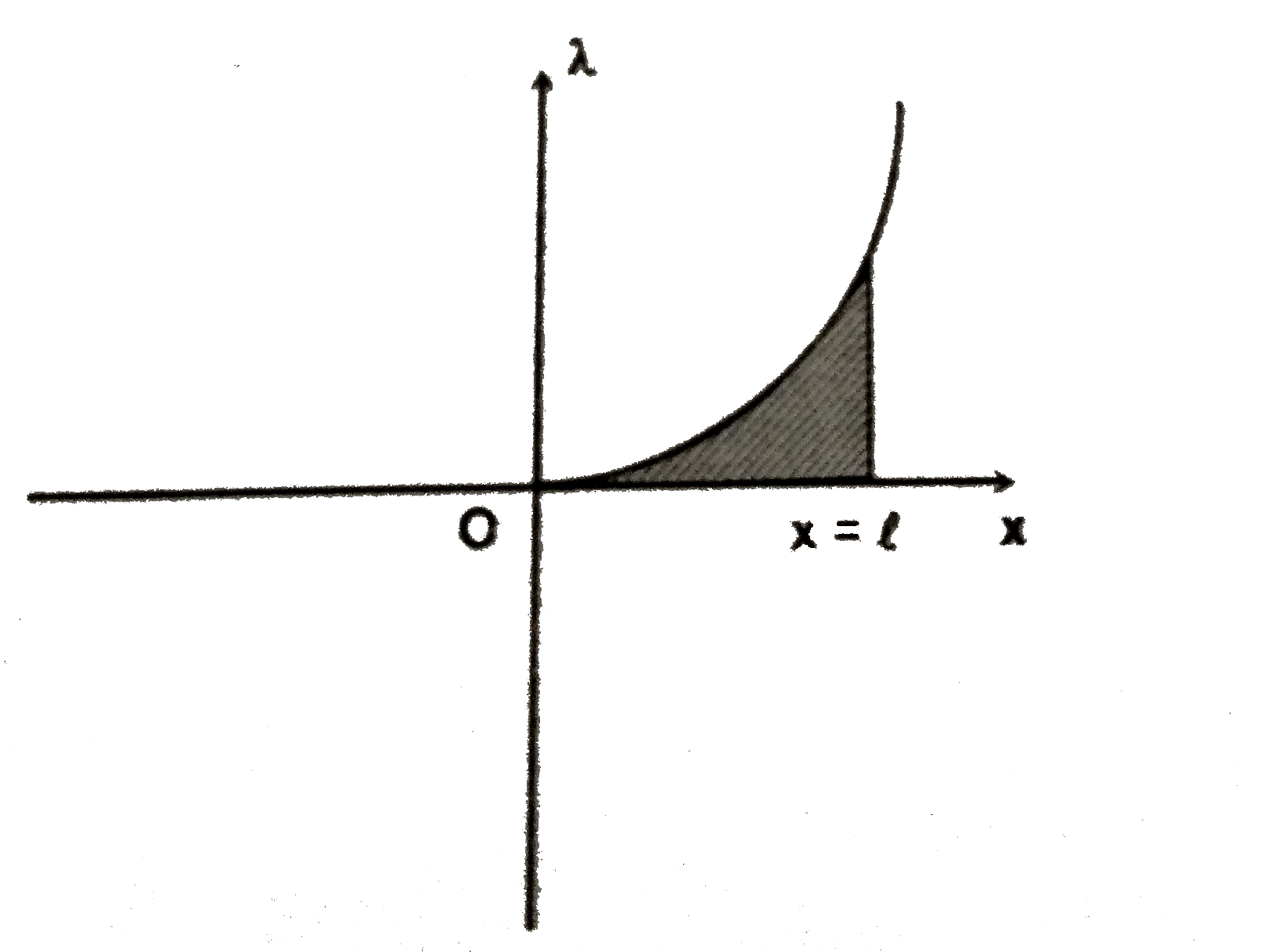
that l/2. We have only two option `(8l)/(15)` and `(4l)/(5)`. For graph it is clear that maximum mass existence is nearer to other end, so it can't be `(8l)/(15)`, so right answer will be `(4l)/(5)`
Promotional Banner

Topper's Solved these Questions

  • TEST PAPERS

    FIITJEE|Exercise PHYSICS|747 Videos
  • SIMPLE HARMONIC MOTION

    FIITJEE|Exercise Assignment Problems (Objective) (Level-II)|20 Videos
  • WORK, ENERGY AND POWER

    FIITJEE|Exercise COMPREHENSIONS ( Comprehension-II)|5 Videos

Similar Questions

Explore conceptually related problems

A rod length L and mass M is placed along the x -axis with one end at the origin, as shown in the figure above. The rod has linear mass density lamda=(2M)/(L^(2))x, where x is the distance from the origin. Which of the following gives the x -coordinate of the rod's center of mass?

A rod of length 2 m, has a mass of 0.12 kg. Its moment of inertia about an axis passing through its one end and perpendicular to the length of the rod is

A non–uniform thin rod of length L is placed along x-axis as such its one of ends at the origin. The linear mass density of rod is lambda=lambda_(0)x . The distance of centre of mass of rod from the origin is :

Linear mass density of a rod AB ( of length 10 m) varied with distance x from its end A as lambda = lambda_0 x^3 ( lamda_0 is positive constant). Distance of centre of mass the rod, form end B is

The moment of inertia of a thin rod of mass M and length L about an axis perpendicular to the rod at a distance L/4 from one end is

Calculate the moment of inertia of a rod of mass M, and length l about an axis perpendicular to it passing through one of its ends.

A non-uniform thin rod of length L is palced along X-axis so that one of its ends is at the origin. The linear mass density of rod is lambda = lambda_(0)x . The centre of mass of rod divides the length of the rod in the ratio:

The linear mass density of a thin rod AB of length L varies from A to B as lambda (x) =lambda_0 (1 + x/L) . Where x is the distance from A. If M is the mass of the rod then its moment of inertia about an axis passing through A and perpendicualr to the rod is :

FIITJEE-TEST PAPERS-PHYSICS
  1. A sphere of mass m and radius r rolls without slipping over a tunnel o...

    Text Solution

    |

  2. In the given figure, a long platform of mass m is placed on frictionle...

    Text Solution

    |

  3. A non uniform rod OM (of length l m) is kept along x-axis and rotating...

    Text Solution

    |

  4. Identical constant forces push two identical cars A and B continuously...

    Text Solution

    |

  5. Two moles of an ideal monoatomic gas is taken through a cyclic process...

    Text Solution

    |

  6. Two ends of a rod of uniform cross sectional area are kept at temperat...

    Text Solution

    |

  7. An ideal gas is taken through a process PT^(3)= constant. The coeffici...

    Text Solution

    |

  8. 4 kg of ice at -20^(@)C is mixed with 5 kg of water at 40^(@)C. The wa...

    Text Solution

    |

  9. The molar heat capacity of an ideal gas in a process varies as C=C(V)+...

    Text Solution

    |

  10. A point charge q'q is placed at distance 'a' from the centre of an unc...

    Text Solution

    |

  11. A solid sphere of radius 'R' density rho and specific heat 'S' initial...

    Text Solution

    |

  12. Two point electric dipoles with dipole moment P(1) and P(2) are separa...

    Text Solution

    |

  13. 4 moles of an ideal monoatomic gas is heated isobarically so that its ...

    Text Solution

    |

  14. A point charge 'q' is placed at the centre of left circular end of a c...

    Text Solution

    |

  15. Two concentric spherical conducting shells of radii 'a' and 2a are ini...

    Text Solution

    |

  16. Three capacitors of capacitances 5muF,2muF and 2muF are charged to 20 ...

    Text Solution

    |

  17. Three concentric spherical conducting shells A, B and C of radii a, 2a...

    Text Solution

    |

  18. In the circuit shown the cell will deliver maximum power to the networ...

    Text Solution

    |

  19. In the circuit shown, all the capacitors are initially uncharged. The ...

    Text Solution

    |

  20. A particle of charge 'q' and mass 'm' enters a uniform magnetic field ...

    Text Solution

    |

