Home
Class 12
PHYSICS
A solid sphere with angular velocity ome...

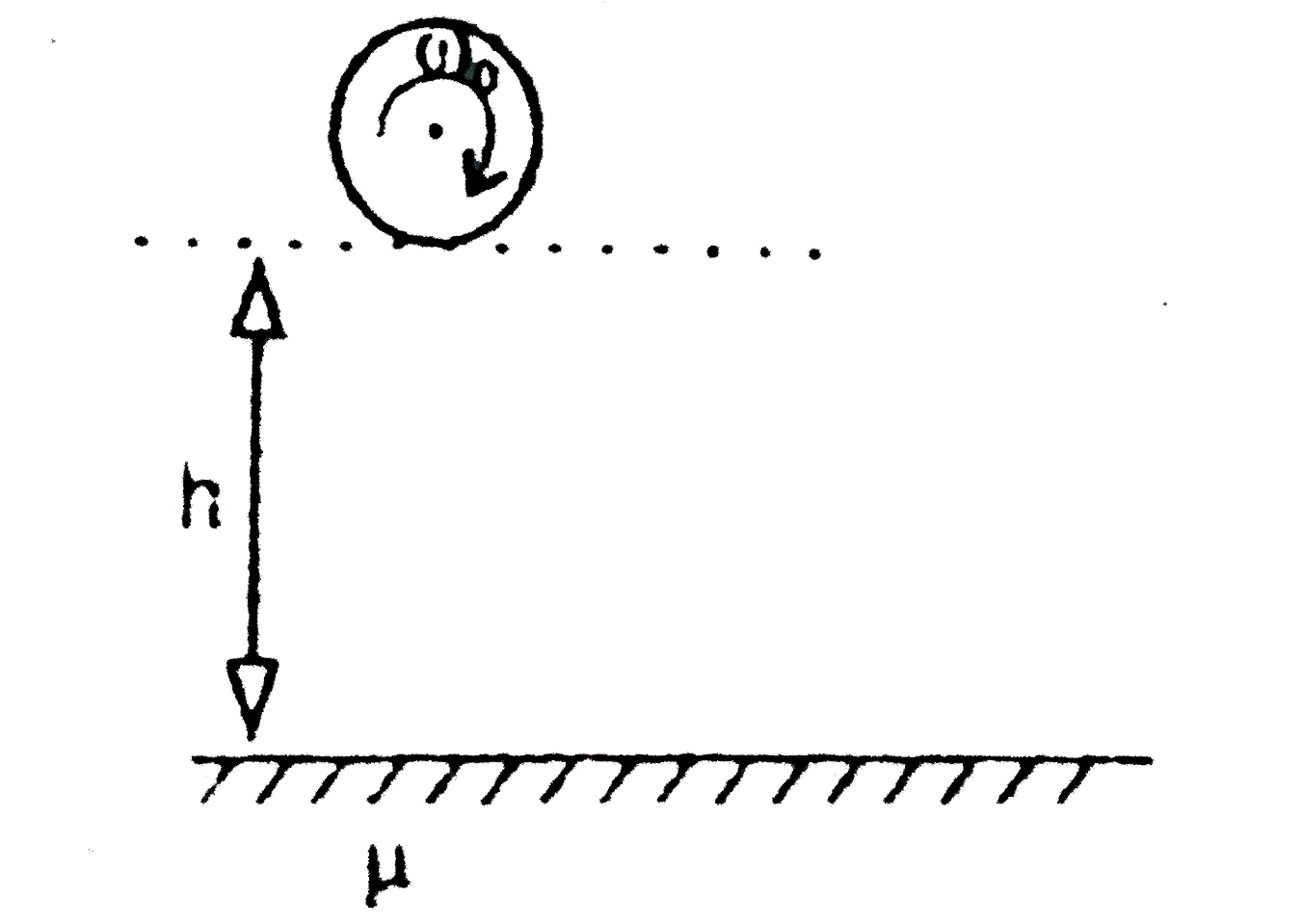
A solid sphere with angular velocity `omega_(0)` is dropped on a rough surface with coefficient of frication `'mu'` froma height `'h'`. If the collision with ground is perfectly inelastic if the velocity of centre of mass just after the impact is `musqrt((xgh)/(3))` then value of `x` would be :

Text Solution

Verified by Experts

The correct Answer is:

6

The collision is perfectly inelastic
Hence , `intNdt = msqrt(2gh)`
and the linear impulse
`int mu Ndt = mv`
`mu m sqrt(2gh) = mv`
`v = mu sqrt(2gh)`
Promotional Banner

Topper's Solved these Questions

  • TEST PAPERS

    RESONANCE|Exercise Physics|775 Videos
  • TEST PAPERS

    RESONANCE|Exercise PT-01|30 Videos
  • TEST PAPERS

    RESONANCE|Exercise PART - II PHYSICS SEC - 2|20 Videos
  • SIMPLE HARMONIC MOTION

    RESONANCE|Exercise Advanced Level Problems|13 Videos
  • TEST SERIES

    RESONANCE|Exercise PHYSICS|127 Videos

Similar Questions

Explore conceptually related problems

A hoop of radius r mass m rotating with an angular velocity omega_(0) is placed on a rough horizontal surface. The initial velocity of the centre of the hoop is zero. What will be the velocity of the centre of the hoop when it cases to slip ?

A solid sphere with a velocity (of centre of mass) v and angular velocity omega is gently placed on a rough horizontal surface. The frictional force on the sphere :

A hoop of radius r and mass m rotating with an angular velocity omega_0 is placed on a rough horizontal surface. The initial velocity of the centre of the hoop is zero. What will be the velocity of the centre of the hoop when it ceases ot slip?

A body of mass m is dropped from a height of h . Simultaneously another body of mass 2m is thrown up vertically with such a velocity v that they collide at height h/2 . If the collision is perfectly inelastic, the velocity of combined mass at the time of collision with the ground will be

A solid ball of mass m and radius R spinning with angular velocity omega falls on a horizontal slab of mass M with rough upper surface (coefficient of friction mu ) and smooth lower surface. Immediately after collision, the normal component of velocity of the ball becomes half of its value just before collision and it stops spinning. Find the velocity of the sphere in horizontal direction immediately after the impact (given : Romega =5 ).

A ring of radius R is first rotated with an angular velocity omega and then carefully placed on a rough horizontal surface. The coefficient of friction between the surface and the ring is mu . Time after which its angular speed is reduced to half is

A solid sphere of mass 10 kg is placed on a rough surface having coefficient of frictio mu=0.1A constant force F=7N is applied along a line passing through the centre of the sphere as shown in the figure. The value of frictional force on the sphere is

A solid sphere of mass m is lying at rest on a rough horizontal surface. The coefficient of friction between the ground and sphere is mu . The maximum value of F , so that the sphere will not slip, is equal to

A sphere of mass M and radius R is moving on a rough fixed surface, having coefficient of friction mu . as shown in Fig. It will attain a minimum linear velocity after time v_(0)gtomega_(0)R)

RESONANCE-TEST PAPERS-PART - II PHYSICS
  1. A unifrom rod AB of length 4m and mass 12 kg is thrown such that just ...

    Text Solution

    |

  2. A block of mass m = 2 kg is connected to a spring of force constant k ...

    Text Solution

    |

  3. A solid sphere with angular velocity omega(0) is dropped on a rough su...

    Text Solution

    |

  4. A block of mass 5 kg is held against a wall with a force of 100 N. as ...

    Text Solution

    |

  5. In the figure shown a thin light inextensible string is wrapped around...

    Text Solution

    |

  6. Consider the following redox reaction : H(2)O + AX + BY rarr HA + YO...

    Text Solution

    |

  7. 1 mol of an ideal gas undergoes different thermodynamical process in P...

    Text Solution

    |

  8. 1 mol of an ideal gas undergoes different thermodynamical process in P...

    Text Solution

    |

  9. Boyle's temperature (T(B)) : It is the temperature at which a real gas...

    Text Solution

    |

  10. Boyle's temperature (T(B)) : It is the temperature at which a real gas...

    Text Solution

    |

  11. The degree of polarity of a convalent compound is measured by the dipo...

    Text Solution

    |

  12. The degree of polarity of a convalent compound is measured by the dipo...

    Text Solution

    |

  13. Identification of +m & -m groups : If the first atom of the group has ...

    Text Solution

    |

  14. Identification of +m & -m groups : If the first atom of the group has ...

    Text Solution

    |

  15. 1 mol of a real gas obeys P(V(m) - b) = RT , where 'b' and 'R' are con...

    Text Solution

    |

  16. One gram of a metallic chloride was found to contain 0.835 g of chlori...

    Text Solution

    |

  17. The graph of compressibility factor (Z) vs. P for one mole of a real g...

    Text Solution

    |

  18. N(2) undergoes photochemical dissociation into one normal N-atom and o...

    Text Solution

    |

  19. Four moles of an ideal diatomic gas (gamma = 1.4) at 300 K and 12 atm ...

    Text Solution

    |

  20. The vapour density of the mixture at equilibrium is 38.3 at 33^(@)C ...

    Text Solution

    |
