Home
Class 12
PHYSICS
A set of a identical cubical blocks lies...

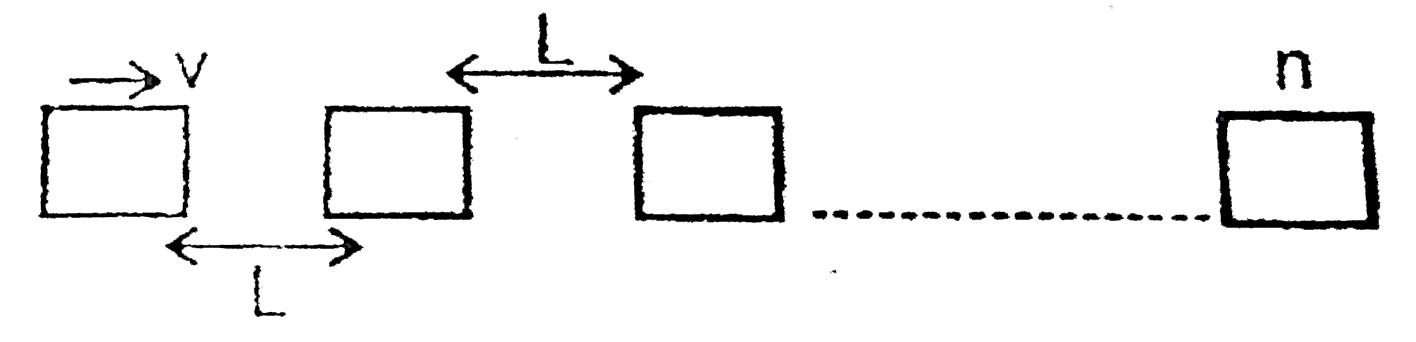
A set of a identical cubical blocks lies at rest parallel to each other along a line on a smooth horizontal surface. The separation between the near surface of any two adjacent blocks is `L`. The block at one and is given a speed `v` towards the next one at time `t = 0`. All collision are completely inelastic , then the last block starts moving at

A

The last block starts moving at `t = n(n - 1)(L)/(2V)`

B

The last block starts moving at `t = (n - 1) (L)/(V)`

C

The centre of mass of the system will have a final speed `v//n`

D

The centre of mass of the system will have a final speed `v`

Text Solution

Verified by Experts

The correct Answer is:
A, C


`mv = nv'm rArr v' =`
time for first collisen is `t_(1) = (L)/(V)` (`2nd` block)
`2`nd collisions `t_(2) = (2l)/(V) = 2t_(1)` (`3`rd block)
so `t = t_(1) + 2l_(1) + 3t_(1) + at_(1)"….."(n-1)t_(1)`.
`t = t_(1)[1 + 2 + 3]"........."(n-1)]`
`= ((n-1)(n-1+1))/(2) = (n(n-1))/(2)`
so `t = (L)/(2V)n(n - 1)`
Promotional Banner

Topper's Solved these Questions

  • TEST PAPERS

    RESONANCE|Exercise Physics|775 Videos
  • TEST PAPERS

    RESONANCE|Exercise PT-01|30 Videos
  • TEST PAPERS

    RESONANCE|Exercise PART - II PHYSICS SEC - 2|20 Videos
  • SIMPLE HARMONIC MOTION

    RESONANCE|Exercise Advanced Level Problems|13 Videos
  • TEST SERIES

    RESONANCE|Exercise PHYSICS|127 Videos

Similar Questions

Explore conceptually related problems

A set of n identical cubical blocks lies at rest parallel to each other along a line on a smooth horizontal surface. The separation between the near surfaces of any two adjacent blocks is L . The block at one end is given a speed v towards the next one at time 0 t . All collisions are completely inelastic, then

Two blocks rest on a smooth horizontal surface. They are connected by a spring of force constant k. If the system is set into oscillation find its time period.

2n identical cubical blocks are kept in a straight line on a horizontal smooth surface. The separation between any two consecutive blocks is same. The odd numbered blocks 1, 3, 5,.....(2n–1) are given velocity v to the right whereas blocks 2, 4, 6,......2n are given velocity v to the left. All collisions between blocks are perfectly elastic. Calculate the total number of collisions that will take place.

A small block of mass m and a concave mirror of radius R fitted with a stand lie on a smooth horizontal table with a separation d between them. The mirror together with its stand has a mass m. The block is pushed at t = 0 towards the mirror so that it starts moving towards the mirror at a constant speed V and collides with it. The collision is perfectly elastic. Find the velocity of the image (a) at a time t lt d/V, (b) at a time t gt d/V .

A large number of small identical blocks, each of mass m, are placed on a smooth horizontal surface with distance between two successive blocks being d. A constant force F is applied on the first block as shown in the figure (a) If the collisions are elastic, plot the variation of speed of block 1 with time. (b) Assuming the collisions to be perfectly inelastic, find the speed of the moving blocks after n collisions. To what value does this speed tend to if n is very large.

Consider a large block placed on a smooth horizontal surface, with a man standing at one end of the block. The man walks to the other end, relative to the block. The distances (absolute) moved by the man and the block are :

Figure shows four blocks that are being pulled along a smooth horizontal surface.The masses of the blocks and tension in one cord are given.The pulling force F is

Two identical 5 kg blocks are moving with same speed of 2 m//s towards each other along a frictionless horizontal surface . The two blocks collide , stick together and come to rest. Consider the two blocks as a system . The work done by the external and ijnternal force are respectively:

A long block A is at rest on a smooth horizontal surface. A small block B whose mass is half of mass of A is placed on A at one end and is given an initial velocity u as shown in figure. The coefficient of friction between the blocks is mu .

RESONANCE-TEST PAPERS-PART - II PHYSICS
  1. The system is released from rest with both the springs in unstretched ...

    Text Solution

    |

  2. On a disc of radius R a concentric circle of radius R//2 is drawn. The...

    Text Solution

    |

  3. A ball of mass 1 kg is thrown up with an initial speed of 4 m//s. A se...

    Text Solution

    |

  4. A particle is acted upon by a force whose component's variations with ...

    Text Solution

    |

  5. A particle is realesed from a height H from ground. At certain height ...

    Text Solution

    |

  6. A set of a identical cubical blocks lies at rest parallel to each othe...

    Text Solution

    |

  7. Choose the correct option(s) for the given sitution.

    Text Solution

    |

  8. A thin uniform rigid rod of mass m and length l is in mechanical equil...

    Text Solution

    |

  9. Two identical discs are positioned on a vertical axis as shown in the ...

    Text Solution

    |

  10. A simple pendulum A and a homogeneous rod B hinged at its enda are rel...

    Text Solution

    |

  11. A ball is thrown onto a smooth floor with speed u at angle theta = 45^...

    Text Solution

    |

  12. A small ball of mass m is released from rest at a height h(1) above gr...

    Text Solution

    |

  13. A uniform disc of mass m & radius R is pivoted at its centre O with it...

    Text Solution

    |

  14. A rod of mass m = 2kg, length l = 1m, has uniform cross-section area A...

    Text Solution

    |

  15. Three bodies each of mass 2kg are arranged as shown in figure. The coe...

    Text Solution

    |

  16. A small ball bearing is released at the top of a long vertical column ...

    Text Solution

    |

  17. A metal wire of length L, area of cross-section A and young's modulus ...

    Text Solution

    |

  18. When a drop splits up into number of drops :

    Text Solution

    |

  19. The displacement of a particle in a medium due to a wave travelling in...

    Text Solution

    |

  20. y-x curve at an instant for a wave travelling along x-axis on a string...

    Text Solution

    |

