Home
Class 11
PHYSICS
A certain mass of an ideal gas is at pre...

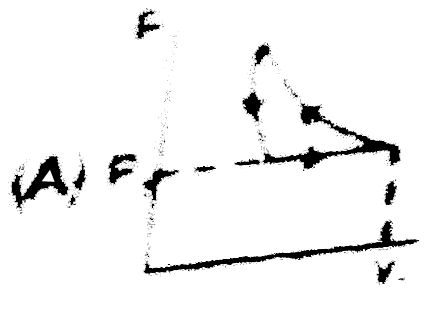
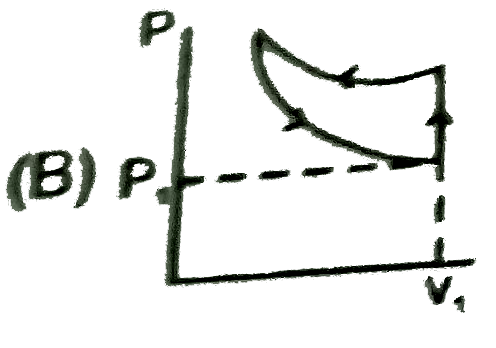
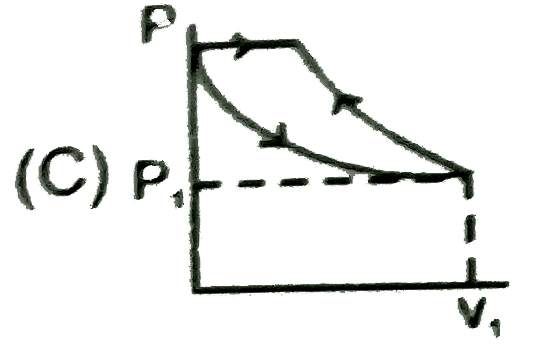
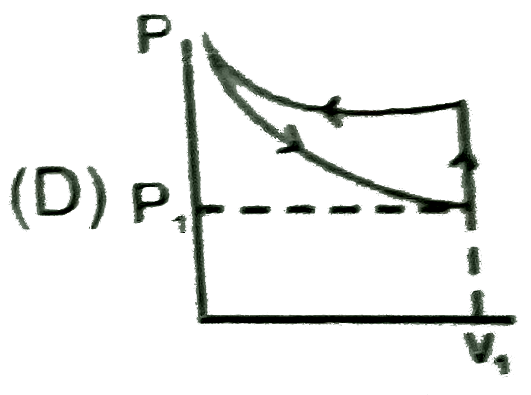
A certain mass of an ideal gas is at pressure `P_(1)` and volume `V_(1)`. If is compressed isothermally and then allowed to expand adiabatically untill its pressure returns to `P_(1)`. The gas is then allowed to expand its original volume. Which of the following `P -V` graphs are these process correctly shown?

A

B

C

D

Text Solution

AI Generated Solution

The correct Answer is:

To solve the problem, we need to analyze the processes that the ideal gas undergoes and how they are represented on a P-V graph. The processes are: 1. **Isothermal Compression**: The gas is compressed at a constant temperature. 2. **Adiabatic Expansion**: The gas expands without heat exchange with the surroundings until it returns to its initial pressure \( P_1 \). 3. **Expansion to Original Volume**: The gas expands to its original volume \( V_1 \). ### Step-by-Step Solution: **Step 1: Initial State** - The gas starts at pressure \( P_1 \) and volume \( V_1 \). This point is our starting point on the graph. **Step 2: Isothermal Compression** - During isothermal compression, the gas's volume decreases while the pressure increases, but the temperature remains constant. This process is represented by a downward curve on the P-V graph. - The curve will start from point \( (V_1, P_1) \) and move to a new point \( (V_2, P_2) \) where \( V_2 < V_1 \) and \( P_2 > P_1 \). **Step 3: Adiabatic Expansion** - After the isothermal compression, the gas undergoes adiabatic expansion. In this process, the gas expands and does work on the surroundings without any heat exchange, resulting in a decrease in pressure. - This process will be represented by a steeper curve moving from point \( (V_2, P_2) \) to a new point \( (V_3, P_1) \) where the pressure returns to \( P_1 \) but the volume \( V_3 > V_2 \). **Step 4: Expansion to Original Volume** - Finally, the gas expands to its original volume \( V_1 \) at constant pressure \( P_1 \). This is represented by a horizontal line moving from \( (V_3, P_1) \) to \( (V_1, P_1) \). **Step 5: Complete P-V Graph** - The complete P-V graph will show: - A downward curve for isothermal compression from \( (V_1, P_1) \) to \( (V_2, P_2) \). - A steeper downward curve for adiabatic expansion from \( (V_2, P_2) \) to \( (V_3, P_1) \). - A horizontal line from \( (V_3, P_1) \) to \( (V_1, P_1) \). ### Conclusion The correct P-V graph that represents these processes is option A.

To solve the problem, we need to analyze the processes that the ideal gas undergoes and how they are represented on a P-V graph. The processes are: 1. **Isothermal Compression**: The gas is compressed at a constant temperature. 2. **Adiabatic Expansion**: The gas expands without heat exchange with the surroundings until it returns to its initial pressure \( P_1 \). 3. **Expansion to Original Volume**: The gas expands to its original volume \( V_1 \). ### Step-by-Step Solution: ...
Promotional Banner

Topper's Solved these Questions

  • KTG & THERMODYNAMICS

    RESONANCE|Exercise SECTION (D)|2 Videos
  • KTG & THERMODYNAMICS

    RESONANCE|Exercise SECTION (I)|2 Videos
  • KTG & THERMODYNAMICS

    RESONANCE|Exercise SECTION (A)|3 Videos
  • KINETIC THEORY OF GASES AND THERMODYNAMICS

    RESONANCE|Exercise Exercise|64 Videos
  • MAGNETIC FIELD AND FORCES

    RESONANCE|Exercise Exercise|65 Videos
RESONANCE-KTG & THERMODYNAMICS-SECTION
  1. In a cyclic process shown in the figure an ideal gas is adiabatically...

    Text Solution

    |

  2. In given figure, a fixed mass of an ideal gas undergoes the change rep...

    Text Solution

    |

  3. A certain mass of an ideal gas is at pressure P(1) and volume V(1). If...

    Text Solution

    |

  4. During an adiabatic process, the pressure of a gas is found to be prop...

    Text Solution

    |

  5. A gas undergoes a process in which its pressure P and volume V are rel...

    Text Solution

    |

  6. V = k((P)/(T))^(0.33) where k is constant. It is an,

    Text Solution

    |

  7. One mole of a gas is subjected to two process AB and BC, one after the...

    Text Solution

    |

  8. An ideal gas has an adiabatic exponent gamma. In some process its mola...

    Text Solution

    |

  9. One mole of an ideal gas undergoes a process in which T = T(0) + aV^(3...

    Text Solution

    |

  10. In the above question, maximum pressure attainable is

    Text Solution

    |

  11. In a certain gas, the ratio of the velocity of sound and root mean squ...

    Text Solution

    |

  12. A polytropic process for an ideal gas is represented by equation PV^(n...

    Text Solution

    |

  13. One mole of an ideal gas at temperature T expands slowly according to ...

    Text Solution

    |

  14. In a process the pressure of a gas is inversely proportional to the sq...

    Text Solution

    |

  15. The molar heat capacity for the process shown in figure is

    Text Solution

    |

  16. The coefficient of performance of a Carnot refrigerator working betwee...

    Text Solution

    |

  17. If the door of a refrigerator is kept open, then which of the followin...

    Text Solution

    |

  18. An ideal gas heat engine operates in a Carnot's cycle between 227^(@)C...

    Text Solution

    |

  19. A scientist says that the efficiency of his heat engine which operates...

    Text Solution

    |

  20. "Heat cannot by itself flow from a body at lower temperature to a body...

    Text Solution

    |
