Home
Class 12
PHYSICS
Find the tension in the horizontal strin...

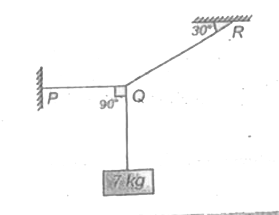
Find the tension in the horizontal string PQ and the string QR in the given figure. [Take `g=10m//s^(2)`]

Text Solution

Verified by Experts

We may take the components and redraw it as
` (##AAK_T1_PHY_C03_SLV_014_S01.png" width="80%">
From figure, we get
` T_(1) sin 30^(@) = 70 N`
and ` T_(2) = T_(1) cos 30^(@)`
` :. T_(1) = 140 N`
and ` T_(2) = 140 xx sqrt(3)/2 = 70 sqrt(3) N`
Promotional Banner

Topper's Solved these Questions

  • LAWS OF MOTION

    AAKASH INSTITUTE|Exercise Illustration|5 Videos
  • LAWS OF MOTION

    AAKASH INSTITUTE|Exercise TRY YOURSELF|67 Videos
  • KINETIC THEORY

    AAKASH INSTITUTE|Exercise EXERCISE (ASSIGNMENT) SECTION - D Assertion - Reason Type Questions|10 Videos
  • MAGNETISM AND MATTER

    AAKASH INSTITUTE|Exercise ASSIGNMENT (SECTION D)|26 Videos

Similar Questions

Explore conceptually related problems

Find the tension in the strings AC and BC shown in figure.

Find the tension in the strings AC and BC shown in figure.

A block of mass 1 kg and density 0.8g//cm^(3) is held stationary with the help of a string as shown in figure. The tank is accelerating vertically upwards with an acceleration a =1.0m//s^(2) . Find (a) the tension in the string, (b) if the string is now cut find the acceleration of block. (Take g=10m//s^(2) and density of water =10^(3)kg//m^(3)) .

Find tension /tensions in the string/strings in the following cases:

A body of mass 100 gram is tied at the end of a string of length 1m. It is rotated in a vertical circle at a critical speed of 4 m/s at the highest point . The tension in the string at the huighest point in its path is [ take g=10 m//s^(2) ]

Calculate the tension in the string shown in the figure. All the surfaces are frictionless. (Take g = 10// ms^(-1) )

A uniform rod of length 1 m and mass 2 kg is suspended. Calculate tension T (in N ) in the string at the instant when the right string snaps (g = 10 m//s^(2)) .

A 2 kg block A is attached to one end of a light string that passes over an an ideal pulley and a 1 kg sleeve B slides down the other part of the string with an acceleration of 5m//s^(2) with respect to the string. Find the acceleration of the block, acceleration of sleeve and tension in the steing. [g=10m//s^(2)]

A 100 cm long wire of mass 40 g supports a mass of 1.6 kg as shown in figure . Find the fundamental frequency of the portion of the string between the wall and the pulley. Take g=10m//s^(2) .

A bob tied to the end of a string of length 2m, other end of which is fixed at a point in a vertical wall at a point O. The bob is imparted a vertical downward velocity of 5 m//s when the string is horizontal and swings in a vertical plane. Find the angular displacement of the bob from its initial position, when the string breaks. Given that the tensile strength of the string is twice the weight of the bob. Take g=10 m//s^(2)

AAKASH INSTITUTE-LAWS OF MOTION-Assignment (SECTION-D) (Assertion-Reason Type Questions)
  1. Find the tension in the horizontal string PQ and the string QR in the ...

    Text Solution

    |

  2. A : Due to inertia an object is unable to change by itself its state o...

    Text Solution

    |

  3. A : Acceleration of an object in uniform motion is zero. R : No forc...

    Text Solution

    |

  4. A : Newton's second law of motion gives the measurement of force. R ...

    Text Solution

    |

  5. A : According to Newton's third law of motion for every action, there ...

    Text Solution

    |

  6. A : Inertia depends on the mass of an object. R : Greater the mass, ...

    Text Solution

    |

  7. Assertion : In the case of free fall of the lift, the man will feel ...

    Text Solution

    |

  8. A : Static friction force is a self adjusting force. R : The interat...

    Text Solution

    |

  9. Assertion : The value of dynamic friction is less than the limiting fr...

    Text Solution

    |

  10. A : During horizontal circular turn of a car, the centripetal force re...

    Text Solution

    |

  11. A : A person on a frictionless surface can get away from it by blowing...

    Text Solution

    |

  12. A : It is difficult to move a cycle along a road with its brakes on. ...

    Text Solution

    |

  13. A : It makes easier to walk on slippery muddy road if we throw some sa...

    Text Solution

    |

  14. A : Banking of roads reduces the wear and tear of the tyres of automob...

    Text Solution

    |

  15. A : The centripetal and centrifugal forces never cancel each other. ...

    Text Solution

    |

  16. A : Work done by friction can increase the kinetic energy of the body...

    Text Solution

    |
