Home
Class 12
PHYSICS
Figure shows a rope of variable mass who...

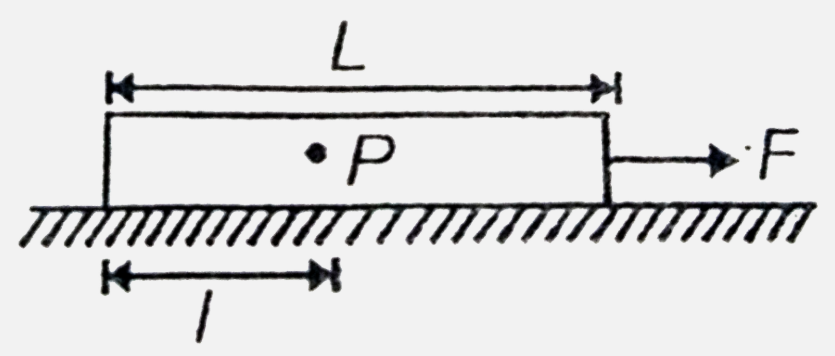
Figure shows a rope of variable mass whose linear mass density is given by , `lambda = Ax` , where A is + ve constant and x is distance from left end . It b is placed on a smooth horizontal surface . A force F is acting on it as shown .
(i) Find total mass of the rope .
(ii) Find tension at point P.

Text Solution

Verified by Experts

(i) Consider a differential element of thickness dx at a distance from left end . Let its mass be dm .
Now, `dm = lambda dx = Axdx`
Total mass, ` M int dm = A overset (L)underset (0) int xdx`
` M = (AL^(2))/2 `
(ii) Net acceleration of the rope is
` a = F/M = (2F)/(AL^(2))`
For system (1)
` T = m_(1)a = (Al_(2))/2 xx (2F)/(AL^(2))`
` T = m_(1)a = (Al_(2))/2 xx (2F)/(AL^(2)) " "[ :'" Here " m_(1) = overset (i) underset (0) int lambda dx = overset (i) underset (0) int Axdx]`
` rArr T = F (l^(2)) /(L^(2)) `
Promotional Banner

Topper's Solved these Questions

  • LAWS OF MOTION

    AAKASH INSTITUTE|Exercise Illustration|5 Videos
  • LAWS OF MOTION

    AAKASH INSTITUTE|Exercise TRY YOURSELF|67 Videos
  • KINETIC THEORY

    AAKASH INSTITUTE|Exercise EXERCISE (ASSIGNMENT) SECTION - D Assertion - Reason Type Questions|10 Videos
  • MAGNETISM AND MATTER

    AAKASH INSTITUTE|Exercise ASSIGNMENT (SECTION D)|26 Videos

Similar Questions

Explore conceptually related problems

The adjacent figure shows a non-uniform metre stick AB having the linear mass density variation lambda = lambda_(0) x , where lambda_(0) is a constant and x is the distance from end A, placed on a smooth horizontal surface. In the first experiment, the rod is pivoted at A and force F is applied perpendicular to the rod at the other end B and in the second experiment, the rod is pivoted at B and the force is applied perpendicular to the rod at the end A. If in the first case angular acceleration is alpha_(A) and in the second case it is alpha_(B) then

Find coordinates of mass center of a non-uniform rod of length L whose linear mass density lambda varies as lambda=a+bx, where x is the distance from the lighter end.

Two blocks A and B of masses m and M are attached with ideal string and pulley, and placed on smooth horizontal surface. Force F is applied horizontally as shown in figure. Find the ratio of the acceleration of A to that of B.

A body of 4 kg mass placed on a smooth horizontal surface experiences a force varying with displacement of block as shown in figure-3.7. Find the speed of the body when force ceases to act on it.

A non-uniform rope of mass M and length L has a variable linear mass density given by mu = kx , where x is the distance from one end of the wire and k is constant. t = sqrt((pML//9F)) where F (constant) is the tension in the wire then and p

A non-uniform wire of length l and mass M has a variable linear mass density given by mu = kx , where x is distance from one end of wire and k is a constant. Find the time taken by a pulse starting at one end to reach the other end when the tension in the wire is T .

Find centre of mass of given rod of linear mass density lambda=(a+b(x/l)^2) , x is distance from one of its end. Length of the rod is l .

Block A of mass 1 kg is placed on the rough surface of block B of mass 3 kg . Block B is placed on smooth horizontal surface. Blocks are given the velocities as shown. Find net work done by the frictional force. [in (-) ve J ]. .

The linear density of a thin rod of length 1m lies as lambda = (1+2x) , where x is the distance from its one end. Find the distance of its center of mass from this end.

AAKASH INSTITUTE-LAWS OF MOTION-Assignment (SECTION-D) (Assertion-Reason Type Questions)
  1. Figure shows a rope of variable mass whose linear mass density is give...

    Text Solution

    |

  2. A : Due to inertia an object is unable to change by itself its state o...

    Text Solution

    |

  3. A : Acceleration of an object in uniform motion is zero. R : No forc...

    Text Solution

    |

  4. A : Newton's second law of motion gives the measurement of force. R ...

    Text Solution

    |

  5. A : According to Newton's third law of motion for every action, there ...

    Text Solution

    |

  6. A : Inertia depends on the mass of an object. R : Greater the mass, ...

    Text Solution

    |

  7. Assertion : In the case of free fall of the lift, the man will feel ...

    Text Solution

    |

  8. A : Static friction force is a self adjusting force. R : The interat...

    Text Solution

    |

  9. Assertion : The value of dynamic friction is less than the limiting fr...

    Text Solution

    |

  10. A : During horizontal circular turn of a car, the centripetal force re...

    Text Solution

    |

  11. A : A person on a frictionless surface can get away from it by blowing...

    Text Solution

    |

  12. A : It is difficult to move a cycle along a road with its brakes on. ...

    Text Solution

    |

  13. A : It makes easier to walk on slippery muddy road if we throw some sa...

    Text Solution

    |

  14. A : Banking of roads reduces the wear and tear of the tyres of automob...

    Text Solution

    |

  15. A : The centripetal and centrifugal forces never cancel each other. ...

    Text Solution

    |

  16. A : Work done by friction can increase the kinetic energy of the body...

    Text Solution

    |

