Home
Class 12
PHYSICS
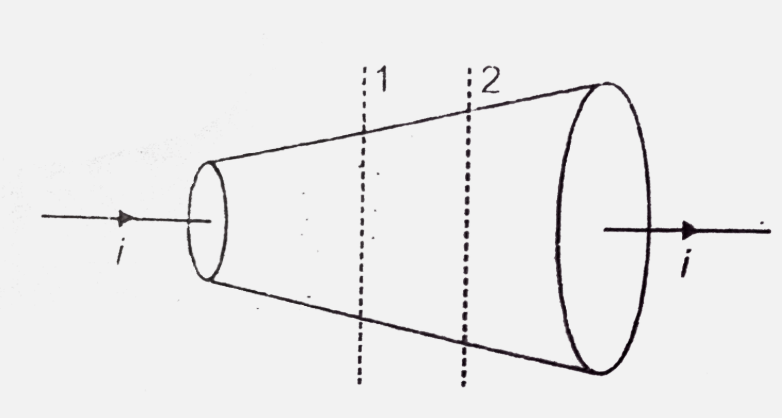
Current I is following through a wire of...

Current I is following through a wire of non-uniform cross-section as shown. Match the following columns.

`{:(,"Column I",,"Column II"),((A),"Current density",(p),"More at section 1 than 2"),((B),"Electric field",(q),"More at section 2 than 1"),((C ) , "Resistance per unit length",(r ),"Same at both section 1 and 2 "),((D ), "Potential difference per unit length",(s),"Data insufficient"):}`

Text Solution

Verified by Experts

The correct Answer is:

A(p), B(p),C(p), D(p)
Promotional Banner

Topper's Solved these Questions

  • CURRENT ELECTRICITY

    AAKASH INSTITUTE|Exercise ASSIGNMENT SECTION-H( INTEGER ANSWER TYPE QUESTIONS)|3 Videos
  • CURRENT ELECTRICITY

    AAKASH INSTITUTE|Exercise ASSIGNMENT SECTION-H ( MULTIPLE TRUE-FALE TYPE QUESTIONS)|5 Videos
  • CURRENT ELECTRICITY

    AAKASH INSTITUTE|Exercise ASSIGNMENT SECTION-E (ASSERTION-REASON TYPE QUESTION)|13 Videos
  • COMMUNICATION SYSTEMS

    AAKASH INSTITUTE|Exercise ASSIGNMENT SECTION D (Assertion-Reason)|10 Videos
  • DUAL NATURE OF RADIATION AND MATTER

    AAKASH INSTITUTE|Exercise ASSIGNMENT (SECTION-D)|10 Videos

Similar Questions

Explore conceptually related problems

Current is flowing through a wire of non-uniform cross section. Cross section of wire at A is les than the cross section of wire at B. Then match the following

Assertion : Current I is flowing through a cylindrical wire of non-uniform cross-section as shown. Section of wire near A will be more heated compared to the section near B. Reason : Current density near A is more.

Match the following {:("Column-I","Column-II"),((A)"unit of length in F.P.S",(p)"m"),((B)"unit of mass in C.G.S",(q)"foot"),((C )"unit of time",(r )"metre"),(,(s)"gm"),(,(t)"second"):}

Match the following. {:(,"Column A",,,"Column B"),((A),"Area/length","( )",(a),"metre"^(-1)),((B),"Mass/volume","( )",(b),"No unit"),((C),"Length/area","( )",(c),"metre"),((D),"Length"^(2)"/area","( )",(d),"kg m"^(-3)):}

Match the following {:("Column-I","Column-II"),((A)"Derived unit",(p)"Height"),((B)"Fundamental unit",(q)"Thickness"),((C )"Derived quantity",(r )"Area"),((D)"Fundamental quantity",(s)"Newton"),(,(t)"Kilogram"):}

Three rods of equal length of same material are joined to form an equivalent triangle ABC as shown figure. Area of cross-section of rod AB is S of rod BC is 2S and that of AC is S , then {:(,"Column-I",,"Column-II"),((A),"Temperature of junction" B,(p),"Greater than" 50^(@)C),((B),"Heat current in" AB,(q),"Less than" 50^(@)C),((C),"Heat current in BC",(r),"Is equal to current in BC"),(,,(s),"Is " 2/3 "times heat current in AC"),(,,(t),"None"):}

{:(,"Column I",,"Column II"),((a),"Work",(p),(W)/(F)),((b),"Kinetic energy",(q),mgh),((c),"Potential energy",(r),(1)/(2) mv^(2)),((d),"Displacement",(s),F xx S):}

Match the following columns. {:(,"Column I",,"Column II"),(A.,"Tesla",p,[ML^(2)A^(-2)T^(-2)]),(B.,"Weber",q,[MLA^(-2)T^(-1)]),(C.,"Weber m"^(-2),q.,[MA^(-1)T^(-2)]),(D.,"Henry",s.,"None"):}

Assertion : If a current is flowing through a conducting wire of non-uniform cross-section, drift speed and resistance both will increase at a section where cross-sectional area is less. Reason : Current density at such sections is more where cross-sectional area is less.
