Home
Class 12
PHYSICS
The fig. shows the variation of photon c...

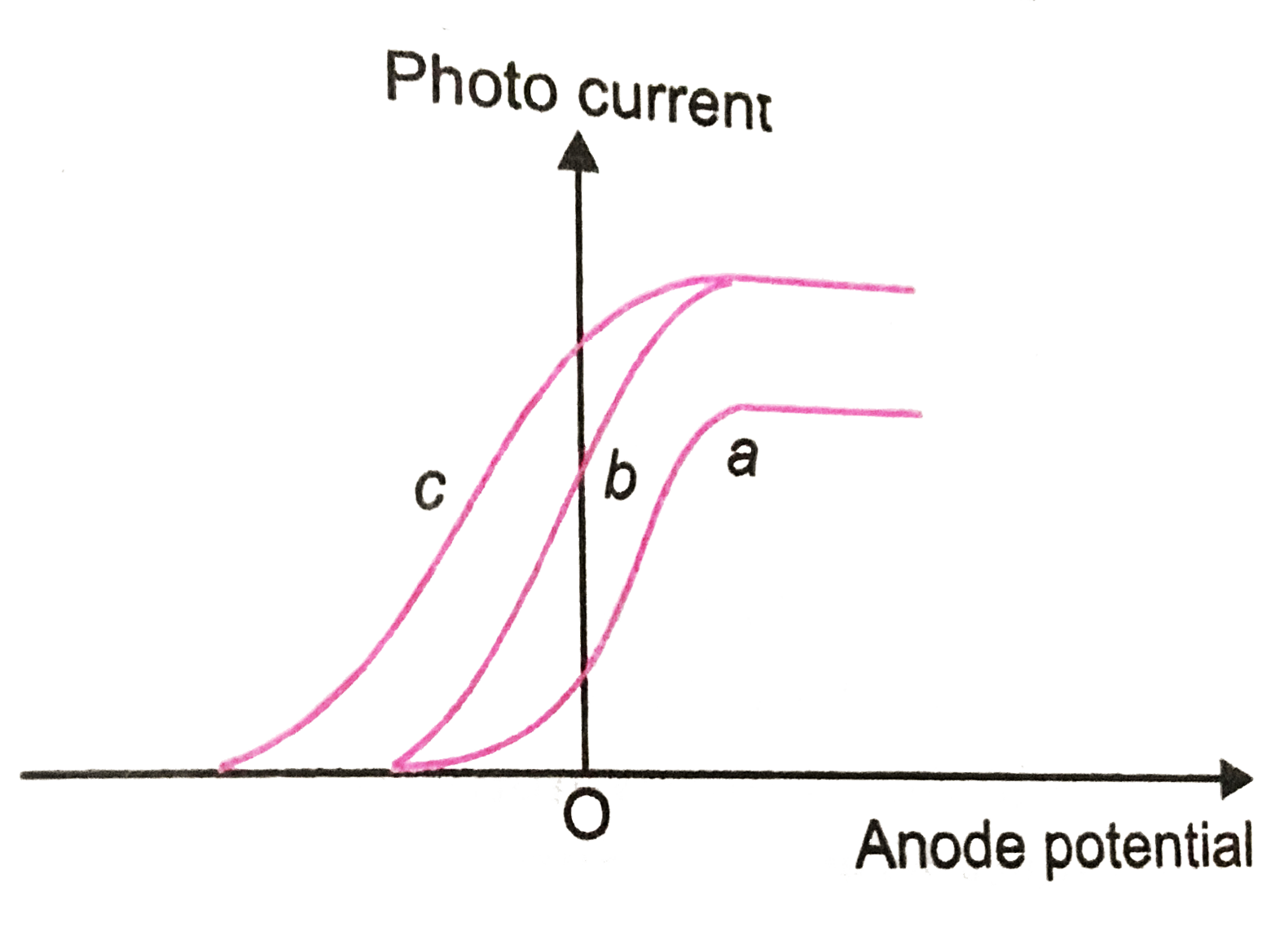
The fig. shows the variation of photon current with anode potential for a photo-sensitive surface for three different radiation. Let `I_(a), I_(b) and I_(c)` be the intensities and `f_(a), f_(b) and f_(c)` be the frequency for the curves a,b and c respectively.

A

`f_(a) = f_(b), l_(a) != l_(b)`

B

`f_(a) = f_(c ), l_(a) = l_(c )`

C

`f_(a) = f_(b), l_(a) = l_(b)`

D

`f_(b) = f_(c), l_(b) = l_(c )`

Text Solution

Verified by Experts

The correct Answer is:

A

stopping potential for a and b are same. Hence `f_(a)=f_(b)` but current `l_(b)` is more than `l_(r )` at zero potential
Promotional Banner

Topper's Solved these Questions

  • TEST PAPERS

    FIITJEE|Exercise PHYSICS|747 Videos
  • SIMPLE HARMONIC MOTION

    FIITJEE|Exercise Assignment Problems (Objective) (Level-II)|20 Videos
  • WORK, ENERGY AND POWER

    FIITJEE|Exercise COMPREHENSIONS ( Comprehension-II)|5 Videos

Similar Questions

Explore conceptually related problems

In the following figure shows the variation of photocurrent with potential of the collector plate for a photosensitive surface for three different radiations. Let I_(a), I_(b) and I_(c) be the intensities and f_(a), f_(b) and f_(c) be the frequencies for the curves a, b, and c, respectively.

The figure shows the variation of photocurrent with anode potential for a photosensitve surface for three different radiations. Let l_a, l_b and l_c be the curves a, b and c, respectively (a) f_a = f_b and l_a != l_b (b) f_a = f_c and l_a = l_c (c ) f_a = f_b and l_a = l_b (d) f_b = f_c and l_b = l_c

The figure shows a plot of photo current versus anode potential for a photosensitive surface for three different radiations. Which one of the following is a correct statement ?

The Fig shows a plot of three curves a, b, c showing the variation of photocurrent versis collector plate potential for the different intensities I_1, I_2 and I_3 having frequencies v_1, v_2 and v_3 respectively, incident on a photosensitive surface. Point out the two curves for which the incident radiation have same frequency but different intensities.

If f is a bijection and g is the inverse of f ,then fog=I_(B and gof=I_(A) where I_(A) and I_(B) are ) the identively. respectively.

In a plot of photoelectric current versus anode potential, how does (i) the saturation current vary with anode potential for incident radiations of different frequencies but same intensity? (ii) the stopping potential vary for incident radiations of different intensities but the same frequency? (iii) Photoelectric current vary of different intensities but same frequency of incident radiation? justify your answer is each case.

FIITJEE-TEST PAPERS-PHYSICS
  1. If a single slit fraunhoffer diffraction set up is used with light of ...

    Text Solution

    |

  2. A thin slice is cut out of a glass cylinder along a plane parallel to ...

    Text Solution

    |

  3. The fig. shows the variation of photon current with anode potential fo...

    Text Solution

    |

  4. Lead is a good absorber of X rays. Specific gravity of Pb = 11.5. To c...

    Text Solution

    |

  5. M(x) and M(y) denote the atomic masses of the parent and the daughter ...

    Text Solution

    |

  6. Power emitted per unit area of a black body is R " watt/m"^(2). At wha...

    Text Solution

    |

  7. The figure shows the initial position of a point source of light s, a ...

    Text Solution

    |

  8. The figure shows a portion of a circuit. Resistor are known and indica...

    Text Solution

    |

  9. A liquid of density rho has to spray with help of aspirator pump at he...

    Text Solution

    |

  10. A non uniform cylinder of mass m, length l and radius r having its C.O...

    Text Solution

    |

  11. A solid object is rotating freely without experiencing any extermal to...

    Text Solution

    |

  12. A 10 cm cube of meatl is fastened rigidly in place. A second, identica...

    Text Solution

    |

  13. In a lake, stream direction is as shown in the figure. A man starting ...

    Text Solution

    |

  14. A particlele is projected vertically upwards from the ground with a sp...

    Text Solution

    |

  15. Which of the following forces in non conservation one ?

    Text Solution

    |

  16. In the figure shown, the wedge is fixedand the masses are released fro...

    Text Solution

    |

  17. A disk is fixed at its centre O and rotating with constant angular vel...

    Text Solution

    |

  18. Magnetic field B in a cylindrical region of radius r varies according ...

    Text Solution

    |

  19. In the circuit shown in the adjacent figure, the batteries are ideal. ...

    Text Solution

    |

  20. A parallel plate capacitor of area A and separation d is provided with...

    Text Solution

    |
