Home
Class 12
PHYSICS
The system is released from rest from th...

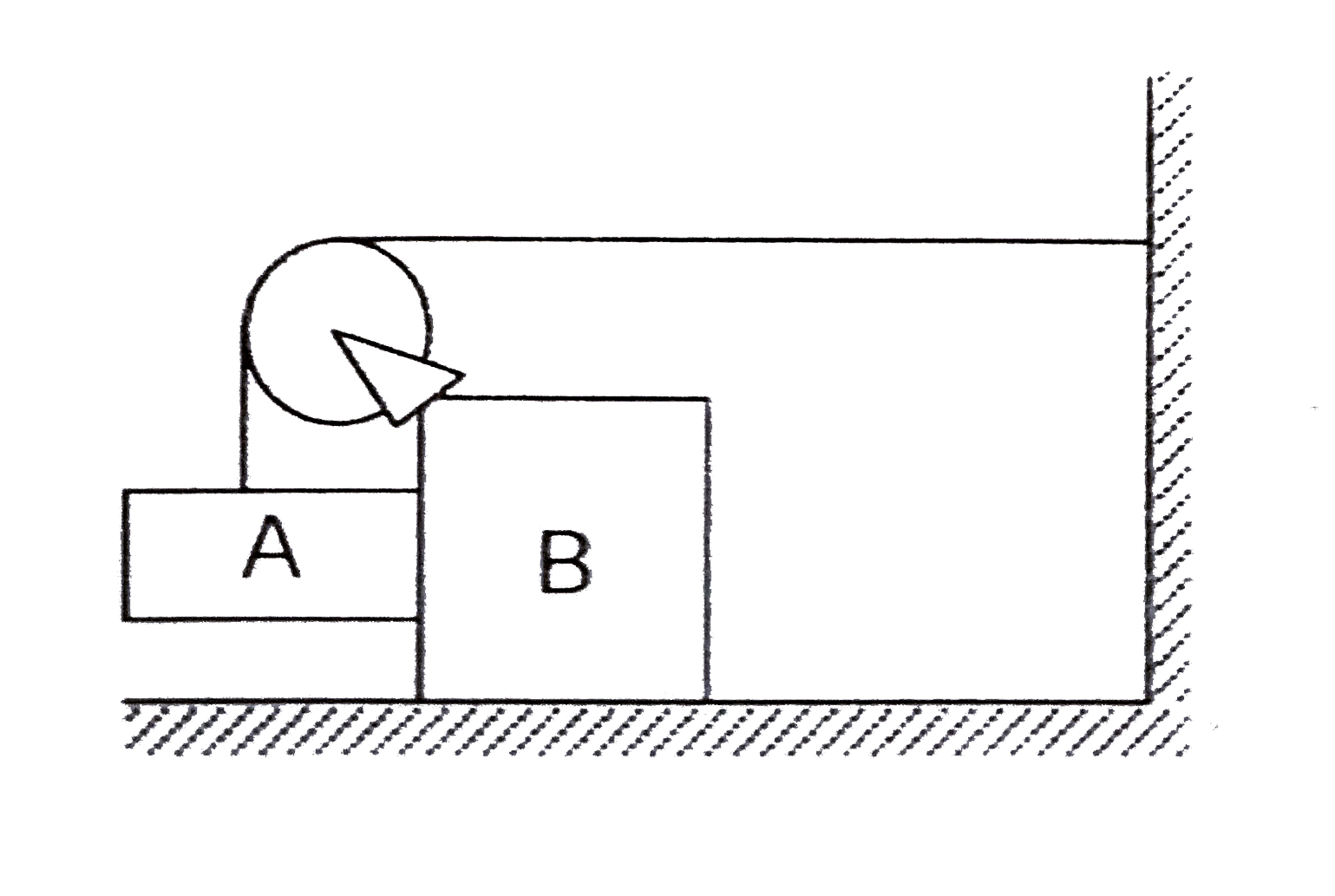
The system is released from rest from the positon shown in the diagram. If A and B has mass m and M respectively and all surfaces are smooth, then the normal reaction between A and B is

A

`(2 M)/(M + m)`

B

`(Mmg)/(2 (M + m))`

C

`(Mmg)/((M + m))`

D

zero

Text Solution

Verified by Experts

The correct Answer is:

D

Zero in fact A will be inclined away from the vertical at some angle.
Promotional Banner

Topper's Solved these Questions

  • TEST PAPERS

    FIITJEE|Exercise PHYSICS|747 Videos
  • SIMPLE HARMONIC MOTION

    FIITJEE|Exercise Assignment Problems (Objective) (Level-II)|20 Videos
  • WORK, ENERGY AND POWER

    FIITJEE|Exercise COMPREHENSIONS ( Comprehension-II)|5 Videos

Similar Questions

Explore conceptually related problems

A small ball of mass m is released from rest from the position shown . All contact surface are smooth . The speed of the ball when it reaches its lowest position is

In the system shown in figure, mass m is released from rest from position A. Suppose potential energy of m at point A with respect to point B is E. Dimensions of m negligible and all surfaces are smooth. When mass reaches at point B.

A block of mass m is released from rest ffrom point A which rests on a semi circular groove as shown in the diagram. Find value of normal reaction between the vertical wall and the large block of mass M when m reaches at B.

In the figure shown A and B are free to move . All the surface are smooth. Mass of A is m . Then

A smooth block of mass m is held stationary on a smooth wedge of mass M and inclination theta as shown in figure .If the system is released from rest , then the normal reaction between the block and the wedge is

Blocks A and B shown in the figure are having equal masses m. The system is released from rest with the spring unstretched. The string between A and ground is cut, when there is maximum extension in the spring. The acceleration of centre of mass of the two blocks at this instant is

FIITJEE-TEST PAPERS-PHYSICS
  1. In a tug of war, the team that exerts a larger tangential foce on the ...

    Text Solution

    |

  2. The magnetic field of a cylindrecal magnet that has a pole - face rad...

    Text Solution

    |

  3. The system is released from rest from the positon shown in the diagram...

    Text Solution

    |

  4. A transmitter supplies 9 kw to the aerial when unmodulated. The power ...

    Text Solution

    |

  5. The combination of the gates shown in figure produces

    Text Solution

    |

  6. Two radioactive X(1) and X(2) have decay constants 10 lambda and lamb...

    Text Solution

    |

  7. When the hydrogen atom is raised from the ground state to fifth state

    Text Solution

    |

  8. An an ideal parallel LC circuit, the capacitor is charged by connectin...

    Text Solution

    |

  9. The graph between (1)/(v) and (1)/(u) for a concave mirror looks like.

    Text Solution

    |

  10. In a voltage regulating of zener diode, the graph of output voltage v(...

    Text Solution

    |

  11. From ideal instruments, current measured is I = 10.0 amp, potential di...

    Text Solution

    |

  12. A cube of mass m and side a is moving along a plane with constant spee...

    Text Solution

    |

  13. A disc of radius R is rolling purely on a flat horizontal surface, wit...

    Text Solution

    |

  14. A small mass slides down an inclined plane of inclination theta the ho...

    Text Solution

    |

  15. Acceleration of a paritcle moving in x-y plane varies with time t as. ...

    Text Solution

    |

  16. Both the blocks as shown in figure are given together a horizontal vel...

    Text Solution

    |

  17. Figure here shows the vertical cross-section of a vessel filled with a...

    Text Solution

    |

  18. Show that the volume thermal expansion coefficient for an ideal gas at...

    Text Solution

    |

  19. A heavy but uniform rope of lenth L is suspended from a ceiling. (a) W...

    Text Solution

    |

  20. A particle moves according to the law, x=acos(pit//2). . What is the d...

    Text Solution

    |
