Home
Class 11
PHYSICS
Two cubes of masses m1 and m2 be on two ...

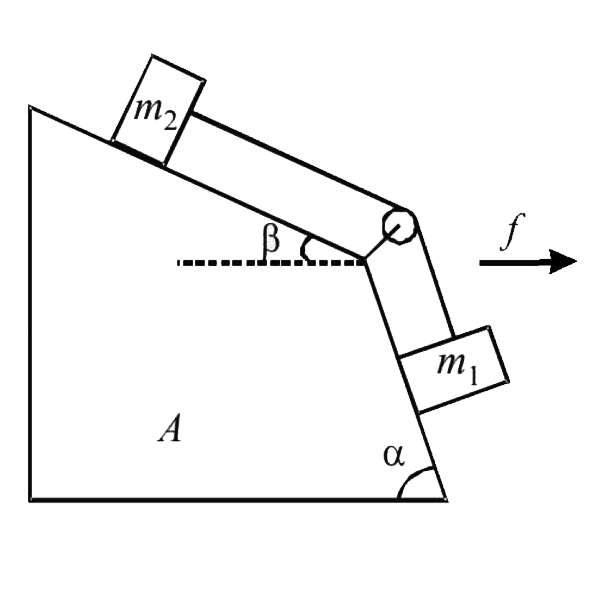
Two cubes of masses `m_1` and `m_2` be on two frictionless slopes of block A which rests on a horizontal table. The cubes are connected by a string which passes over a pulley as shown in figure. To what horizontal acceleration f should the whole system (that is blocks and cubes) be subjected so that the cubes do not slide down the planes. What is the tension of the string in this situation?

Text Solution

Verified by Experts

The correct Answer is:

`T=(m_(1)m_(2)g sin(alpha-beta))/(m_(1)cos alpha+m_(2)cos beta)`

If the block has an acceleration towards right,the blocks would have some acceleration towards left. Resoving horizontally and vertically, we have
`R_(2)=m_(2)g cos beta +m_(2)f sin beta .....(1)`
`m_(2)f=Tcos beta +R_(2) sin beta ......(2)`
and
`R_(1)=m_(1)g cos alpha+m_(1)fsin alpha .....(3) m_(1)f=R_(1) sin alpha alpha - T cos alpha ......(4)`
From equaiton `(2)` and `(1)` , we get
`m_(2)f=T cos beta +[m_(2)g cos beta +m_(2)fsinbeta]sin beta`
`=T cos beta +m_(2)g cos beta sin beta +m_(2)f sin^(2)beta`
`:. T cos beta =m_(2)f-m_(2)fsin^(2)beta-m_(2)g cos beta sin beta `
`or T cos beta m_(2) cos^(2) beta-m_(2)beta cos beta sin beta`
`or T=m_(2)fcos beta -m_(2)g sin beta .....(5)`
From equations `(3)` and `(4)` , we have
`m_(1)f=(m_(1)gcos alpha+m_(1)f sin alpha)sin alpha-T cos alpha`
`=m_(1)g cos alpha sin alpha+m_(1)f sin^(2)alpha-T cos alpha `
`:. T cos alpha=m_(1)g cos alpha sin alpha +m_(1)f(sin^(2)alpha-1)`
`or T =m_(1)g sin alpha-m_(1)f cos alpha ....(6)`
Equating `(5)` and `(6)`, we get
`m_(2)f cos alpha -m_(2)g sin beta=m_(1)g sin alpha-m_(1)f cos alpha `
`:. f=g^(g)[((m_(1)sinalpha+m_(2)sinbeta))/((m_(2)cos beta+m_(1)cos alpha))] ....(7)`
Substituting the value of `f` in `eqn. (6)`, we get
`T=m_(1)g sin alpha - m_(1)g`
`{((m_(1)sin alpha+m_(2)sinbeta))/((m_(2)cos beta+m_(1)cos alpha))}cos alpha`
Simplifying , we get
`T=(m_(1)m_(2)gsin(alpha-beta))/(m_(1)cosalpha+m_(2)cos beta)Ans.`
Promotional Banner

Topper's Solved these Questions

  • DAILY PRACTICE PROBLEMS

    RESONANCE|Exercise dpp 26|8 Videos
  • DAILY PRACTICE PROBLEMS

    RESONANCE|Exercise dpp 27|3 Videos
  • DAILY PRACTICE PROBLEMS

    RESONANCE|Exercise TRUE/FALSE|2 Videos
  • CURRENT ELECTRICITY

    RESONANCE|Exercise Exercise|54 Videos
  • ELASTICITY AND VISCOCITY

    RESONANCE|Exercise Advanced Level Problems|9 Videos

Similar Questions

Explore conceptually related problems

Two cubes of masses m_(1) and m_(2) lie on two frictionless slopes of the block A which rests on horizontal table. The cubes are connected by a string, which passes over a pulley as shown in the figure-2.67. To what horizontal acceleration "f" the block accelerates so that the cubes do not slide down the planes ? What is the tension in the string in this situation ? [f=g((m_(1)sinalpha+m_(2)sinbeta)/(m_(1)cosalpha+m_(2)cosbeta)),T = (m_(1)m_(2)gsin(alpha-beta))/(m_(1)cosalpha+m_(2)cosbeta)]

Two blocks of masses of 40 kg and 30 kg are connected by a weightless string passing over a frictionless pulley as shown in the figure.

Two masses of 8 kg and 4 kg are connected by a string as shown in figure over a frictionless pulley.The acceleration of the system is

Two blocks A and B , each of mass 10 kg , are connected by a light string passing over a smooth pulley as shown in the figure. Block A will remain at rest if the friction on it is

Two blocks of masses 3 kg and 6 kg are connected by a string as shown in the figure over a frictionless pulley. The acceleration of the system is

Two identical masses are attached by a light string that passes over a small pulley, as shown . The table and the pulley are frictionless. The hanging block is moving

Two block of masses m_(1) and m_(2) are lying on a frictionless horizontal table connected by a light string m_(2) is pulled by horizontal force F. Calculate the tension in the string .
