Home
Class 11
PHYSICS
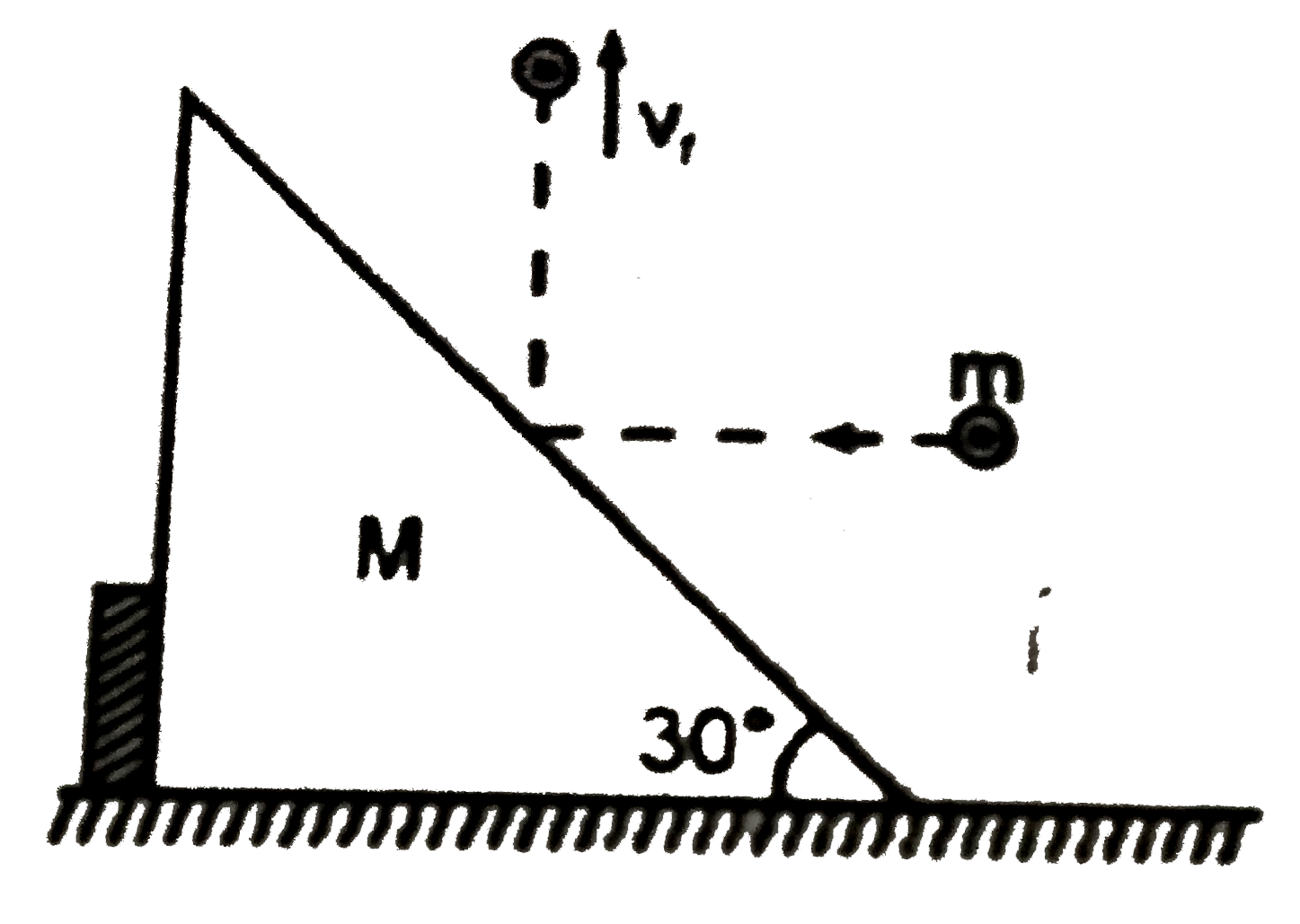
As shown in the figure a body of mass m...

As shown in the figure a body of mass `m` moving horizontally with speed `sqrt(3) m//s` hits a fixed smooth wedge and goes up with a velocity `1v_(t)` in the vertical direction. If `/_` of wedge is `30^(@)`, the velocity `v_(f)` will be `:`

A

`sqrt(3)m//s`

B

`3m//s`

C

`(1)/(sqrt(3))m//s`

D

this is not possible

Text Solution

Verified by Experts

The correct Answer is:

D

Velocity along the plane does not change
So `sqrt(3)Sin f o^(@)=V_(1)sin 30^(@)`
`rArrV_(1)=3m//sgt sqrt(3)m//s`
Which in impossible `:. Ans. (D)`
Promotional Banner

Topper's Solved these Questions

  • DAILY PRACTICE PROBLEMS

    RESONANCE|Exercise dpp 56|7 Videos
  • DAILY PRACTICE PROBLEMS

    RESONANCE|Exercise dpp 57|7 Videos
  • DAILY PRACTICE PROBLEMS

    RESONANCE|Exercise dpp 54|8 Videos
  • CURRENT ELECTRICITY

    RESONANCE|Exercise Exercise|54 Videos
  • ELASTICITY AND VISCOCITY

    RESONANCE|Exercise Advanced Level Problems|9 Videos

Similar Questions

Explore conceptually related problems

As shown in the figure a body of mass m moving vertically with speed 3 m/s hits a smooth fixed inclined plane and rebounds with a velocity v_(f) in the horizontal direction . If angle of plane with horizontal is 30^(@) , the velocity v_(f) will be

A wedge mass m rest on horizontal surface. The inclination of the wedge is alpha . A ball of mass m moving horizontal with speed u hits the inclined face of the wedge in elastically and after hitting slides up the inclined face of the wedge. Find the velocity of the wedge just after collision. Neglect any friction.

A body of mass m moving at a constant velocity v hits another body of the same mass moving with a velocity v//2 but in the opposite direction and sticks to it. The common velocity after collision is

A body of mass m moving with a constant velocity v hits another body of the same mass moving with the same velocity v but in the opposite direction and sticks to it. The velocity of the compound body after collision is

A particle of mass m moving horizontal with v_(0) strikes a smooth wedge of mass M, as shown in figure. After collision, the ball starts moving up the inclined face of the wedge and rises to a height h. The final velocity of the wedge v_(2) is

A system is shown in the figure. Block A is moving with 1m//s towards left. Wedge is moving with 1m//s towards right. Then speed of the block B will be :

A body of mass m moving with a velocity v in the x direction collides with another body of mass M moving in y direction with a velocity V . They coalesce into one body during collision.

A mass m moving horizontal (along the x-axis) with velocity v collides and stricks to mass of 3m moving vertically upward (along the y-axis) with velocity 2v . The final velocity of the combination is
