Home
Class 11
PHYSICS
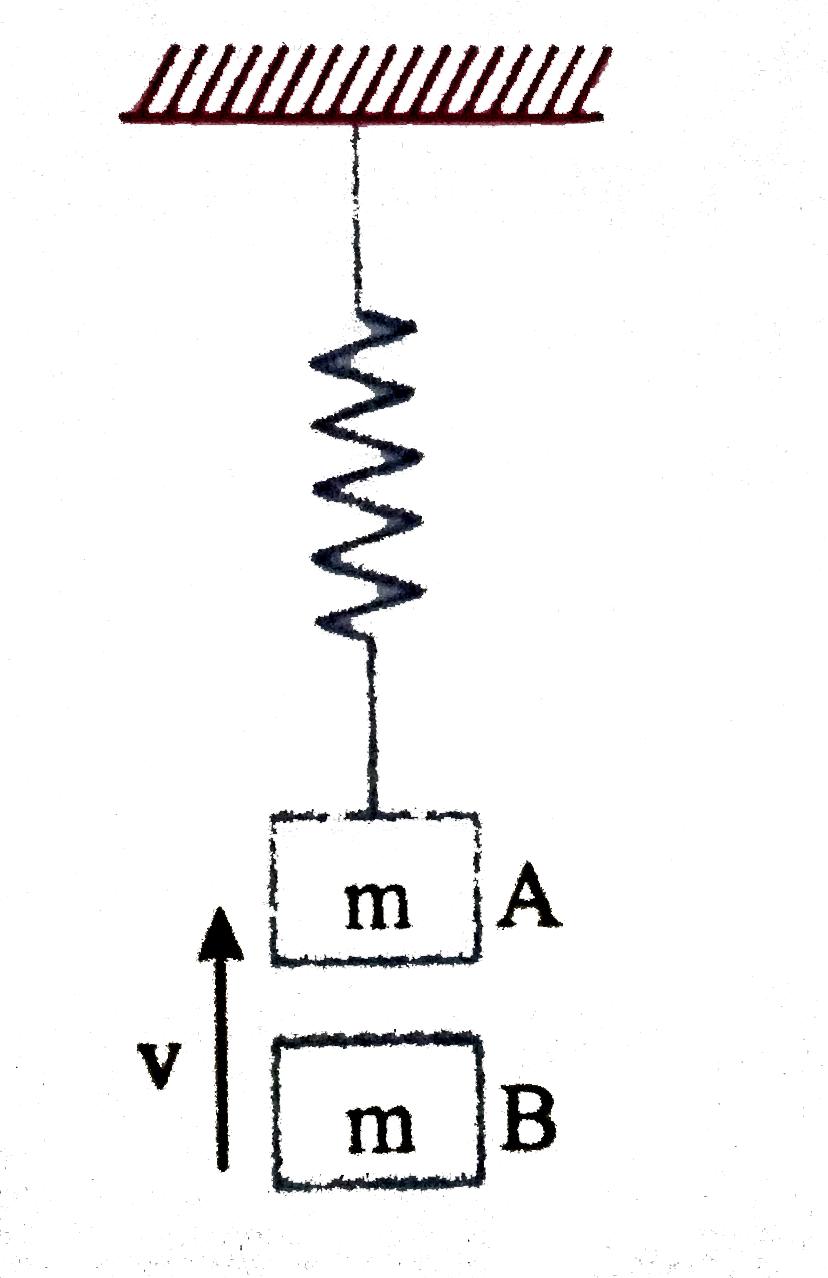
Block A is hanging from vertical spring ...

Block `A` is hanging from vertical spring of spring constant `K` and is rest. Block `B` strikes block `A` with velocity `v` and sticks to it. Then the value of `v` for which the spring just attains natural length is

A

`sqrt((60mg^(2))/(k))`

B

`sqrt((60mg^(2))/(k))`

C

`sqrt((10mg^(2))/(k))`

D

None of these

Text Solution

Verified by Experts

The correct Answer is:
B

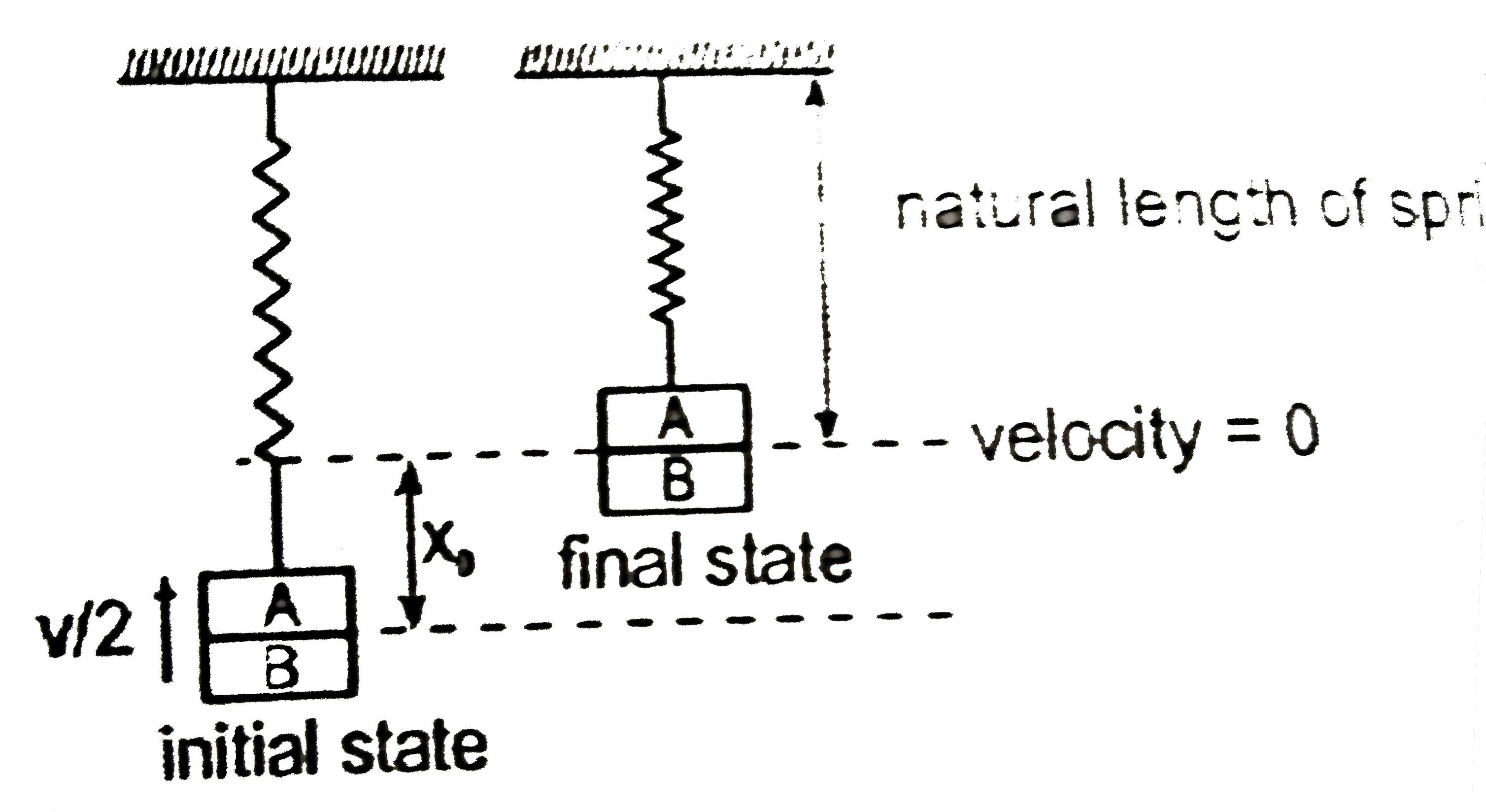
`(B)` The initial extension in spring is `x_(0)=(mg)/(k)` Just after collision of `B` with `A` the speed of combined mass is `(v)/(2)`.
For the spring to just attain natural length the combined mass must rise up by `x_(0)=(mg)/(k) (` sec. fig. `)` and comes to rest.

Applying conservation of energy between initial and final states
`(1)/(2)2m((v)/(2))^(2)+(1)/(2)k((mg)?(k))^(2)=2mg((mg)/(k))`
Solving we get `v=sqrt((6mg^(2))/(k))`
Promotional Banner

Topper's Solved these Questions

  • DAILY PRACTICE PROBLEMS

    RESONANCE|Exercise dpp 57|7 Videos
  • DAILY PRACTICE PROBLEMS

    RESONANCE|Exercise dpp 58|9 Videos
  • DAILY PRACTICE PROBLEMS

    RESONANCE|Exercise DPP 55|8 Videos
  • CURRENT ELECTRICITY

    RESONANCE|Exercise Exercise|54 Videos
  • ELASTICITY AND VISCOCITY

    RESONANCE|Exercise Advanced Level Problems|9 Videos

Similar Questions

Explore conceptually related problems

Block A is hanging from a vertical spring and is at rest. Block B strikes the block A with velocity v and sticks to it. Then the value of v for which the spring just attains natural length is

A block A of mass 2m is hanging from a vertical massless spring of spring constant k and is in equilibrium. Another block B of mass m strikes the block A with velocity u and sticks to it as shown in the figure. The magnitude of the acceleration of the combined system of the blocks just after the collision is

The ball strikes the block and sticks to it. Find the maximum compression of spring. ( L : natural length of spring)

A block Q of mass 2m is placed on a horizontal frictionless plane. A second block of mass m is placed on it and is connected to a spring of spring constant K, the two block are pulled by distance A. Block Q oscillates without slipping. The work done by the friction force on block Q when the spring regains its natural length is:

A block of mass m, attacted to a string of spring constant k, oscillates on a smooth horizontal table. The other end of the spring is fixed to a wall. The block has a speed v when the spring is at its natural length. Before coming to an instantaneous rest. If the block moves a distance x from the mean position, then

A block of mass m hangs from a vertical spring of spring constant k. If it is displaced from its equilibrium position, find the time period of oscillations.

Two blocks A and B of masses m and 2m are connected by a massless spring of natural length L and spring constant k . The blocks are intially resting on a smooth horizontal floor with the spring at its natural length , as shown . A third identical block C of mass m moves on the floor with a speed v_(0) along the line joining A and B and collides elastically with A . FInd (a) the velocity of c.m. of system (block A + B + spri ng) and (b) the minimum compression of spring.

