Home
Class 11
PHYSICS
A particle of mass m is moving along the...

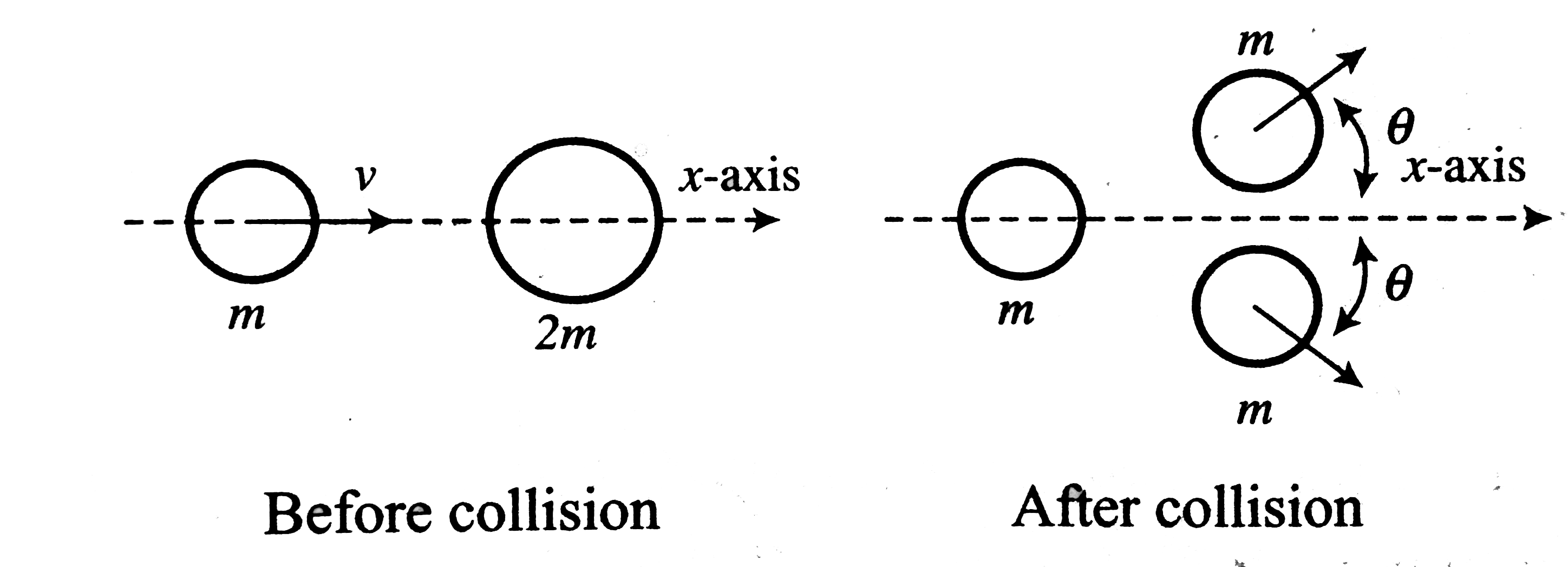
A particle of mass `m` is moving along the `x`-axis with speed v when It collides with a particle of mass `2m` initially at rest. After the collision, the first particle has come to rest and the second particle has split into two equal-mass pieces that are shown in the figure. Which of the following statements correctly describes the speeds of the two places? `(thetagt0)`

A

Each piece moves with speed `v`.

B

Each pece moves with speed `v//2`

C

One of the pieces moves with speed `v//2`, the othher moves with speed greater than `v//2`

D

Each piece moves with speed greater than `v//2`

Text Solution

Verified by Experts

The correct Answer is:
D

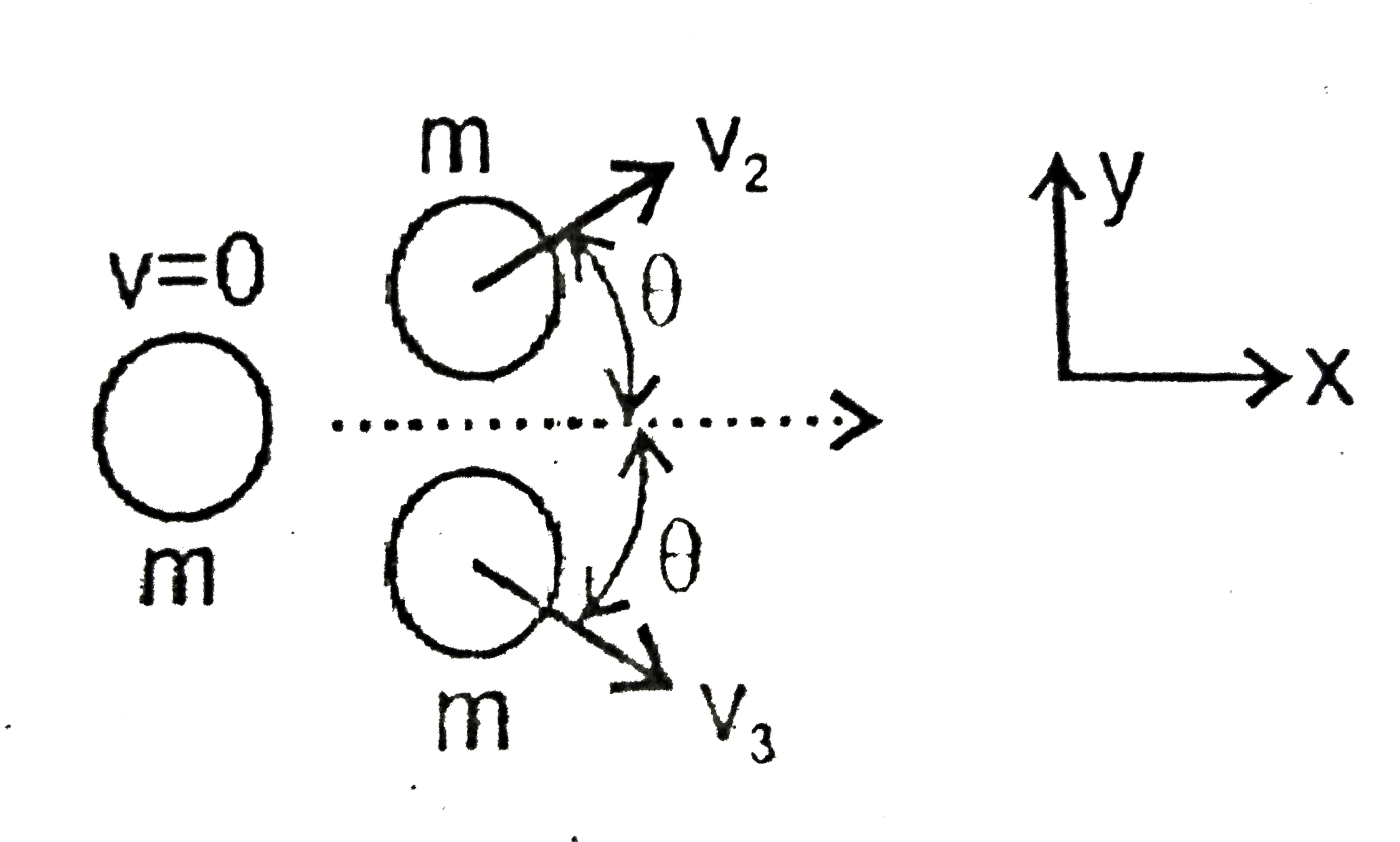
After collision by momentum conservation Along `y-` axis

`0=0+mv_(2)sin theta -mv_(3)sin theta `
`rArr v_(2)=v_(3)`
Along `x-` axis
`mv=0+mv_(2)cos theta +mv_(3)cos theta `
`mv=2mv_(2)cos theta`
`v_(2)=(v)/(2)(1)/(cos theta )` so `v_(2)=v_(3)lt(v)/(2):' cos theta lt1`
Promotional Banner

Topper's Solved these Questions

  • DAILY PRACTICE PROBLEMS

    RESONANCE|Exercise dpp 67|2 Videos
  • DAILY PRACTICE PROBLEMS

    RESONANCE|Exercise dpp 68|7 Videos
  • DAILY PRACTICE PROBLEMS

    RESONANCE|Exercise DPP 65|5 Videos
  • CURRENT ELECTRICITY

    RESONANCE|Exercise Exercise|54 Videos
  • ELASTICITY AND VISCOCITY

    RESONANCE|Exercise Advanced Level Problems|9 Videos

Similar Questions

Explore conceptually related problems

A particle of mass m moving with speed V collides eleastically with another particle of mass 2mFind speed of smaller mass after head on collision

A particle of mass m moving with velocity u collides elastically head on with a particle of mass 2m at rest. After collision the heavier particle moves with velocity?

A particle of mass m moving with speed u collides perfectly inelastically with another particle of mass 3 m at rest. Loss of KE of system in the collision is

A particle of mass m moving with velocity vecV makes a head on elastic collision with another particle of same mass initially at rest. The velocity of the first particle after the collision will be

A particle P moving with speed v undergoes a head -on elastic collision with another particle Q of identical mass but at rest. After the collision the collision

A particle of mass 0.1kg moving with an initial speed v collides with another particle of same mass kept at rest. If after collision total energy becomes 0.2J . Then

A particle of mass m with an initial velocity u hati+2u hatj collides with a particle of mass 3m at rest. After collision, the two particles stick together and the combined particle moves with a velocity v hati+v' hatj . Which of the following is incorrect?

