Home
Class 11
PHYSICS
A block of mass m(1)=1kg is attached to ...

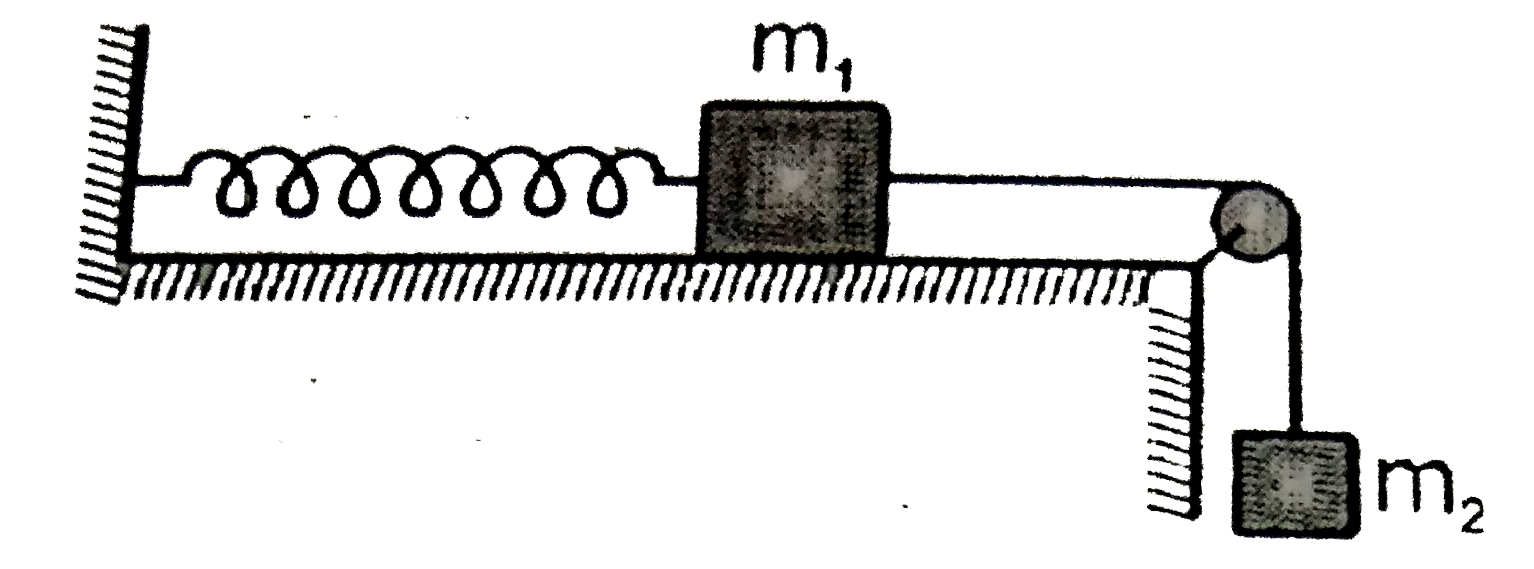
A block of mass `m_(1)=1kg` is attached to a spring of force constant `k=24N//cm` at one end and attached to a string tensioned by mass `m_(2)=5kg` . Dedcue the frequency of oscillaitons of the system. If `m_(2)` is initially supported in hand and then suddenly released, find

`(a)` instantaneous tension just after `m_(2)` is released . ltbr. `(b)` the maximum displacement of `m_(1)`.
`(c)` the maximum and minimum tensions in the string during oscillations.

Text Solution

Verified by Experts

The correct Answer is:

A, B, C

`T=2pisqrt((m_(1)+m_(2))/(K))`
`=2pi sqrt((6)/(2400))=(pi)/(10)`
`rArr f=(10)/(pi)`
Instantaneous tension just after `m_(2)` is released will be zero as the spring is unstressed.
Amplitude of `m_(1)=m_(2)g//K=25//12 cm`, hence maximum displacement of `m_(1) ` will be `25//6 cm`.
Promotional Banner

Topper's Solved these Questions

  • DAILY PRACTICE PROBLEMS

    RESONANCE|Exercise dpp 75|5 Videos
  • DAILY PRACTICE PROBLEMS

    RESONANCE|Exercise dpp 76|5 Videos
  • DAILY PRACTICE PROBLEMS

    RESONANCE|Exercise dpp73|4 Videos
  • CURRENT ELECTRICITY

    RESONANCE|Exercise Exercise|54 Videos
  • ELASTICITY AND VISCOCITY

    RESONANCE|Exercise Advanced Level Problems|9 Videos

Similar Questions

Explore conceptually related problems

A block of mass 0.2 kg is attached to a mass less spring of force constant 80 N/m as shown in figure. Find the period of oscillation. Take g=10 m//s^(2) . Neglect friction

Two bodies with masses m_(1) = 1kg and m_(2) = 2kg are connected by a spring of force constant k=24Nm^(-1) . The left ball is imparted an initial velocity v_(0) =12 cm/s. Find (a) the frequency of the oscillations (b) the energy and the amplitude of the osciallations.

A block of mass m attached with a an ideal spring of force constant k is placed on a rough inclined plane having inclination theta with the horizontal and coefficient of friction mu=1//2 tan theta , Initially the block is held stationary with the spring in its relaxed state, find the maximum extension in the spring if the block is released.

Two blocks of mass m_(1) and m_(2) are connected by a spring of force constant k. Block of mass m_(1) os pulled by a constant force f_(2) [see fig 4E.19 (a)] find the maximum elongation in the spring .

A block of mass m held touching the upper end of a light spring of force constant K as shown in figure. Find the maximum potential energy stored in the spring if the block is released suddenly on the spring.

A block of mass m = 2 kg is attached to two unstretched spring of force constant k_(1)=100 N//m and k_(2)=125 N//m The block is displaced towards left through a distance of 10 cm and released. Find the speed of the block as it passes through the mean position.

A spring of force constant 1200Nm^(-1) is mounted on a horizontal table as shown in figure. A mass of 3.0kg is attached to the free end of the spring, pulled side ways to a distance of 2.0cm and released. Determing. (a) the frequency of oscillation of the mass. (b) the maximum acceleration of the mass. (c) the maximum speed of the mass.

Two blocks of masses m_(1) =1kg and m_(2) = 2kg are connected by a spring of spring constant k = 24 N/m and placed on a frictionless horizontal surface. The block m_(1) is imparted an initial velocity v_(0) = 12cm/s to the right. The amplitude of osciallation is

A block of mass 1 kg is attached to one end of a spring of force constant k = 20 N/m. The other end of the spring is attached to a fixed rigid support. This spring block system is made to oscillate on a rough horizontal surface (mu = 0.04) . The initial displacement of the block from the equilibrium position is a = 30 cm. How many times the block passes from the mean position before coming to rest ? (g = 10 m//s^(2))
