Home
Class 11
PHYSICS
A rod of 1.5m length and uniform density...

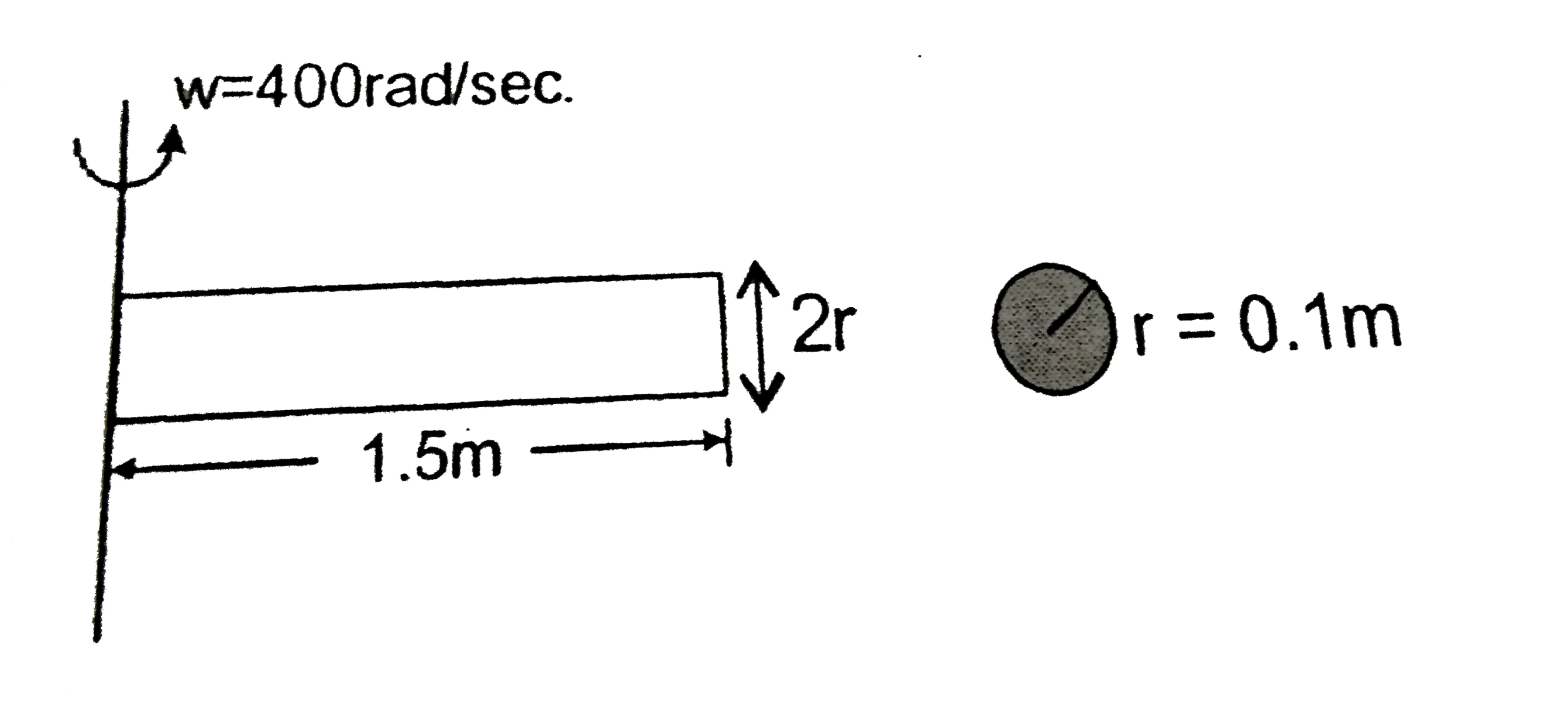
A rod of `1.5m` length and uniform density `10^(4)kg//m^(3)` is rotating at an angular velocity `400 rad//sec` about its one end in a horizontal plane. Find out elongation in rod.
Given `y=2xx10^(11)N//m^(2)`

Text Solution

Verified by Experts
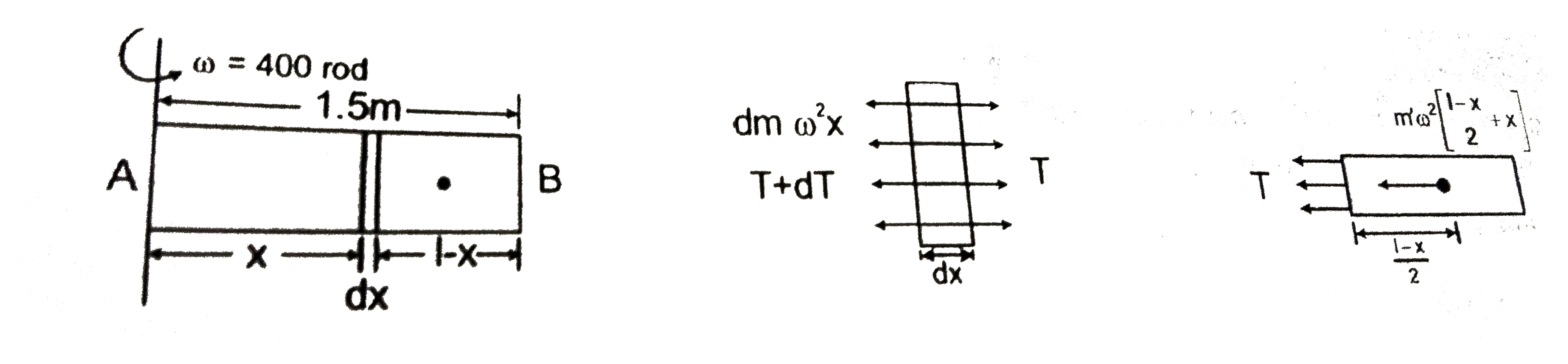
mass of shaded portion
`m'-(m)/(l)(l-x) [` where `m=` total mass `rhoAl]`
`T=m'omega^(2)[(l-x)/(2)+x] rArrT=(m)/(l)(l-x)omega^(2)((l+x)/(2)) T=(momega^(2))/(2l)(l^(2)-x^(2))`

this tension will be maximum at `A((m omega^(2)l)/(2))` and minum at 'B' (zero), elongation in element of width `dx'=(Tdx)/(Ay)`
Total elongation
`delta=int(Tdx)/(Ay)=underset(0)overset(l)int(m omega^(2)(l^(2)-x^(2)))/(2lAy)dx`
`delta=(momega^(2))/(2lAy)[l^(2)x-(x^(3))/(3)]_(0)^(l)=(momega^(2)xx2l^(3))/(2lAyxx3)=(momega^(2)l^(2))/(3Ay)=(rho Alomega^(2)l^(2))/(3Ay)`
`delta=(rhoomega^(2)l^(3))/(3y)=(10^(4)xx(400)xx(1.5)^(3))/(3xx2xx10^(11))=9xx10^(-3)m=9mm`
Promotional Banner

Topper's Solved these Questions

  • DAILY PRACTICE PROBLEMS

    RESONANCE|Exercise dpp 90 Illustration|2 Videos
  • DAILY PRACTICE PROBLEMS

    RESONANCE|Exercise dpp 91 illustration|2 Videos
  • DAILY PRACTICE PROBLEMS

    RESONANCE|Exercise Now answer the following :|20 Videos
  • CURRENT ELECTRICITY

    RESONANCE|Exercise Exercise|54 Videos
  • ELASTICITY AND VISCOCITY

    RESONANCE|Exercise Advanced Level Problems|9 Videos

Similar Questions

Explore conceptually related problems

A uniform rod of length 1m and mass 0.5 kg rotates at angular speed of 6 rad//sec about one of its ends. What is the KE (in joule) of the rod ?

A thin uniform metallic rod of length 0.5 m and radius 0.1 m rotates with an angular velocity 400rad/s is a horizontal plane about a vertical axis passing through one of its ends. Calculate (a) tenstion in the rod and (b) the elogation of te rod. The density of material of the rod is 10^(4)kg//m^(3) and the young's modulus is 2xx10^(11)N//m^(2)

A rod of mass 2 kg ad length 2 m is rotating about its one end O wth an angular velocity omega=4rad//s . Find angular momentum of the rod about the axis rotation.

A copper wire of negligible mass, 1 m length and cross-sectional area 10^(6) m^(2) is kept on a smooth horizontal table with one end fixed. A ball of mass 1 kg is attached to the other end. The wire and the ball are rotating with an angular velocity of 20 rad//s . If the elongation in the wire is 10^(-3) m . a. Find the Young's modulus of the wire (in terms of xx 10^(11) N//m^(2) ). b. If for the same wire as stated above, the angular velocity is increased to 100 rad//s and the wire breaks down, find the breaking stress (in terms of xx 10^(10) N//m^(2) ).

A body of mass 1 kg is fastened to one end of a steel wire of cross- section area 3 xx 10^(-6)m^(2) and is rotated in horizantal circle of radius 20 cm with a constant speed 2 m//s . Find the elongation of the wire (Y= 2 xx 10^(11) N//m^(2))

A metal rod of length 2 m is rotating with an angular velocity of 100 rad//sec in a plane perpendicular to a uniform magnetic field of 0.3 T . The potential difference between the ends of the rod is

A unifrom rod AB of length 4m and mass 12 kg is thrown such that just after the projection the centre of mass of the rod moves vertically upwards with a velocity 10 m//s and at the same time its is rotating with an angular velocity (pi)/(2) rad//sec about a horizontal axis passing through its mid point. Just after the rod is thrown it is horizontal and is as shown in the figure. Find the acceleration (in m//sec^(2) ) of the point A in m//s^(2) when the centre of mass is at the highest point. (Take = 10 m//s^(2) and pi^(2) = 10 )

A metal wire of negligible mass, length 1 m and cross-sectional area 10^(-6) m^(2) is kept on a smooth horizontal table with one end fixed on the table. A ball of mass 2kg is attached to the other end of the wire. When the wire and the ball are rotated with angular velocity of 20 rad/s, it is found that the wire is elongated by 10^(-3)m . If the Young's modulus of the metal is n xx 10^(11) N//m^(2) , then the value of n is

A rod of length l and total charge 'q' which is uniformly distributed is rotating with angular velocity omega about an axis passing through the centre of rod and perpendicular to rod. Find the magnitude of magnetic dipole moment (in Amp. m^(2) ) of rod. If q=4C, omega=3rad//s and l=2m

