Home
Class 12
PHYSICS
An object lies in front if a thick paral...

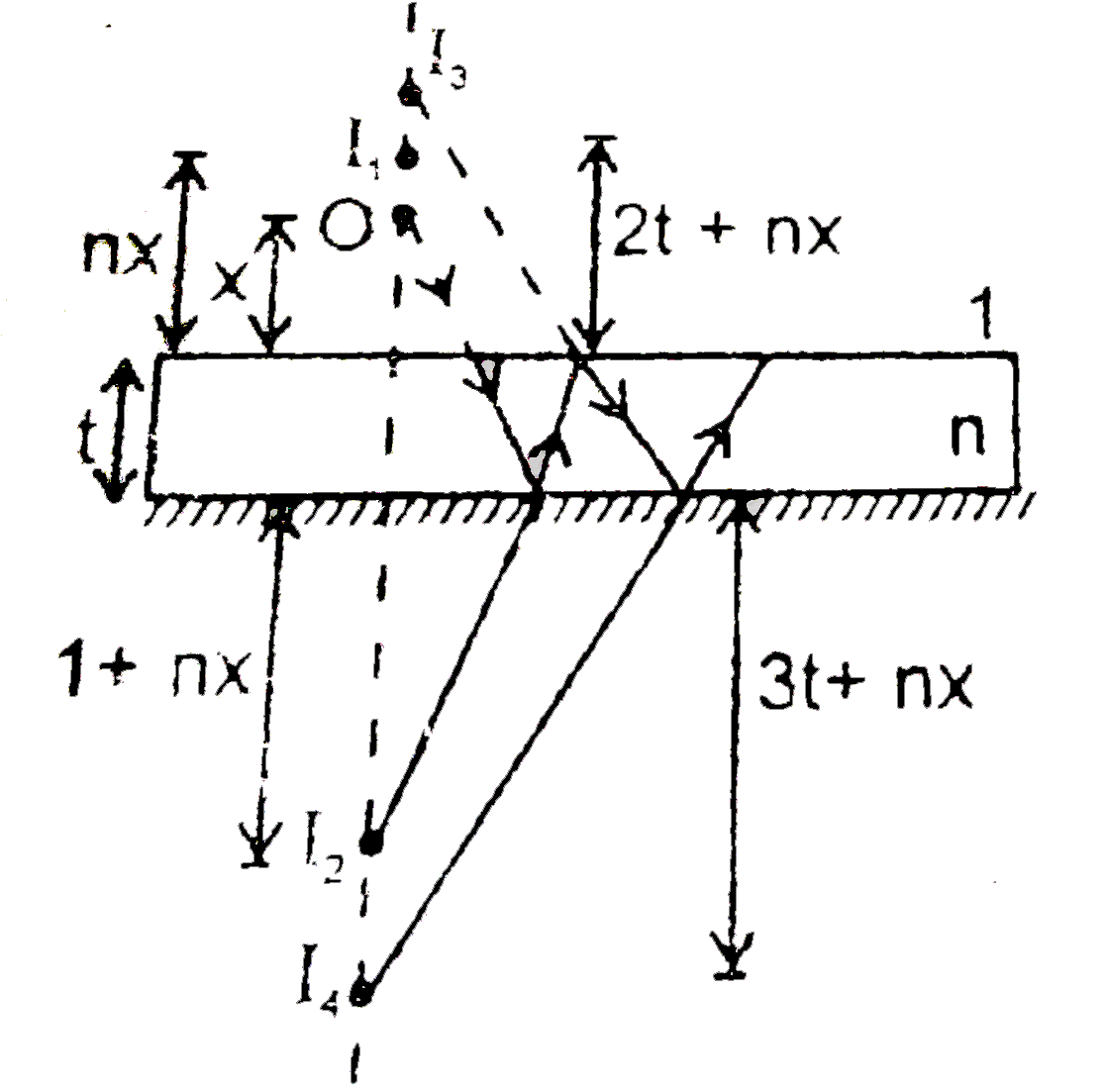
An object lies in front if a thick parallel glass slab, the bottom of which is published if the distance between m first two images formed by bottom surface is `4 cm` then find the thickness of the slab [Assume `n_(glass) = 3//2` paraxial rays].

A

2 cm

B

4 cm

C

6 cm

D

none of these

Text Solution

Verified by Experts

The correct Answer is:
A


The figure shows the image formation in different steps.
Given `2t =4`
`rArr t=2 cm`.
Promotional Banner

Topper's Solved these Questions

  • DAILY PRACTICE PROBLEM

    RESONANCE|Exercise DPP No.10|9 Videos
  • DAILY PRACTICE PROBLEM

    RESONANCE|Exercise DPP No.11|20 Videos
  • DAILY PRACTICE PROBLEM

    RESONANCE|Exercise DPP No.8|9 Videos
  • CURRENT ELECTRICITY

    RESONANCE|Exercise High Level Problems (HIP)|21 Videos
  • ELECTRO MAGNETIC WAVES

    RESONANCE|Exercise Exercise 3|27 Videos

Similar Questions

Explore conceptually related problems

A point object is placed at a distance of 20 cm from a glass slab, half immersed in water as shown in figure. The distance between two images when seen from the other side of the slab is (mu_(g) = (3)/(2) and mu_(w) = (4)/(3))

A small object is placed 20 cm in front of a block of glass 10 cm thick and its farther side silvered. The image is formed 22 cm behind the silvered face. Find the refractive index of glass.

An object is placed 20cm in front of a block of glass 10cm thick having its farther side silvered. The image is formed 23.2cm behind the silvered face. The refractive index of glass is

A point object is placed at a distance of 25cm from a convex lens. Its focal length is 22cm. A glass slab of refractive index 1.5 is inserted between the lens and the object, then the image is formed at infinity. Find the thickness of the glass slab (in cm).

Onc face of a rectangular glass plate 6 cm thick is silcerd. An object held 8 cm in front of the first face, froms an image 12 cm behind the silvered face. The refractive index of the glass is

A point object O is placed at a distance of 41 cm from a convex lens of focal length f = 20 cm on its principal axis. A glass slab of thickness 3 cm and refractive index mu = 1.5 is placed between the lens and the object with its faces perpendicular to the principal axis of the lens. Image of the object is formed at point I_(1) . Now the glass slab is tilted by an angle of theta = 1° (as shown in the Figure) and the final image is formed at I_(2) . Calculate the distance between points I_(1) and I_(2) . Consider only paraxial rays for the lens and near normal incidence for the glass slab.

A biconvex lens of focal length 40 cm is placed in front of an object at a distance of 20 cm . Now a slab of refractive index 4/3 is placed somewhere in between the lens and the object. The shift in the image formed after the introduction of slab equals (thickness of the slab is 2 mm)

When a dielectric slab of thickness 4 cm is introduced between the plates of parallel plate condenser, it is found the distance between the plates has to be increased by 3 cm to restore to capacity to original value. The dielectric constant of the slab is.

RESONANCE-DAILY PRACTICE PROBLEM-DPP No.9
  1. In the figure shown, the maximum number of reflection will be : .

    Text Solution

    |

  2. If a prism having refractive index sqrt 2 has angle of minimum deviati...

    Text Solution

    |

  3. Which of the following relations is correct for a spherical mirror if ...

    Text Solution

    |

  4. A partical revolves in clockwise direction (as seen from point A) in a...

    Text Solution

    |

  5. In the figure shown sin i/sin r is equal to

    Text Solution

    |

  6. The xz plane separates two media A and B with refractive indices mu(1)...

    Text Solution

    |

  7. Find the displacement of the ray after it imerges from CD .

    Text Solution

    |

  8. An object lies in front if a thick parallel glass slab, the bottom of ...

    Text Solution

    |

  9. A ray R(1) is incident on the plane surface of the glass slab (kept in...

    Text Solution

    |

  10. A concave spherical surface of radius of curvature 10 cm separates two...

    Text Solution

    |

  11. The observer 'O' sees the distance AB as infinitely large. If refracti...

    Text Solution

    |

  12. A beam of monochromatic light is incident at i= 50^(@) on one face of ...

    Text Solution

    |

  13. The refracting angle of a prism is A and refractive index of the mater...

    Text Solution

    |

  14. A point moves in a straight line under the retardation av^(2), where '...

    Text Solution

    |

  15. The displacement 'x' and time of travel 't' for a particle moving an a...

    Text Solution

    |

  16. The acceleration-time graph of a particle moving along a straight line...

    Text Solution

    |

  17. The velocity time graph of a linear motion is shown in the figure. The...

    Text Solution

    |

  18. A particle is moving along a straight line with constant acceleration....

    Text Solution

    |

  19. A particle starts from rest with uniform acceleration and is velocity ...

    Text Solution

    |

  20. A ball is thrown vertically upwards in air, If the resistance cannot b...

    Text Solution

    |

