Home
Class 12
PHYSICS
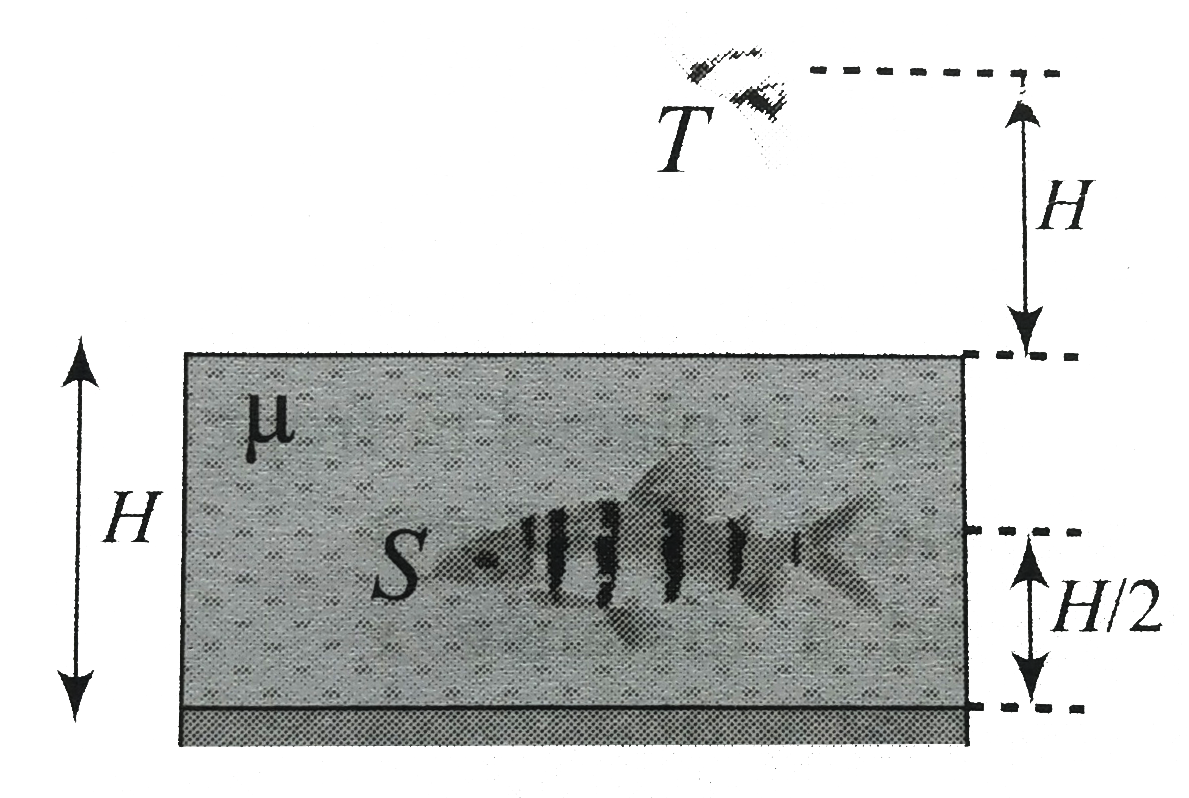
Consider the situation in Fig. The botto...

Consider the situation in Fig. The bottom of the pot is a reflecting plane mirror, Sis a small fish, and T is a human eye. Refractive index of water is `mu`.
a. At what distance(s) from itself will the fish see the image(s) of the eye?
b. At what distance(s) from itself will the eye see the image(s) of the fish?

A

At the distance `H(mu+1/2)` above itself will the fish see the image of the eye.

B

At the distance `H(1+1/(2mu))` below itself will the eye see the image of the fish

C

At the distance `H(mu+3/2)` below itself will the fish see the image of the eye.

D

At the distance `H(1+3/(2mu))` below itself will the eye see the image of the fish

Text Solution

Verified by Experts

The correct Answer is:

A, B, C, D
Promotional Banner

Topper's Solved these Questions

  • DAILY PRACTICE PROBLEM

    RESONANCE|Exercise DPP No.15|20 Videos
  • DAILY PRACTICE PROBLEM

    RESONANCE|Exercise DPP No.16|9 Videos
  • DAILY PRACTICE PROBLEM

    RESONANCE|Exercise DPP No.13|20 Videos
  • CURRENT ELECTRICITY

    RESONANCE|Exercise High Level Problems (HIP)|21 Videos
  • ELECTRO MAGNETIC WAVES

    RESONANCE|Exercise Exercise 3|27 Videos

Similar Questions

Explore conceptually related problems

Consider the situation in figure. The bottom of the pot is a reflecting plane mirror, S is a small fish and T is a human eye. Refractive index of water is mu. (a) At what distance(s) from itself will the fish see the image(s) of the eye ? (b) At what distance(s) from itself will the eye see the image(s) of the fish. (11-T

Consider the situation in figure. The bottom of the pot is reflecting plane mirror , S is small fish is a human eye . Refractive index of water is mu . Fish can see two images of human eye , first due to refractive only and other due to refraction and than reflection . Distance of these images from fish are S_(1) "and" S_(2) respectively . Human eye can also see the two images of fish, first due to refraction only and other due to reflection and then refraction . Distance of these images from human eye are S_(3) "and" S_(4) respectively . Match the quantities of column-I (with their value in column-(II) {:("Column I","Column II"),((A) S_(1),(p)H[1 + (1)/(2mu)]),((B)S_(2),(q) H[mu + (1)/(2)]),((C)S_(3) , (r) H[1 + (3)/(2mu)]) , ((D) S_(4) , (s) H[mu + (3)/(2)]):}

Consider the situation shown in figure. Find distance of image of P from eye E.

See Fig. and answer the following question. a. Find apparent height of the bird. b. Find apparent depth of the fish. c. At what distance will the bird appear to the fish ? d. At what distance will the fish appear to the bird?

At what distance eye E will observe the fourth image (after four refractions from plane surfaces) of object O from itself.

What happens to the image distance in the eye when we increase the distance of an object from the eye ?
