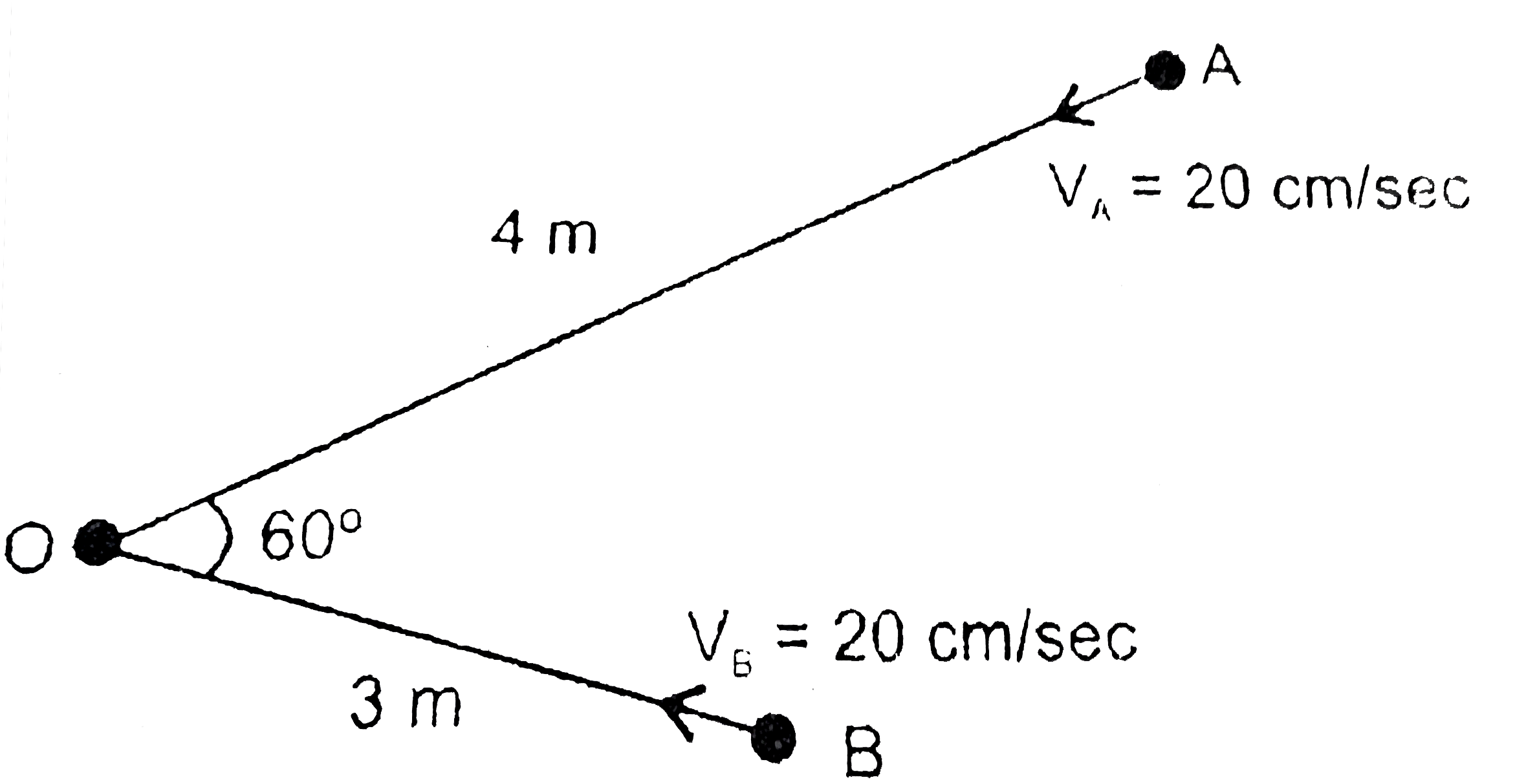
A
B
C
D
Text Solution
Verified by Experts
The correct Answer is:



Topper's Solved these Questions
DAILY PRACTICE PROBLEM
RESONANCE|Exercise DPP No.18|9 VideosDAILY PRACTICE PROBLEM
RESONANCE|Exercise DPP No.19|20 VideosDAILY PRACTICE PROBLEM
RESONANCE|Exercise DPP No.16|9 VideosCURRENT ELECTRICITY
RESONANCE|Exercise High Level Problems (HIP)|21 VideosELECTRO MAGNETIC WAVES
RESONANCE|Exercise Exercise 3|27 Videos
Similar Questions
Explore conceptually related problems
RESONANCE-DAILY PRACTICE PROBLEM-DPP No.17
- Lights of two different frequencies whose photons have energies 1 and ...
Text Solution
|
- An electron in the hydrogen atom jumps from excited state n to the gro...
Text Solution
|
- An electron of mass m and a photon have same energy E. The ratio of de...
Text Solution
|
- A particle of mass m is projected form ground with velocity u making a...
Text Solution
|
- A homogeneous ball (mass=m) of ideal black material at rest is illumin...
Text Solution
|
- An orbit electron in the ground state of hydrogen has an angular momen...
Text Solution
|
- When a metallic surface is illuminated with monochromatic light of wav...
Text Solution
|
- A photosensitive metallic surface has work function , h v(0). If photo...
Text Solution
|
- A source S(1) is producing 10^(15) photons/s of wavelength 5000 Å Anot...
Text Solution
|
- What will be the ratio of de - Broglie wavelengths of proton and alpha...
Text Solution
|
- Two electrons starting from rest are accelerated by equal potential di...
Text Solution
|
- Two photons having
Text Solution
|
- After absorbing a slowly moving neutrons of mass m(N) (momentum ~0) a...
Text Solution
|
- Two particles move with constant velocities towards point O along stra...
Text Solution
|
- A simple telescope, consisting of an objective of focal length 60 cm a...
Text Solution
|
- A particle when projected in vertical plane moves along smooth surface...
Text Solution
|
- A body released from a great height, falls freely towards the earth. A...
Text Solution
|
- A system is shown in the figure. Block A is moving with 1m//s towards ...
Text Solution
|
- Two graphs of the same projectile motion (in the xy-plane) projected f...
Text Solution
|
- The potential energy of a partical varies as . U(x) = E0 for 0 le x...
Text Solution
|