Home
Class 12
PHYSICS
What is the minimum acceleration with wh...

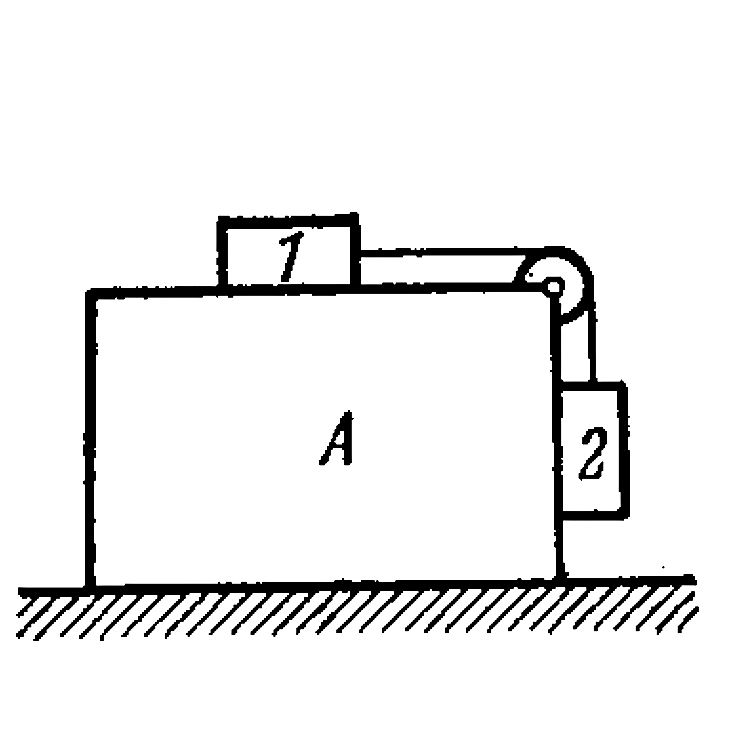
What is the minimum acceleration with which bar A (figure) should be shifted horizontally to keep bodies 1 and 2 stationary relative to the bar? The masses of the bodies are equal, and the coefficient of friction between the bar and the bodies is equal to k. The masses of the pulley and the threads are negligible, the friction in the pulley is absent.

Text Solution

Verified by Experts

The correct Answer is:

`a_(min) = (1-k)/(1-k)g`
Promotional Banner

Topper's Solved these Questions

  • DAILY PRACTICE PROBLEM

    RESONANCE|Exercise DPP No.21|20 Videos
  • DAILY PRACTICE PROBLEM

    RESONANCE|Exercise DPP No.22|9 Videos
  • DAILY PRACTICE PROBLEM

    RESONANCE|Exercise DPP No.19|20 Videos
  • CURRENT ELECTRICITY

    RESONANCE|Exercise High Level Problems (HIP)|21 Videos
  • ELECTRO MAGNETIC WAVES

    RESONANCE|Exercise Exercise 3|27 Videos

Similar Questions

Explore conceptually related problems

In the arrangement shown in figure the masses m of the bar and M of the wedge, as well as the wedge angle alpha , are known. The masses of the pulley and the thread are negligible. The friction is absent. Find the acceleration of the wedge M.

A body of mass 2 kg is placed on rough horizontal plane. The coefficient of friction between body and plane is 0.2 Then,

A body of mass 2 kg at rest on a horizontal table. The coefficient of friction between the body and the table is 0.3 . A force of 5N is applied on the body. The force of friction is

In the arrangement shown in fig the bodies have masses m_(0), m_(1) and m_(2) the friction is absent the masses of pulleys and the threads are negligible find the acceleration of the body m_(1)

In the arrangement shown in the figure, the blocks have masses 3m,m and 2m , the friction is absent, the masses of the pulleys and the threads are negligible. Find the acceleration of mass 3m .

A body of mass 2kg is at rest on a horizontal table. The coefficient of friction between the body and the table is 0.3 . A force of 5N is applied on the body. The acceleration of the body is.

In the arrangement shown in figure the bodies have masses m_0 , m_1 , m_2 , the friction is absent, the masses of the pulleys and the threads are negligible. Find the acceleration of the body m_1 . Look into possible cases.

Find the acceleration of the block of mass m in the arrangement shown in the following figures. The masses of the pulleys and the threads, as well as the friction are assumed to be negligible.

The following parameters of the arrangement of figure are available: the angle alpha which the inclined plane forms with the horizontal, and the coefficient of friction k between the body m_1 and the inclined plane. The masses of the pulley and the threads, as well as the friction in the pulley, are negligible. Assuming both bodies to be motionless at the initial moment, find the mass ratio m_2//m_1 at which the body m_2 (a) starts coming down, (b) starts going up, (c) is at rest.

The inclined plane of figure forms an angle alpha=30^@ with the horizontal. The mass ratio m_2//m_1=eta=2//3 . The coefficients of friction between the body m_1 and the inclined plane is equal to k=0.10 . The masses of the pulley and the threads are negligible. Find the magnitude and the direction of acceleration of the body m_2 when the formely stationary system of masses starts moving.
