Home
Class 12
PHYSICS
Figure shows an ideal pulley block of ma...

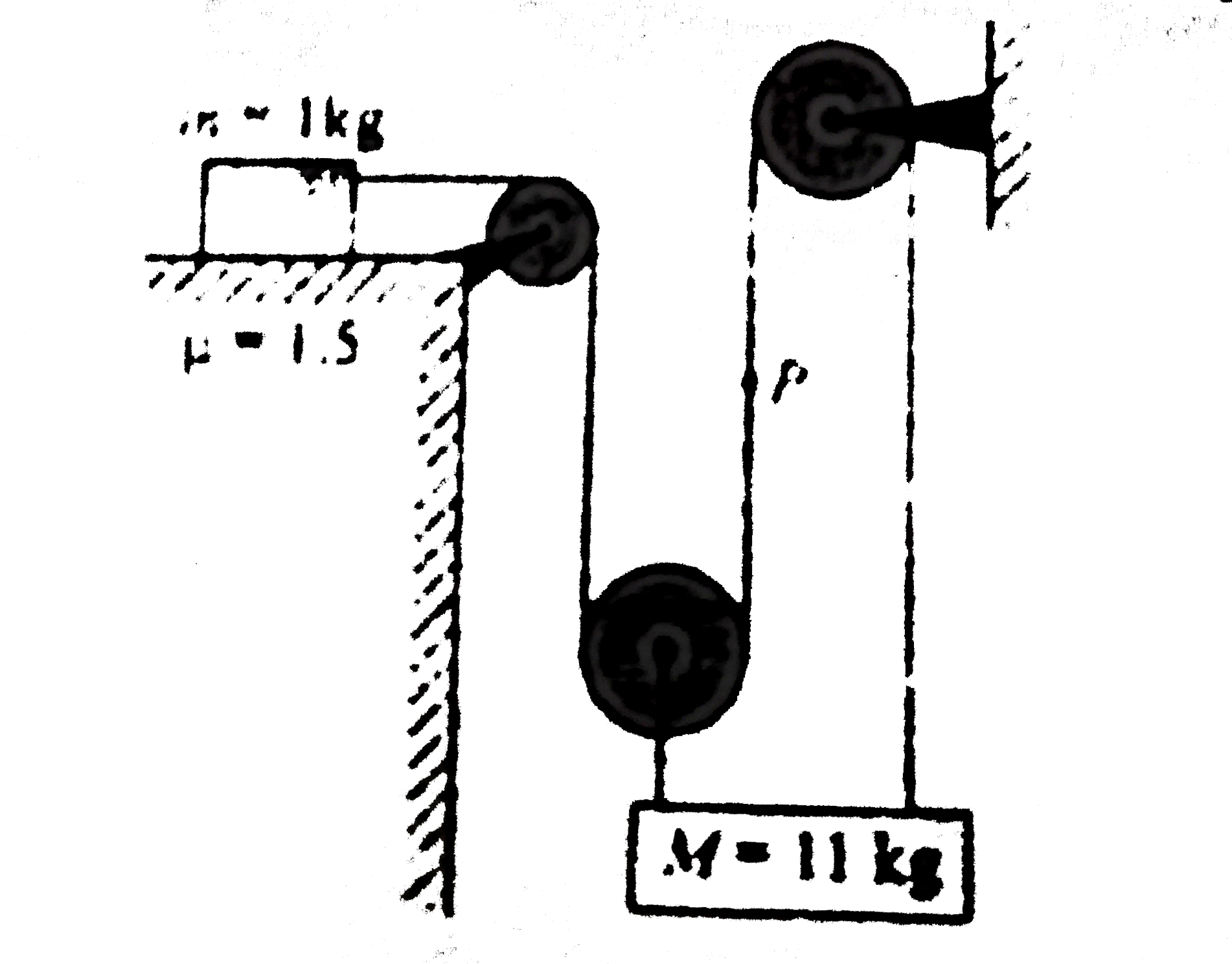
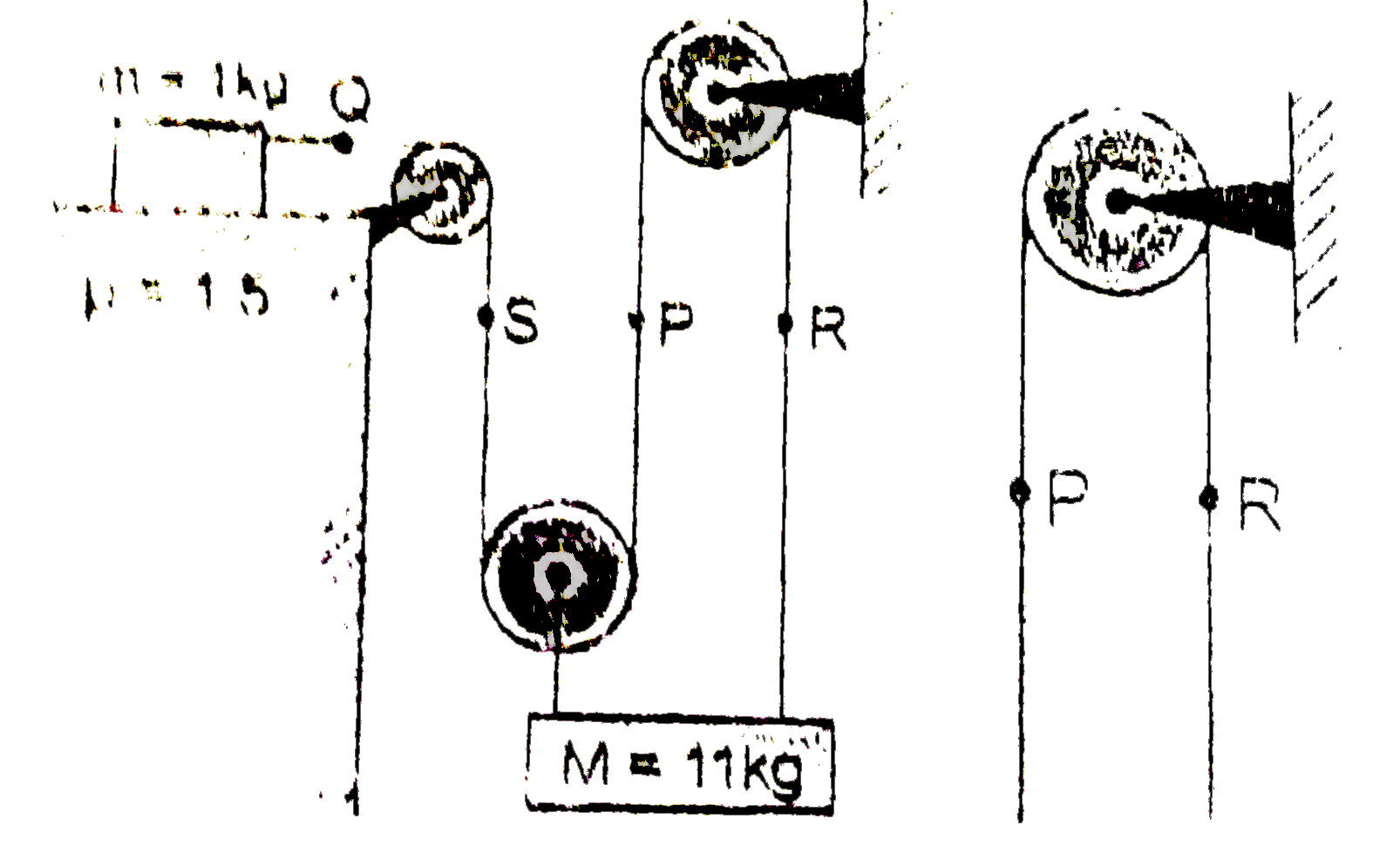
Figure shows an ideal pulley block of mass m = 1 kg. resting on a rough ground with friction coefficient `mu = 1.5`. Another block of mass `M = 11 kg` is hanging as shown. When system is released it is found that the magnitude of acceleration of point P on string is a. Find value of 4a in `m//s^(2)` (Use `g = 10 m//s^(2)`)

Text Solution

Verified by Experts

The correct Answer is:
13


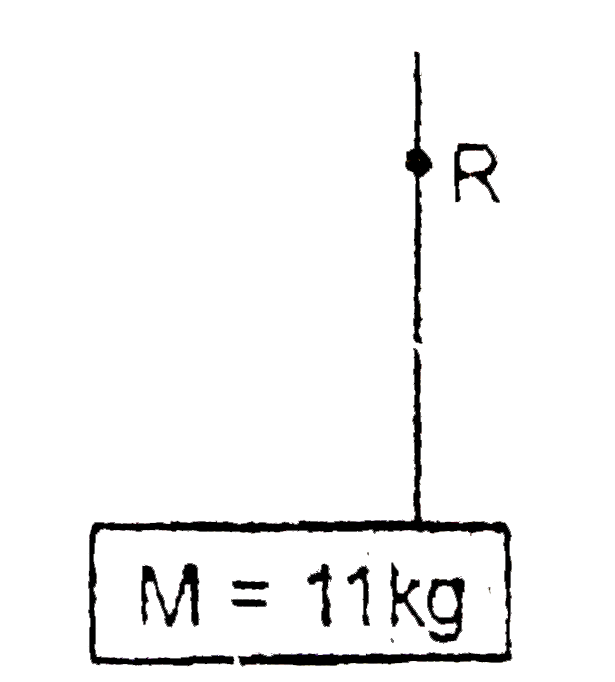
If the point P has an acceleration a upwards then the acceleration of point R will be a downwards.

The point R has an acceleration a downwards so the block will also have an acceleration a downwards.

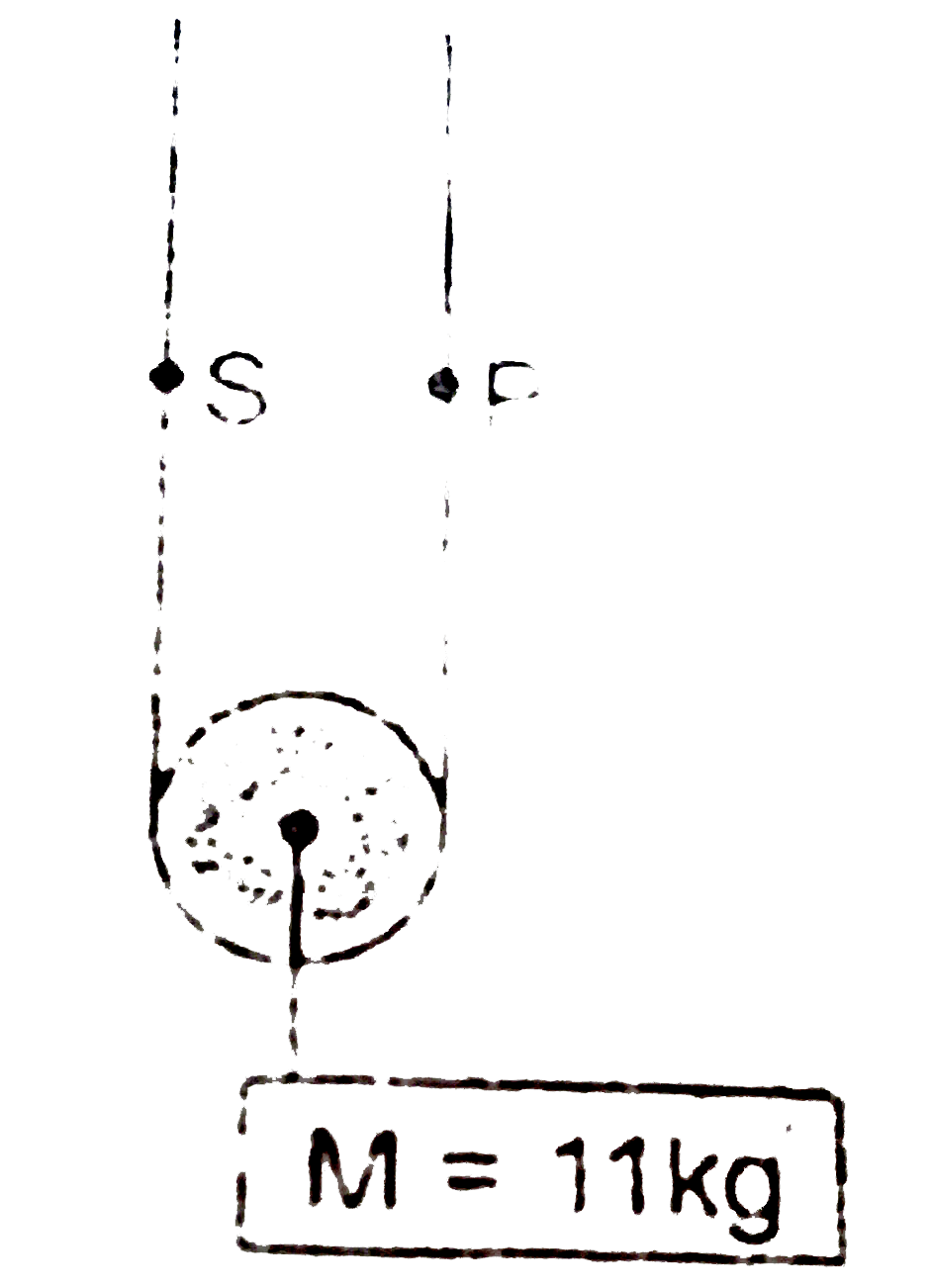
The point P has an acceleration on a upwards the block as an acceleration a downwards so the acceleration of S will be 3a downwards (because `(vec_(a)_(S)+vec(a)_(P))/(2) = vec(a)_("block")`)
The point Q will also have an acceleration 3a towards right.
`((vec(a)_(S)+vec(a)_(P))/(2)=vec(a)_("block"))`
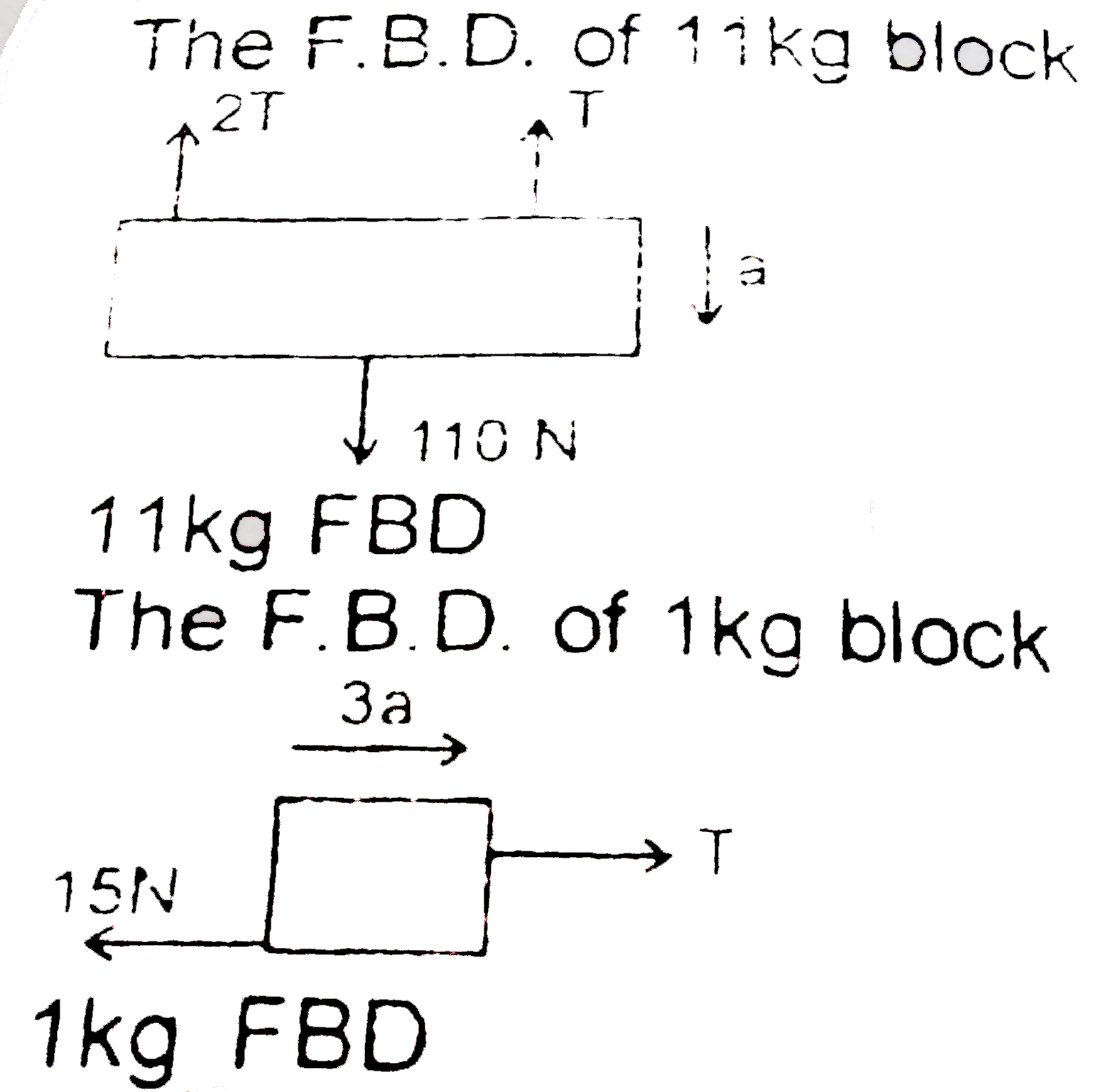
The F.B.D of 11 kg block

Using FBD of 11 kg block, which will have acceleration a downwards.
`110 - 3T = 11a`...(1)
(in downwards direction)
for 1 kg block, which will have acceleration 3a,
`T - 15 = 3a` (in horizontal direction)
or `3T - 45 = 9a` ....(2)
on adding equation (1) & (2) we get
`20 a = 65`
`rArr 4a = 13 m//s_(2)`
Promotional Banner

Topper's Solved these Questions

  • DAILY PRACTICE PROBLEM

    RESONANCE|Exercise DPP No.21|20 Videos
  • DAILY PRACTICE PROBLEM

    RESONANCE|Exercise DPP No.22|9 Videos
  • DAILY PRACTICE PROBLEM

    RESONANCE|Exercise DPP No.19|20 Videos
  • CURRENT ELECTRICITY

    RESONANCE|Exercise High Level Problems (HIP)|21 Videos
  • ELECTRO MAGNETIC WAVES

    RESONANCE|Exercise Exercise 3|27 Videos

Similar Questions

Explore conceptually related problems

Figure-2.54 shows a block of mass m is placed on an inclined wedge of mass M If the system is released from rest find the acceleration of m and M.

Two identical ladders, each of mass M and length L are resting on the rough horizontal surface as shown in the figure. A block of mass m hangs from P. If the system is in equilibrium, find the magnitude and the direction of frictional force at A and B.

Two identical ladders, each of mass M and length L are resting on the rough horizontal surface as shown in the figure. A block of mass m hangs from P. if the system is in equilibrium, find the magnitude and the direction of frictional force at A and B.

Two blocks of masses 5 kg and 4 kg are connected with ideal string which is passing over an ideal pulley as shown in figure. If the system is released from rest then the magnitude of acceleration of the blocks will be (Take g = 10 ms^-2 and sqrt3 = 1.7 )

Figure-2.64 shows a block of mass M supporting a bar of mass m through a pulley system. If system is released from rest, find the acceleration of block M and the tension in the strings

In the arrangement shown in the figure, block A of mass 8 kg rests on a horizontal table having coefficient of friction mu = 0.5 . Block B has a mass of 6 kg and rests on a smooth incline having inclination angle theta = sin^(-1) ((2)/(5)) . All pulleys and strings are mass less . Mass of block C is M . [g = 10 m//s^(2)] (a) Find value of M for which block B does not accelerate (b) Find maximum value of M for which A does not accelerate.

A block of mass m=5kg is resting on a rough horizontal surface for which the coefficient of friction is 0.2 . When a force F=40N is applied, the acceleration of the block will be (g=10m//s^(2)) .

A 'block' of mass 10 kg is suspended with string as shown in figure. Find tension in the string. (g=10m//s^(2))

Two blocks of masses 5kg and 10kg are attached with the help of light string and placed on a rough incline as shown in the figure. Coefficients of friction are as marked in the figure. The system is released from rest. Determine the acceleration of the two blocks.