Home
Class 12
PHYSICS
A meter stick AB of length 1 meter rests...

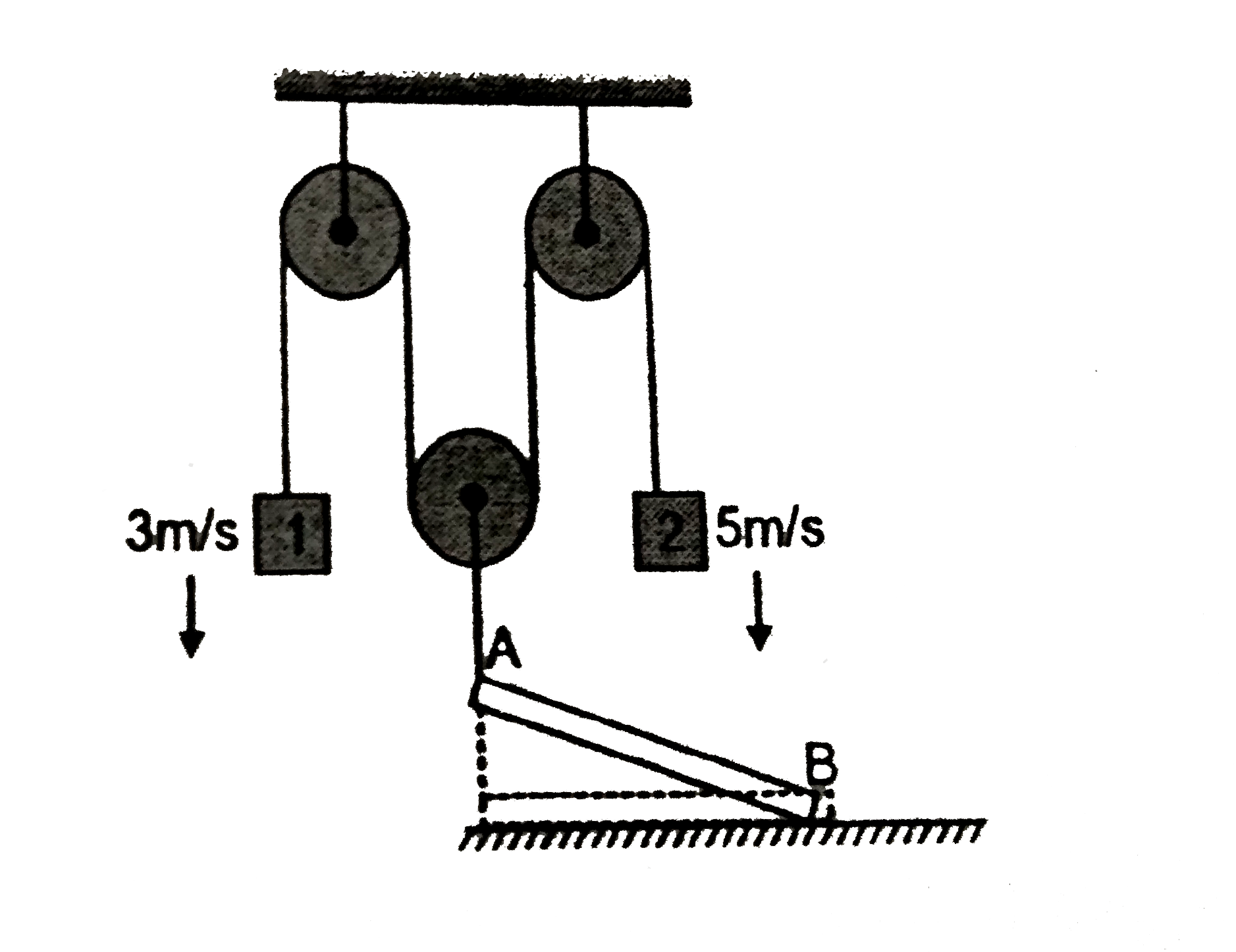
A meter stick `AB` of length 1 meter rests on a frictionless floor in horizontal position with end `A` attached to the string as shown. Assume that string connecting meter stick with pulley always remains vertical.

Time taken to cover the distance in above part is `:`

A

`((sqrt(2)+1)/(4 sqrt(2)))sec`

B

`((sqrt(2)-1)/(4 sqrt(2)))sec`

C

`(1)/(4 sqrt(2))sec`

D

`(1)/(8)sec`

Text Solution

Verified by Experts

The correct Answer is:

C

`t = (x)/(v_(A))=(1)/(4 sqrt(2))sec`
Promotional Banner

Topper's Solved these Questions

  • DAILY PRACTICE PROBLEM

    RESONANCE|Exercise DPP No.21|20 Videos
  • DAILY PRACTICE PROBLEM

    RESONANCE|Exercise DPP No.22|9 Videos
  • DAILY PRACTICE PROBLEM

    RESONANCE|Exercise DPP No.19|20 Videos
  • CURRENT ELECTRICITY

    RESONANCE|Exercise High Level Problems (HIP)|21 Videos
  • ELECTRO MAGNETIC WAVES

    RESONANCE|Exercise Exercise 3|27 Videos

Similar Questions

Explore conceptually related problems

A meter stick AB of length 1 meter rests on a frictionless floor in horizontal position with end A attached to the string as shown. Assume that string connecting meter stick with pulley always remains vertical. Minimum magnitude of relative velocity of A with respect to B during the motino specified in question 5 is :

A meter stick AB of length 1 meter rests on a frictionless floor in horizontal position with end A attached to the string as shown. Assume that string connecting meter stick with pulley always remains vertical. If block 1 and 2 are given constant speeds as shown then the distance moved by end B over the floor in the period for which speed of B is less than A .

Two identical blocks are attached by a massless string running over a pulley as shown in figure. The rope initially runs over the pulley at its (the rope's) midpoint, and the surface that block 1 rests on is frictionless. Blocks 1 and 2 are initially at rest when block 2 is released with the string taut and horizontal. Assume that the initial distance from block 1 to the pulley is the same as the initial distance from block 2 to the wall.

Shown in the figure is rigid and uniform one meter long rod AB held in horizontal position by two strings tied to its ends and attached to the ceiling . The rod is of mass 'm' and has another weight of mass 2 m hung at a distance of 75 cm from A . The tension in the string at A is :

A particle of mass 2m is connected by an inextensible string of length 1.2 m to a ring of mass m which is free to slide on a horizontal smooth rod. Initially the ring and the particle are at the same level with the string taut. Both are then released simultaneously. The distance in meter moved by the ring when the string becomes veritcal is :-

A stick of length L = 2.0 m is leaned against a wall as shown. It is released from a position when theta = 60^(@) . The end A of the stick remains in contact with the wall and its other end B remains in contact with the floor as the stick slides down. Find the distance travelled by the centre of the stick by the time it hits the floor.

Two blocks A and B having masses m_(1)=1 kg m_(2)=4 kg are arranged as shown in the figure The pulleys P and Q are light and frictionless. All the blocks are resting on a horizontal floor and the pulleys are held such that strings remains just taut. At moment t=0 a force F=30 t (N) starts acting on the pulley P along vertically upward direction as shown in the figure The time when the blocks A and B loose contact with ground is 4//x sec then x is:

A particle A of mass 2m is held on a smooth horizontal table and is attached to one end of an inelastic string which runs over a smooth light pulley at the edge of the table. At the other end of the string there hangs another particle B of mass m, the distance from A to the pulley is l. The particle A is then projected towards the pulley with velocity u. (a) Find the time before the string becomes taut, and shown that after the string becomes taut, the initial velocity of A and B is 4u//3 . (b) Find the common velocity when A reaches the pulley (assume that B has not yet reached the ground).
