Home
Class 12
PHYSICS
Work done by force F to move block of ma...

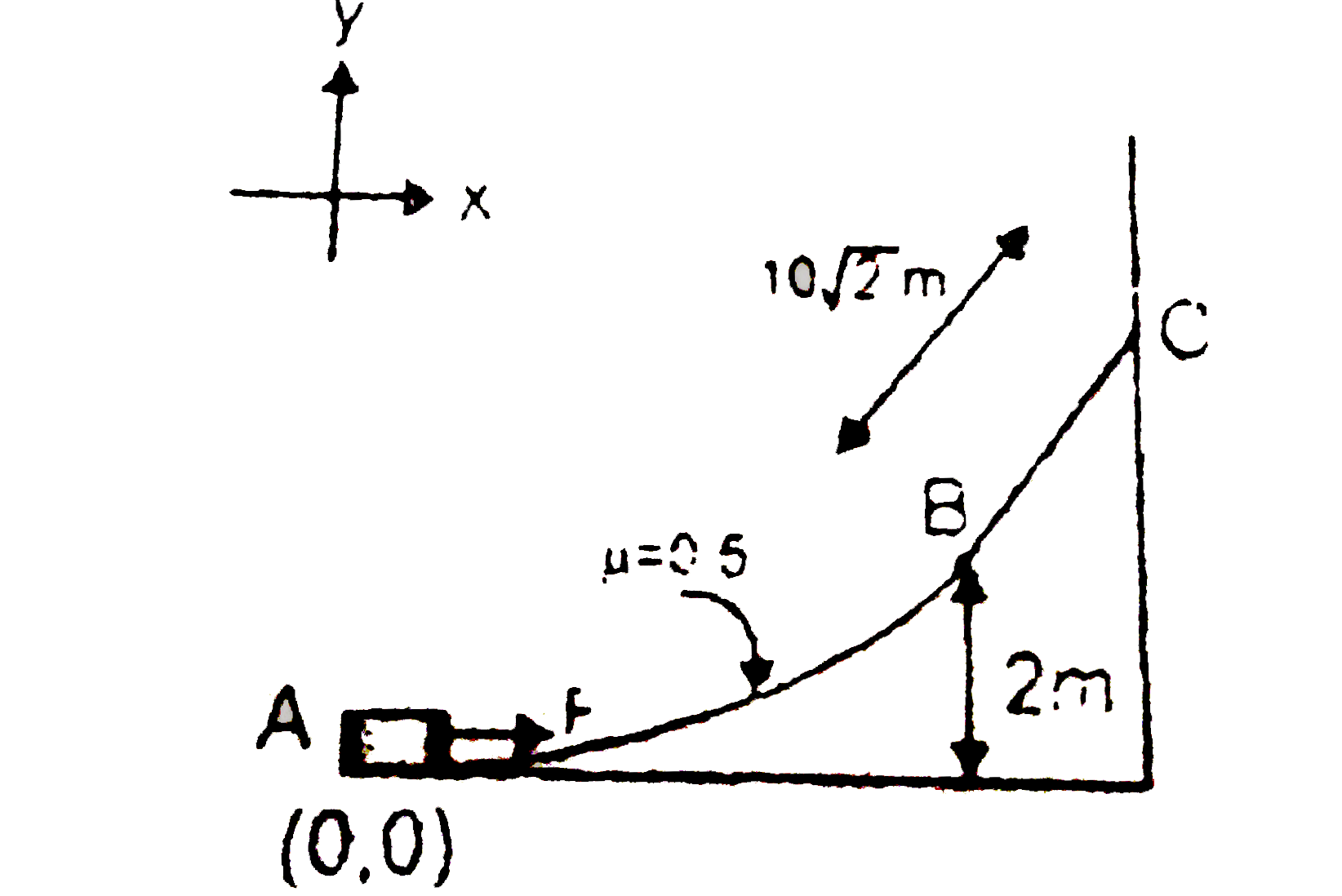
Work done by force F to move block of mass `2 kg` from A to C very slowly is `(76 lambda) J`. Force F is always acting tangential to path. Equation of path AB is `x^(2)=8y` and BC is straight line which tangent on curve AB to Point B (` mu` between block and path ABC is 0.5). Then value of `'lambda'` is `[g =10m//s^(2)]`

Text Solution

Verified by Experts
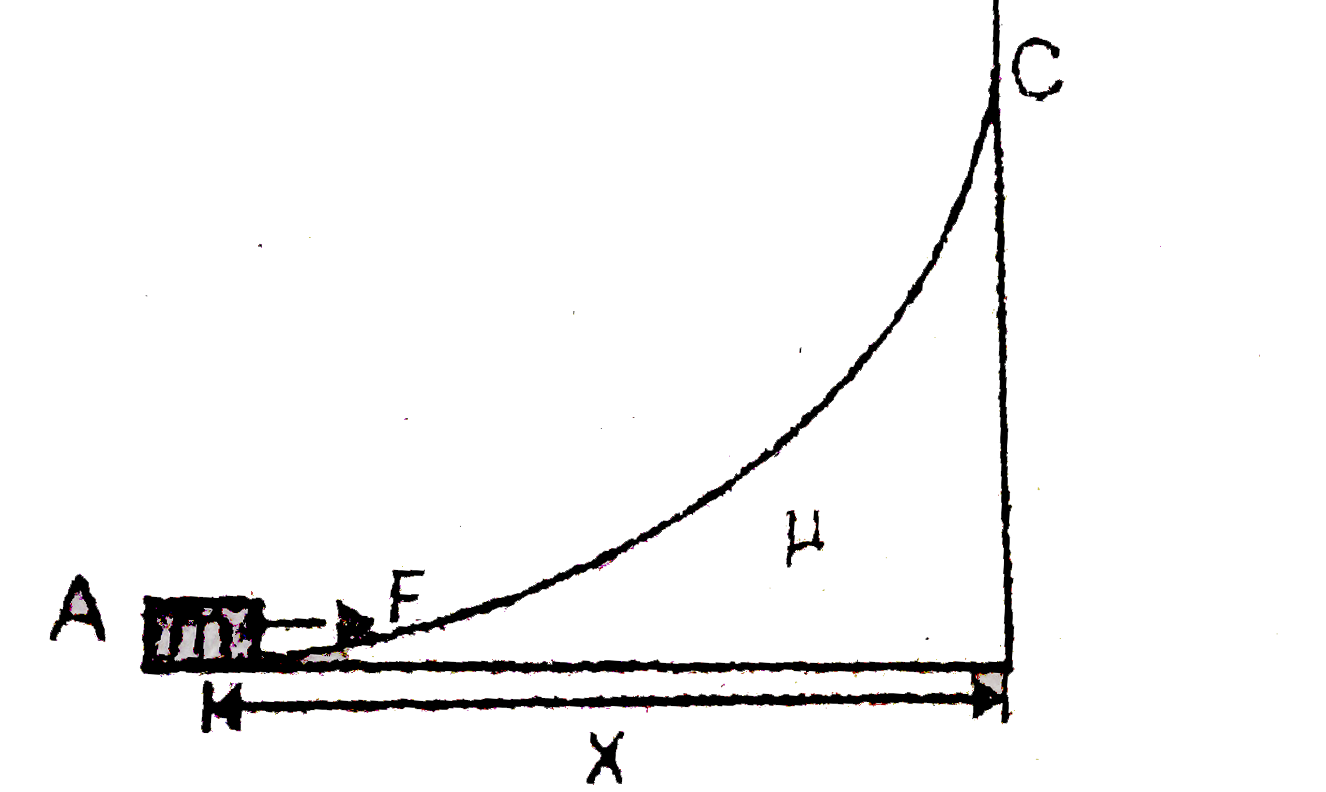
Slope of line `BC = (dy)/(dx) =(2x)/(8)=(2 xx4)/(8)=1`
`rArr theta = 45^(@)`

If the mass m is taken from A to C slowly work done by friction will always be equal to the `W_(r) = mu mg x`

Now, by `W_("net") = Delta KE =0`
`W_(F)-mg(10+2)-mu mg(10+4)=0`
`rArr W_(F) = 380 = 76 xx 5`
`rArr lamda = 5`
Promotional Banner

Topper's Solved these Questions

  • DAILY PRACTICE PROBLEM

    RESONANCE|Exercise DPP No.25|20 Videos
  • DAILY PRACTICE PROBLEM

    RESONANCE|Exercise DPP No.26|9 Videos
  • DAILY PRACTICE PROBLEM

    RESONANCE|Exercise DPP No.23|20 Videos
  • CURRENT ELECTRICITY

    RESONANCE|Exercise High Level Problems (HIP)|21 Videos
  • ELECTRO MAGNETIC WAVES

    RESONANCE|Exercise Exercise 3|27 Videos

Similar Questions

Explore conceptually related problems

A block of mass 1 kg is pulled slowly along the curve path ACB by a tangential force as shown in figure. The magnitude of work done by the frictional force when the block moves from A to B is

A block of mass m is slowly carried on a inclined plane by a force F which always acts along the tangent to the plane. If the co-efficient of friction between the block and incline be mu , then work done by force of friction while carrying block from bottom of the plane to the top will be :

The force acting on the block of mass 1 kg is given by F=5-2t . The frictional force acting on the block after time t=2 seconds will be: (mu=0.2)

A block of mass 2 kg, initially at rest on a horizontal floor, is now acted upon by a horizontal force of 10 N . The coefficient of friction between the block and the floor is 0.2. If g = 10 m//s^(2) , then :

A is a 100kg block, and B is a 200kg block. As shown in figure the block A is attached to a string tied to a wall. The coefficient of friction between A and B is 0.2 and the coefficient of fricition between B and floor is 0.3. Then calculate the minimum force required to move the block B. (take g=10m//s^(2) ).

A block of mass 10 kg is held at rest against a rough vertical wall [mu=0.5] under the action a force F as shown in figure. The minimum value of F required for it is (g=10m//s^(2))

A block of mass 20 kg is acted upon by a force F=30N at an angle 53^@ with horizontal in downward direction as shown. The coefficient of friction between the block and the forizontal surface is 0.2 . The friction force acting on the block by the ground is (g=10(m)/(s^2) )

A block of mass 1kg when placed on an inclined plane does not slip down. Now it is taken from A to B and then B to A very slowly such that pulling force is always along the direction of motion of block. If work done by friction in the round trip is 15 J , then find maximum value of h (in m).

A block of mass 12 kg moving on a rough horizontal surface having (mu_(k) = 0.5, mu_(s) = 0.6) with a speed 2 m//s at any instant and a 12 N force is acting opposite to its motion as shown in figure. Friction force acting on the block is