Home
Class 12
PHYSICS
Two infinitely long line charges having ...

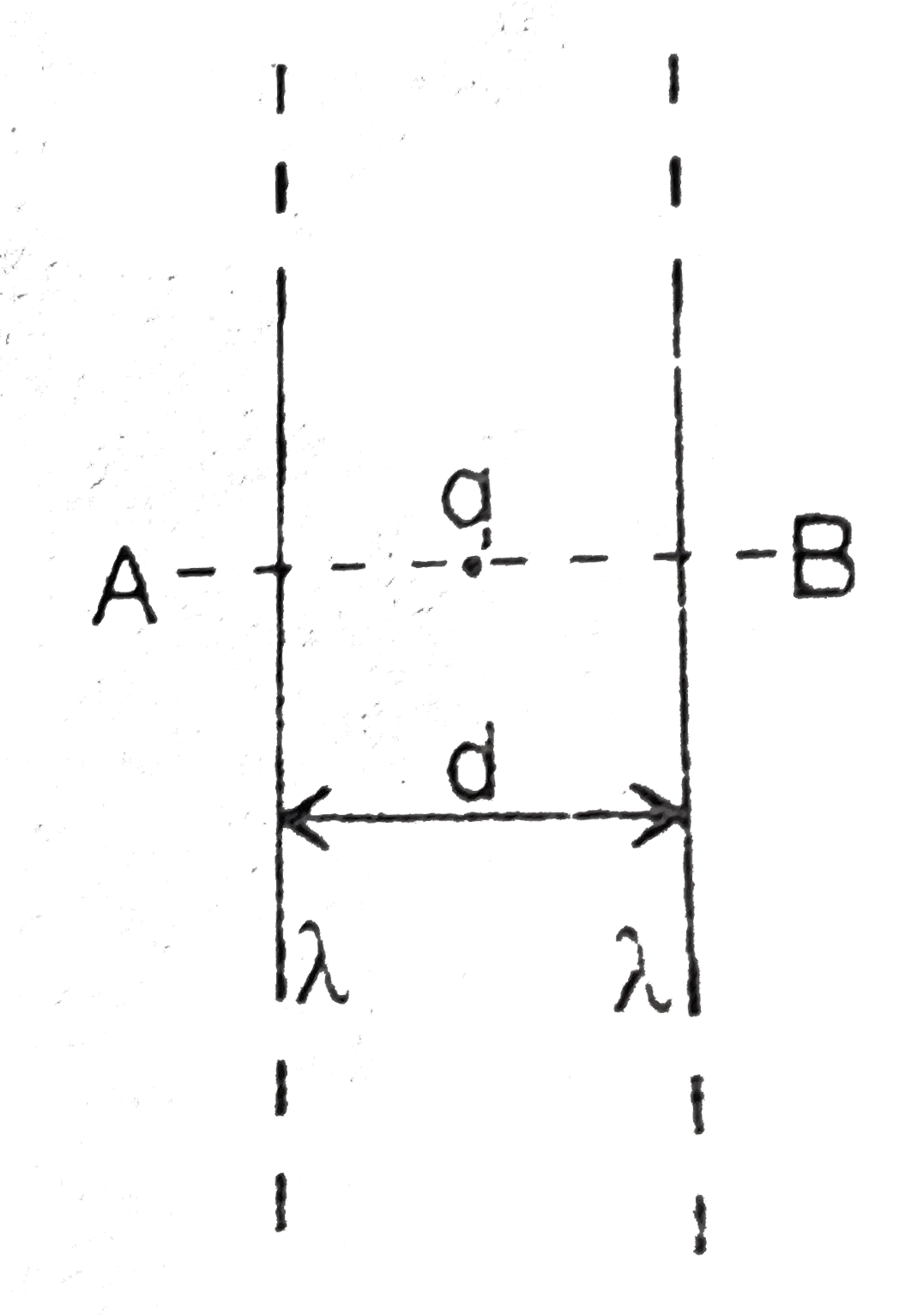
Two infinitely long line charges having charge density `lamda` each are parallel to each other and separated by distance d. A charge particle of mass m and charge q is placed at mid point between them. This charge displaced slightly along a line AB which is perpendicular to the line charges and in the plane of the charges. prove that the motion of the particle will be SHM for small displacement and `lamda q gt 0` Neglect gravity. Find the time period.

Text Solution

Verified by Experts

The correct Answer is:

`2 pi sqrt((md^(2) pi in_(0))/(4 lamdaq))`

`F=-2qk lamda((1)/((d)/(2)-x)-(1)/((d)/(2)+x))`
`rArr F = -((q lamda)/(pi epsilon_(0))(1)/((d^(2))/(4)))x :. T = 2 pi sqrt((md^(2) pi in_(0))/(4 lamda q))`
Promotional Banner

Topper's Solved these Questions

  • DAILY PRACTICE PROBLEM

    RESONANCE|Exercise DPP No.29|20 Videos
  • DAILY PRACTICE PROBLEM

    RESONANCE|Exercise DPP No.30|9 Videos
  • DAILY PRACTICE PROBLEM

    RESONANCE|Exercise DPP No.27|20 Videos
  • CURRENT ELECTRICITY

    RESONANCE|Exercise High Level Problems (HIP)|21 Videos
  • ELECTRO MAGNETIC WAVES

    RESONANCE|Exercise Exercise 3|27 Videos

Similar Questions

Explore conceptually related problems

A particle of mass m and charge q is located midway between two fixed charged particles each having a charge q and a distance 2l apart. Prove that the motion of the particle will be SHM if it is displaced slightly along the line connecting them and released. Also find its time period.

An infinitely long time charge has linear charge density lamdaC//m the line charge is along the line x=0,z=2m find the electric field at point (1,1,1) m.

For an infinite line of charge having linear charge density lambda lying along x-axis the work done in moving a charge q form C to A along CA is

A particle of mass m and charge +q is located midway between two fixed charged particles each having a charge +q and at a distance 2L apart. Assuming that the middle charge moves along the line joining the fixed charges, calculate the frequency of oscillation when it is displaced slightly.

Two electrons each are fixed at a distance '2d'. A third charge proton placed at the midpoint is displaced slightly by a distance x (x lt lt d) perpendicular to the line joining the two fixed charges. Proton will execute simple harmonic motion having angular frequency : (m = mass of charged particle)

two identical rings of radius R have uniformly distributed charge Q(Qgt0) each. Both the rings are fixed and are placed coaxially separated by a distance of R. if a small positive point charge is placed at the mid point and is displaced slightly along the axis then,

Two identical charges, 5 muC each are fixed at a distance 8 cm and a charged particle of mass 9 xx 10^(-6) kg and charge -10 muC is placed at a distance 5 cm from each of them and is released. Find the speed of the particle when it is nearest to the two charges.

Two point charges, each of mass m and charge q are released when they are at a distance from each other. What is the speed of each charged particle when they are at a distance 2r ?
