Home
Class 12
PHYSICS
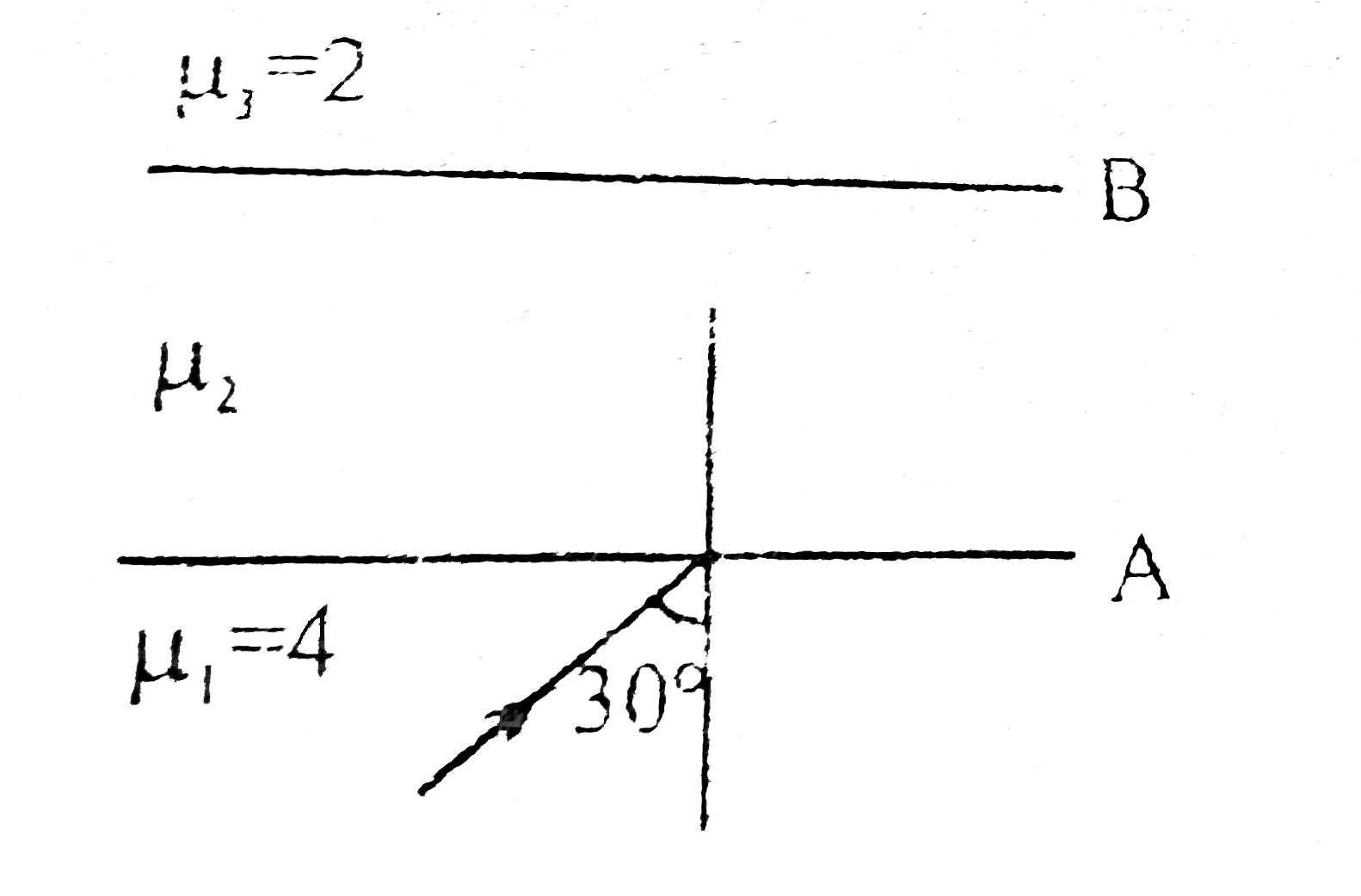
A light ray is incident on lower medium ...

A light ray is incident on lower medium boundary at an angle `30^(@)` with the normal. Which of following statement is/are true ?

A

If `mu_(2) gt 2` then total deviation is `60^(@)`

B

If `mu_(2) lt 2` then total deviation is `60^(@)`

C

If `mu_(2) gt 2` then total deviation is `120^(@)`

D

If `mu_(2) lt 2` then total deviation is `120^(@)`

Text Solution

Verified by Experts

The correct Answer is:

A, D

For refraction `mu_(1) sin 30^(@) = mu_(2) sin theta = mu_(3) sin e`
`rArr 2 = mu_(2) sin theta = 2 sin e`
For emergence through B
`sin theta lt 1`
`2 lt mu_(2), e= 90^(@)`
`D = 90^(@) - 30^(@) = 60^(@)`
If `mu_(2) lt 2` ray will suffer TlR on A
`D = 180^(@) -2 xx 30^(@) = 120^(@)`.
Promotional Banner

Topper's Solved these Questions

  • DAILY PRACTICE PROBLEM

    RESONANCE|Exercise DPP No.42|20 Videos
  • DAILY PRACTICE PROBLEM

    RESONANCE|Exercise DPP No.43|20 Videos
  • DAILY PRACTICE PROBLEM

    RESONANCE|Exercise DPP No.40|20 Videos
  • CURRENT ELECTRICITY

    RESONANCE|Exercise High Level Problems (HIP)|21 Videos
  • ELECTRO MAGNETIC WAVES

    RESONANCE|Exercise Exercise 3|27 Videos

Similar Questions

Explore conceptually related problems

Figure, a light ray is incident on the lower medium boundary at an angle if 45^(@) with the normal. Which of the following statement is//are true?

In the diagram shown, a light ray is incident on the lower medium boundary at an angle 45° with the normal. Find the deviation suffered by the light ray if– (a) mu_(2) gt sqrt(2) (b) mu_(2) lt sqrt(2)

A ray of light is incident on a plane mirror at an angle of 20^(@) with the normal, at the point of incidence, Through what angle, the ray of light will be deviated from its direction of incidence ?

For a ray of light, which of the following statements holds true?

A ray of light is incident in situation as shown in figure. Which of the following statements is//are true?

A ray of light is incident on a plane mirror, making an angle 'q' with the surface of the mirror. Arrange the following steps in sequential order to calculate the angle between the incident light ray and the reflected light ray. (A) Draw a normal line on the plane mirror at the point of incidence of the light ray. (B) Note down the angle between the plane mirror and the incident light ray. (C) The sum of the angle of incidence and the angle between the plane mirror and the incident ray is 90^(@) .Determine the angle of incidence. (D) From the laws of reflection, the angle of incidence is equal to the angle of reflection. Then the sum of the angle of incidence and the angle of reflection gives the angle between the incident light ray and the reflected light ray.
