Home
Class 12
PHYSICS
A smooth track is in the form of a quart...

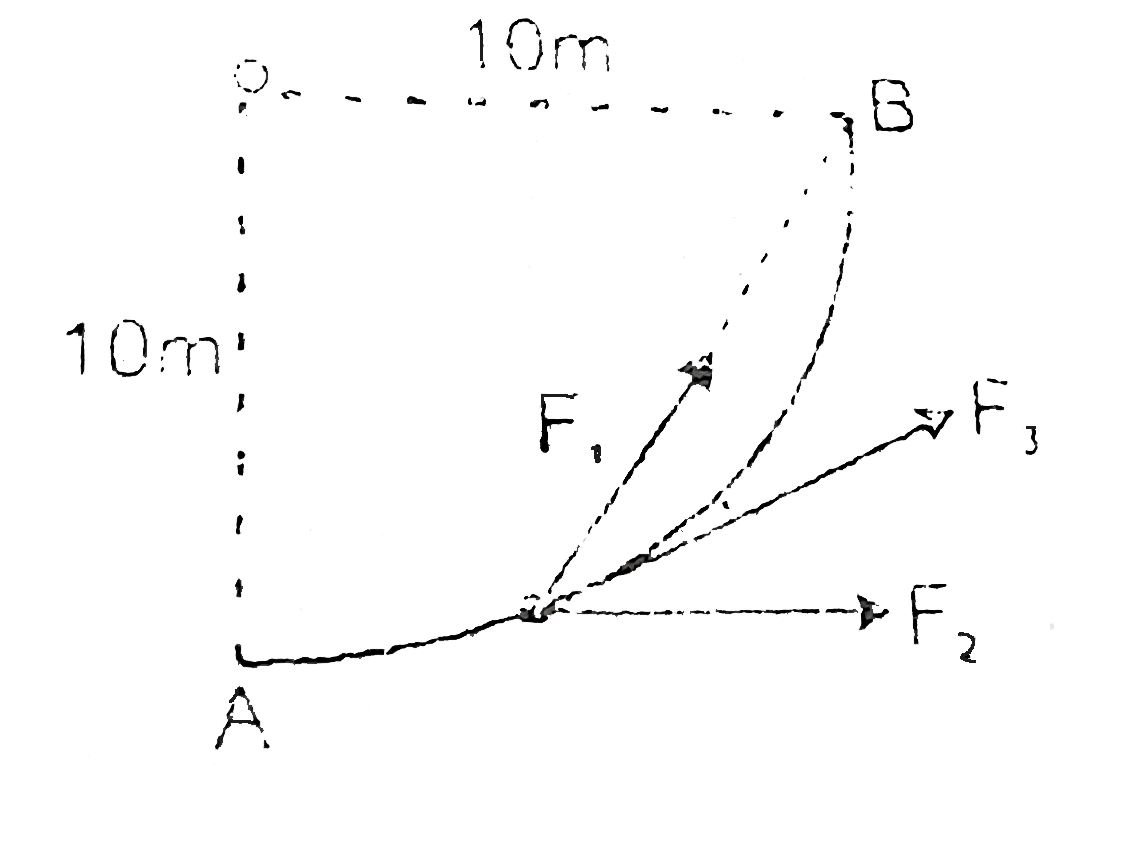
A smooth track is in the form of a quarter circle of radius 10 m lies in the vertical plane. A bead moves from A and B along the circular track under the action of forces `vec(F)_(1),vec(F)_(2)` and `vec(F)_(3)` Force `vec(F)_(1)` acts always towards point B and is always 20 N in magnitude Force `vec(F)_(2)` always acts horizontally and is always 25 N in magnitude. Force `vec(F)_(3)` always acts tangentially to the track and is of constant magnitude 10 N. Select the correct answer.

A

Work done by `vec(F)_(1)` is 750 J on the bead

B

Work done by `vec(F)_(2)` is 20 J on the bead

C

Work done by `vec(F)_(3)` is `50 pi J` on the bead

D

Work done by `vec(F)_(3)` is `100 sqrt(2) J`on the bead

Text Solution

Verified by Experts

The correct Answer is:

B, C

Work done by `F_(1) = 20 xx 10 sqrt(2) = 200 sqrt(2) J`
Work done `F_(2) = 25 xx 10 = 250 J`
Work done by `F_(3)=10 xx(2pi R)/(4)=50 pi J`.
Promotional Banner

Topper's Solved these Questions

  • DAILY PRACTICE PROBLEM

    RESONANCE|Exercise DPP No.53|20 Videos
  • DAILY PRACTICE PROBLEM

    RESONANCE|Exercise DPP No.54|9 Videos
  • DAILY PRACTICE PROBLEM

    RESONANCE|Exercise DPP No.51|20 Videos
  • CURRENT ELECTRICITY

    RESONANCE|Exercise High Level Problems (HIP)|21 Videos
  • ELECTRO MAGNETIC WAVES

    RESONANCE|Exercise Exercise 3|27 Videos

Similar Questions

Explore conceptually related problems

A smooth track in the form of a quarter-circle of radius 6 m lies in the vertical plane. A ring of weight 4(N) moves from P_(1) and P_(2) under the action of forces F_(1) , F_2 and F_3 . is always towards P_(2) under the action of forces F_(1),F_(2) and F_(3) Force F_(1) is always towards P_(2) and is always (20) N in maghitude, force F_(2) always acts hotizontally and is always (30 N) in magnitude, force F_(3) always acts tangentially to the track and is of magnitude (15-10 s) N , where s is in metre. If the particle has speed 4 m//s at P_(1) ,what will its speed be at P_(2) ?

A smooth track in the form of a quarter circle of radius 6 m lies in the vertical plane. A particle moves from P_(1) to P_(2) under the action of forces vec F_(1),vecF_(2) and vec F_(3) Force vec F_(1) is 20N, Force vec F_(2) is always 30 N in magnitude. Force vec F_(3) always acts tangentiallly to the track and is of magnitude 15 N . Select the correct alternative (s) : .

Two forces vec(F_(1)) and vec(F_(2)) are acting at right angles to each other , find their resultant ?

Three forces vec(F)_(1), vec(F)_(2) and vec(F)_(3) are represented as shown. Each of them is equal magnitude. Now match the given columns and select the correct option from the codes given below.

A body of mass m has an initial speed v is acted by two forces vec(F)_(1) and vec(F)_(2) . After something work done by vec(F)_(1) is -1/2 mv^(2) and speed of the body is 2v. Then, the work done by vec(F)_(2) is

A body is at rest under the action of three forces, two of which are vec(F)_(1)= 4hat(i), vec(F)_(2)= 6hat(j) , the third force is

When force vec(F)_(1),vec(F)_(2),vec(F)_(3) are acting on a particle of mass m , the particle remains in equilibrium. If the force vec(F)_(1) is now removed then the acceleration of the particle is :

A particle moves along a curve of unknown shape but magnitude of force F is constant and always acts along tangent to the curve.Then

Which of the figure's six arrangements correctly show the vector addition of forces vec(F)_(1) and vec(F)_(2) to yield the third vector, which is meant to represent their net force vec(F)_("net") ?

The figure shows a ring in which a square is inscribed. Four equal forces vec(F)_(1), vec(F)_(2), vec(F)_(3), vec(F)_(4) of magnitude 10 N each act at A, B, C, D. Two force F_(5) and F_(6) of magnitude 10 sqrt2 N each act at A and B. The ring will
